What Is the Direction of Acceleration in Circular Motion?
TL;DR
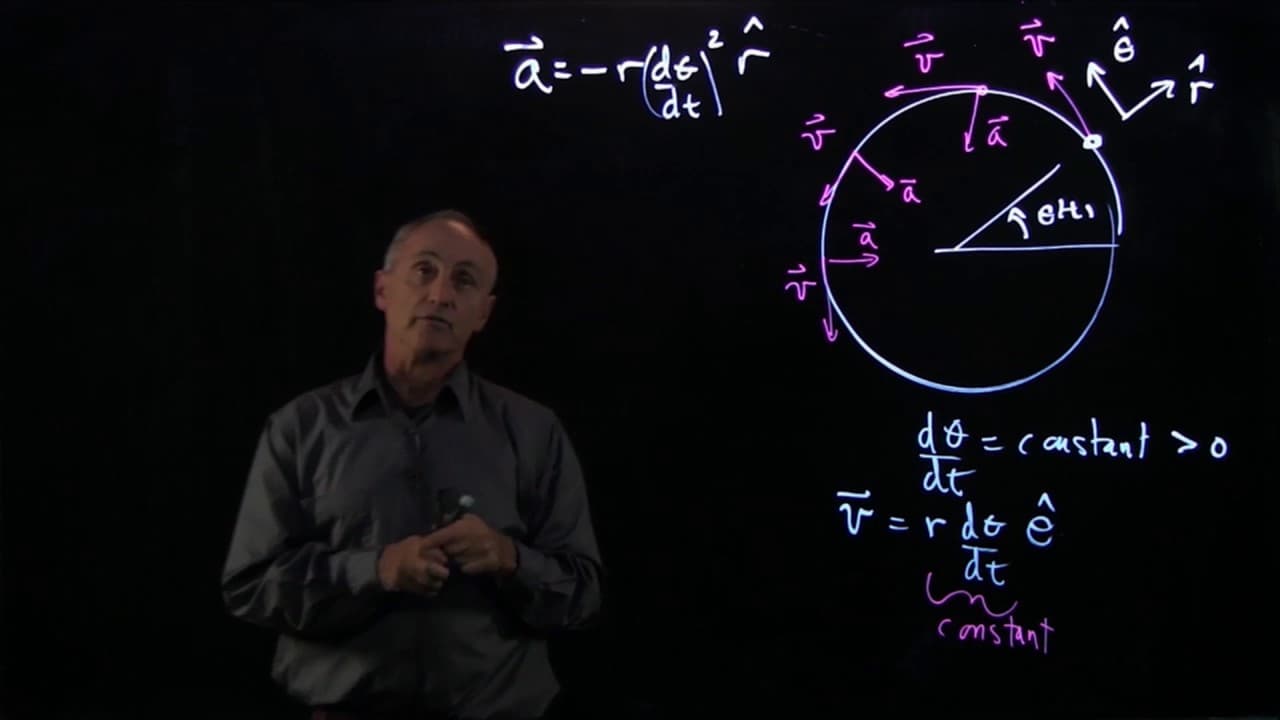
In uniform circular motion, the acceleration always points toward the center of the circle, while the velocity remains tangent to the circle with constant magnitude. This inward acceleration occurs due to the continuous change in the direction of the velocity vector, not its magnitude, leading to a centripetal acceleration defined as r times the square of the angular velocity.
Transcript
For a particle that's moving in a circle, we found that when it's moving at a constant rate of d theta dt--- and let's recall what we meant by theta of t-- and here's our particle, and we introduced our polar coordinates r hat and theta hat, then we found that the velocity was r d theta dt theta hat. And so let's assume that this quantity is positi... Read More
Key Insights
- 🥋 In uniform circular motion, the velocity vector is always tangent to the circle, and the magnitude remains constant.
- 😥 The acceleration vector in uniform circular motion always points towards the center of the circle.
- 🛩️ The direction of acceleration can be understood by considering the change in velocity over a small time interval.
- ☠️ Uniform circular motion is characterized by a constant rate of change of the angle.
- 🥋 The acceleration vector in uniform circular motion is in the negative radial direction.
- 🥋 The velocity vector in uniform circular motion changes direction but not magnitude.
- ☠️ The magnitude of the acceleration vector is given by r times the square of the rate of change of the angle.
Install to Summarize YouTube Videos and Get Transcripts
Explore YouTube Video Summarizer or Get YouTube Transcript Extractor
Questions & Answers
Q: How does velocity behave in uniform circular motion?
In uniform circular motion, the velocity vector is always tangent to the circle, with a constant magnitude.
Q: What is the direction of acceleration in uniform circular motion?
The acceleration in uniform circular motion is always pointing towards the center of the circle.
Q: How can we understand why the acceleration vector is inward?
By considering the change in velocity over a small time interval, we can see that the acceleration vector points towards the center because it is defined as the limit of the change in velocity as the time interval approaches zero.
Q: What is the condition for uniform circular motion?
Uniform circular motion is defined by the condition that the rate of change of the angle (d theta dt) is constant.
Summary & Key Takeaways
-
In uniform circular motion, the velocity vector points tangentially to the circle, with a constant magnitude.
-
The acceleration vector in uniform circular motion is always pointing towards the center of the circle.
-
The direction of acceleration can be understood by considering the change in velocity over a small time interval, which leads to the acceleration vector pointing inward.
Read in Other Languages (beta)
Share This Summary 📚
Summarize YouTube Videos and Get Video Transcripts with 1-Click
Try YouTube Summary with ChatGPT & Claude or YouTube Transcript Generator
Explore More Summaries from MIT OpenCourseWare 📚


Summarize YouTube Videos and Get Video Transcripts with 1-Click
Try YouTube Summary with ChatGPT & Claude or YouTube Transcript Generator