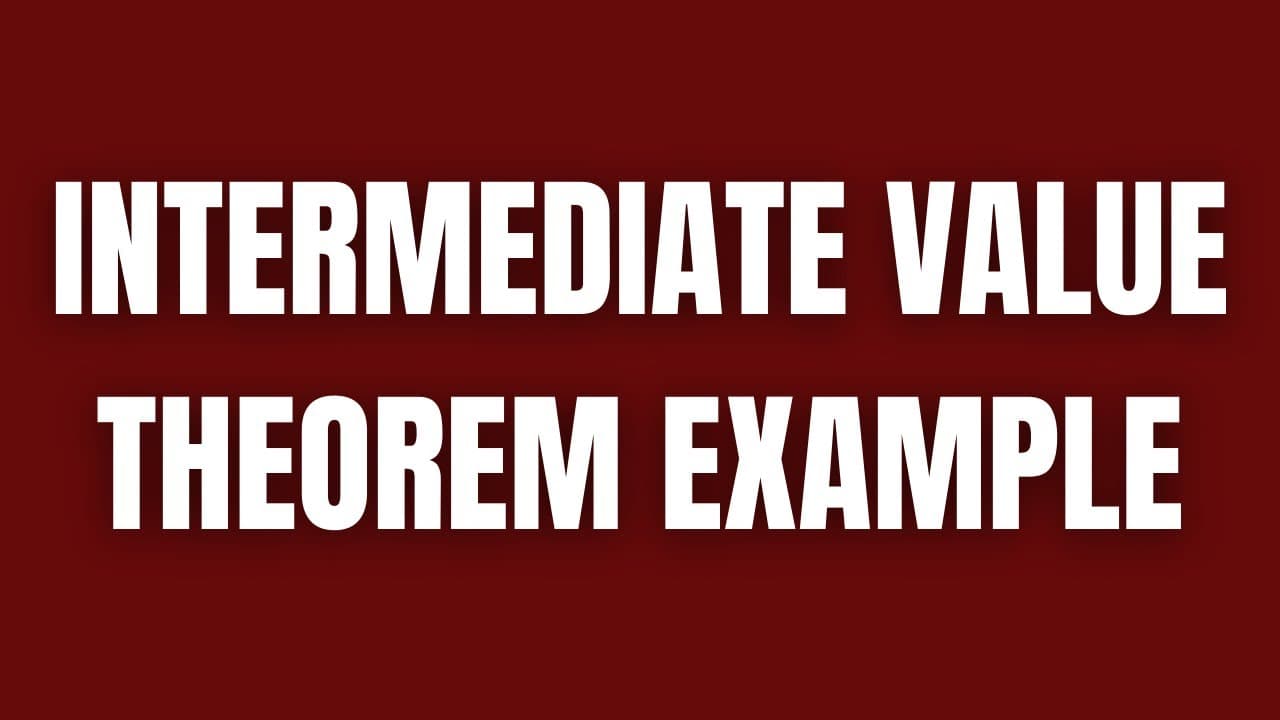
Use the Intermediate Value Theorem to Verify the Polynomial has a Zero
TL;DR
Using the Intermediate Value Theorem to find zeros of a polynomial through sign changes.
Transcript
hello in this problem we have a function and we're being asked to use the intermediate value theorem to verify that f has a zero in this interval so the version of the intermediate value theorem we're using is one that is sometimes stated specifically for polynomials that says you have a polynomial p of x and it's on an interval say a b and if you ... Read More
Key Insights
- 🔨 The Intermediate Value Theorem is a powerful tool for verifying the existence of zeros in polynomial functions within a specified interval.
- 🖐️ Sign changes at the endpoints of the interval play a crucial role in determining the presence of zeros.
- ❓ Understanding the concept behind the Intermediate Value Theorem is more important than the computational intricacies.
- 🤘 Messy calculations can detract from the main idea of finding zeros through sign changes.
- 🫰 The theorem aids in identifying where a polynomial crosses the x-axis, indicating zeros.
- 🤘 Checking for sign changes provides a reliable method for locating zeros accurately.
- ❓ Precision in computations is crucial to uphold the integrity of results when applying mathematical theorems like the Intermediate Value Theorem.
Install to Summarize YouTube Videos and Get Transcripts
Explore YouTube Video Summarizer or Get YouTube Transcript Extractor
Questions & Answers
Q: How does the Intermediate Value Theorem help in finding zeros of a polynomial?
The theorem states that if a polynomial changes sign at the endpoints of an interval, there must be at least one zero within that interval. By checking sign changes, we can pinpoint where the zero occurs within the range.
Q: What happens when the function values at endpoints have the same sign?
If the function values at the endpoints have the same sign, the Intermediate Value Theorem cannot guarantee the existence of a zero within the interval. Sign changes are crucial in determining zero presence.
Q: Why is understanding sign changes important in polynomial analysis?
Sign changes in a polynomial's function values indicate the presence of zeros within a given interval. Recognizing these changes helps in pinpointing the specific location of zeros and understanding polynomial behavior.
Q: How can one minimize errors in computations while applying the Intermediate Value Theorem?
To minimize errors, it's essential to triple-check computations, use calculators for accuracy, and focus on the sign changes rather than getting lost in the numerical details to avoid mistakes.
Summary & Key Takeaways
-
The video explains using the Intermediate Value Theorem with polynomials to find zeros in an interval by checking sign changes at endpoints.
-
The function values at the endpoints of the interval are checked for opposite signs to determine the existence of a zero within the interval.
-
Despite messy computations, the main idea is to understand that sign changes in a polynomial indicate a zero within the interval.
Read in Other Languages (beta)
Share This Summary 📚
Summarize YouTube Videos and Get Video Transcripts with 1-Click
Try YouTube Summary with ChatGPT & Claude or YouTube Transcript Generator
Explore More Summaries from The Math Sorcerer 📚


Summarize YouTube Videos and Get Video Transcripts with 1-Click
Try YouTube Summary with ChatGPT & Claude or YouTube Transcript Generator