Hans Rosling: The River of Myths
TL;DR
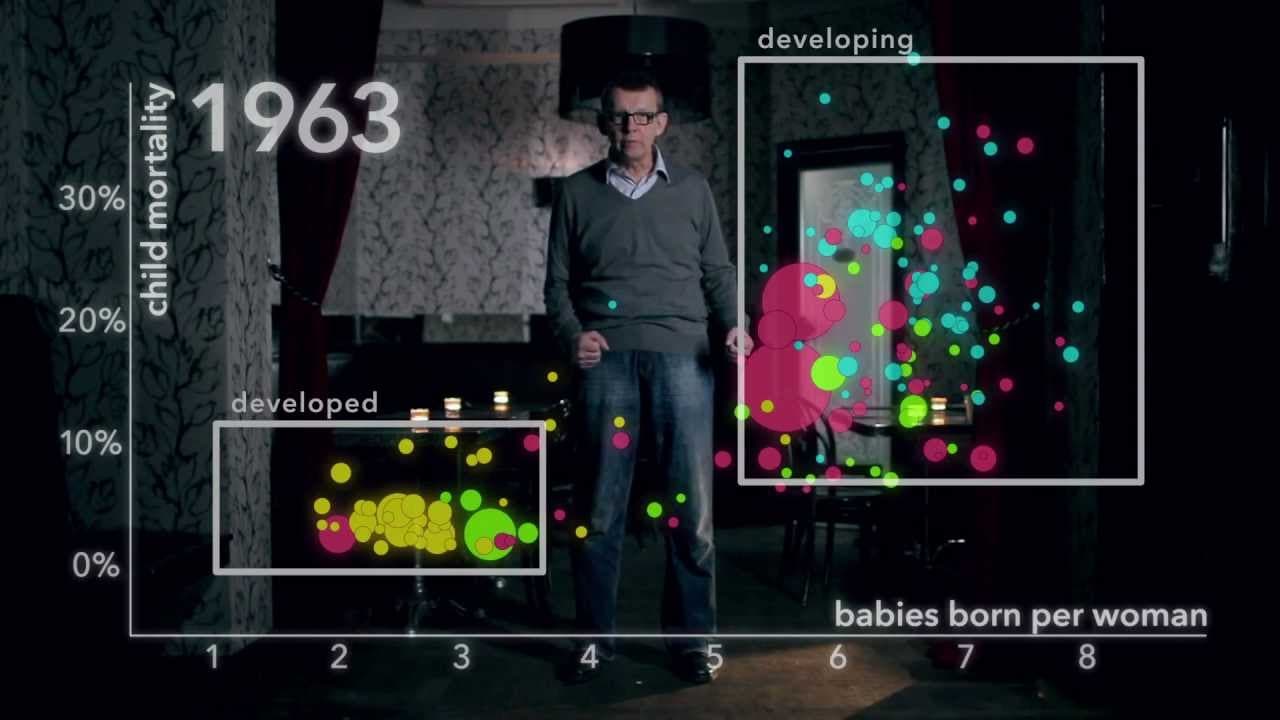
In the last 50 years, the world has seen immense improvements with child mortality dropping and women having fewer babies, challenging the myth of a divided world between developing and developed nations.
Transcript
the world my father told me about 50 years ago was a divided world it looked like this each bubble is a country size is population blue Africa red Asia yellow Europe and green the Americas vertical is child mortality from 30% of children dying before the age of five don't almost zero child death horizontal number of babies born per woman from eight... Read More
Key Insights
- 🌍 The world has improved immensely in the last 50 years, as child mortality decreased and women chose to have fewer babies.
- 📉 Developing countries have made significant progress in reducing child mortality, but some regions still face challenges, such as the remote Somali region of Ethiopia.
- 🏥 Improved access to health services in rural areas and better family planning have contributed to the dramatic decrease in child mortality in Ethiopia.
- 👶 By having fewer babies, women are able to invest more time and resources in each child, leading to improved outcomes.
- 📈 If the poorest countries can follow the path of Ethiopia, it is possible that the world will no longer have any countries in the box referred to as the "developing world."
- 🌍 To ensure progress, it is essential to measure the progress of countries accurately and regularly.
- 🗺️ The common perception of the world as divided between developed and developing areas is a myth, as countries have shown significant improvements over time.
- 🌍 The world has witnessed a significant decline in child mortality rates and birth rates, pointing towards a positive trend in global development.
Install to Summarize YouTube Videos and Get Transcripts
Explore YouTube Video Summarizer or Get YouTube Transcript Extractor
Questions & Answers
Q: How has child mortality changed globally over the past 50 years?
Child mortality has greatly decreased in almost all countries, allowing women to have fewer children and invest more resources in each child's well-being.
Q: What role does improved access to health services play in reducing child mortality rates?
Improved access to health services, particularly in rural areas, has contributed to a significant decline in child mortality rates, as seen in the case of Ethiopia.
Q: How has Ethiopia's progress impacted the perception of Africa's problems being unsolvable?
Ethiopia's progress in reducing child mortality challenges the belief that Africa's problems are unsolvable, demonstrating that with targeted efforts and resources, transformative change is possible.
Q: Will there be any countries left in the "developing" world by 2030?
It is fully possible that by 2030, there will be no countries left in the box labeled "developing world" if progress continues and challenges are addressed. This would signify a significant shift in the global development landscape.
Q: Why is measuring the progress of countries crucial for their development?
Measuring the progress of countries allows for accurate assessment and identification of areas that require intervention, enabling targeted efforts to address challenges and ultimately achieve global development goals.
Summary & Key Takeaways
-
Over the past 50 years, child mortality has significantly decreased worldwide, leading to fewer babies being born per woman.
-
Access to health services in developing countries, like Ethiopia, has improved, resulting in a dramatic decline in child mortality rates.
-
While challenges still exist, if the poorest countries can follow the path of Ethiopia, it is possible that the world will no longer have a "developing" category by 2030.
Read in Other Languages (beta)
Share This Summary 📚
Summarize YouTube Videos and Get Video Transcripts with 1-Click
Try YouTube Summary with ChatGPT & Claude or YouTube Transcript Generator
Explore More Summaries from Bill Gates 📚




Summarize YouTube Videos and Get Video Transcripts with 1-Click
Try YouTube Summary with ChatGPT & Claude or YouTube Transcript Generator