How to Calculate Maximum Error Using Taylor's Remainder
TL;DR
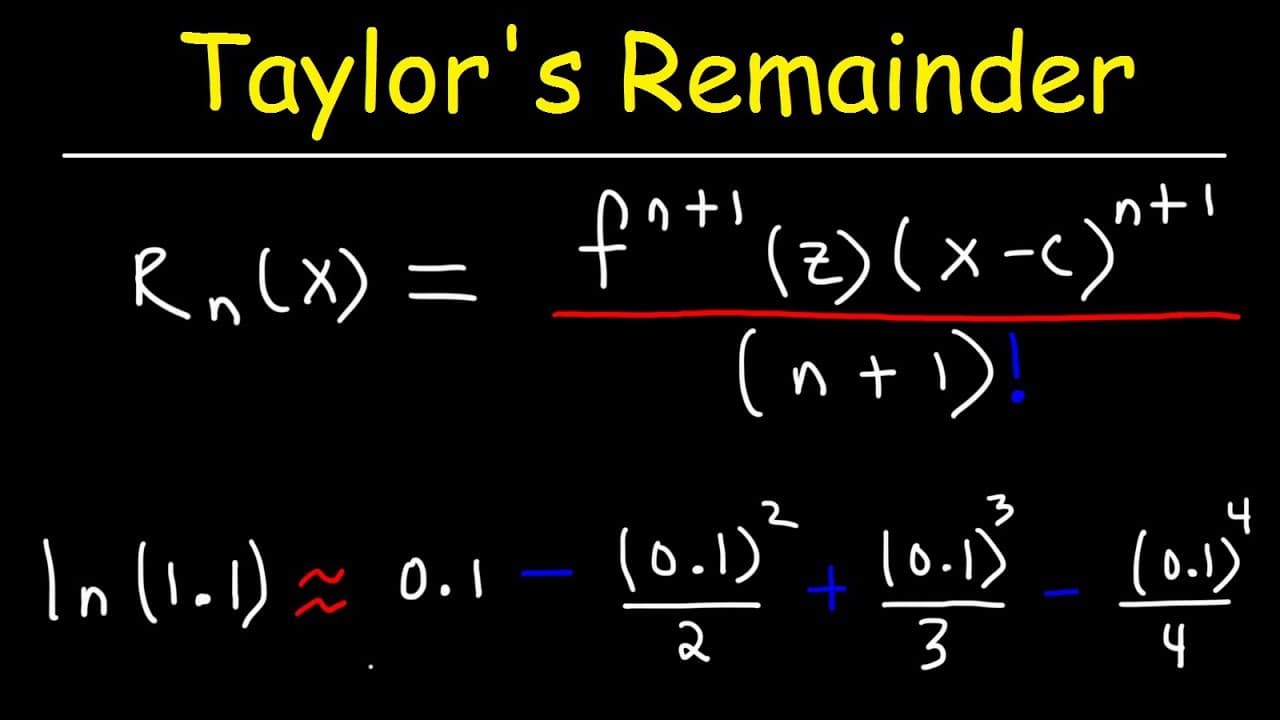
To calculate the maximum error of an approximation using Taylor's Remainder Theorem, use the formula for the remainder: Rn(x) = |f^(n+1)(z)| * |x - c|^(n+1) / (n+1)!. The maximum error is determined by evaluating the (n+1)-th derivative at a value between x and c, and the exact error is the difference between the true value and the polynomial approximation.
Transcript
in this video we're going to talk about how to calculate the maximum error of an approximation using taylor's remainder theorem so let's go ahead and begin so what is the formula that we need to use here's the formula you need so the remainder is going to be the n plus one derivative evaluated at some number z times x minus c raised to the n plus o... Read More
Key Insights
- 👻 Taylor's Remainder Theorem allows us to calculate the maximum error of an approximation.
- 😀 The value of n determines the degree of the polynomial used for the approximation.
- 🤪 To find the maximum error, we need to evaluate the derivative at a specific value of z to maximize its value.
- 😥 The exact error is the difference between the actual value and the approximation at the given point.
Install to Summarize YouTube Videos and Get Transcripts
Explore YouTube Video Summarizer or Get YouTube Transcript Extractor
Questions & Answers
Q: What is the formula for calculating the maximum error using Taylor's Remainder Theorem?
The formula for the remainder is the n plus one derivative evaluated at a number, multiplied by x minus c raised to the n plus one power, divided by (n + 1) factorial.
Q: How do you determine the values of n, x, c, and z?
The video explains that n is given, x is the value we're approximating, c is the difference between x and the starting point, and z is a number between x and c that maximizes the derivative.
Q: How do you calculate the exact error?
The exact error is found by taking the difference between the actual value and the value of the approximation at the given point.
Q: What does it mean if the maximum error is larger than the exact error?
If the maximum error is larger than the exact error, it means the approximation overshoots the true value, providing a conservative estimate of the error.
Summary & Key Takeaways
-
The video explains how to calculate the maximum error of an approximation using Taylor's Remainder Theorem.
-
It discusses the formula for the remainder, which includes the n plus one derivative, evaluated at a number, multiplied by x minus c raised to the n plus one power.
-
The video provides step-by-step instructions on determining the values of n, x, c, and z, and demonstrates how to calculate the maximum and exact error for two different problems.
Read in Other Languages (beta)
Share This Summary 📚
Summarize YouTube Videos and Get Video Transcripts with 1-Click
Try YouTube Summary with ChatGPT & Claude or YouTube Transcript Generator
Explore More Summaries from The Organic Chemistry Tutor 📚



Summarize YouTube Videos and Get Video Transcripts with 1-Click
Try YouTube Summary with ChatGPT & Claude or YouTube Transcript Generator