Hydrostatic Force, Sect 8.3 #8
TL;DR
Calculating hydrostatic force on a trapezoid under water using equations and integration.
Transcript
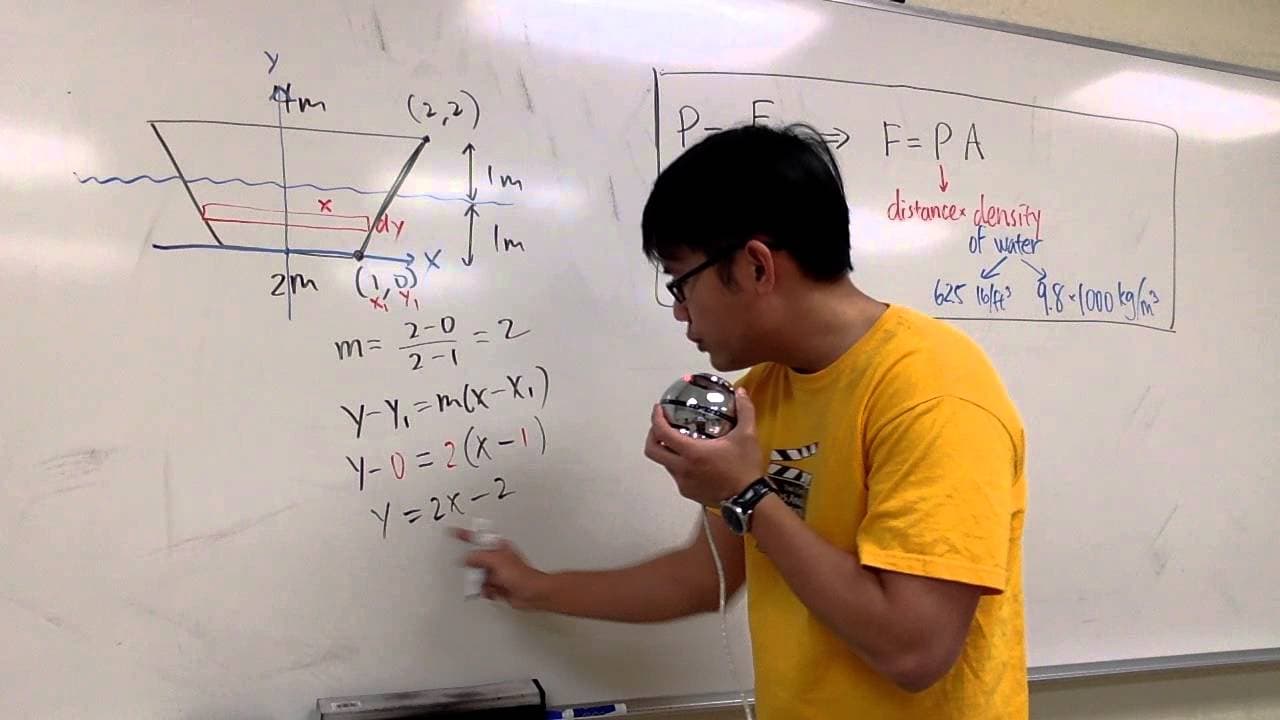
we are going to find the hydrostatic Force that's acting on this part of the trapazoid when this is underneath the water verticality and you know the deal I'm not going to run through the introduction again let's begin look at this picture I will start with drawing a rectangle and we might as well just label this as Dy and we might as well put the ... Read More
Key Insights
- 😫 Geometry and symmetry play crucial roles in setting up the equations for hydrostatic force calculations.
- ❓ Calculus principles, such as slope determination and integration, are applied to solve the problem effectively.
- 💦 Understanding the properties of water density and vertical distances is essential for accurate force calculations.
- ❓ The final result, measured in Newtons, provides a tangible value for the hydrostatic force on the trapezoid section.
- 🎮 The step-by-step approach in the video offers a clear and structured method for tackling hydrostatic force problems.
- 🇦🇪 Knowledge of the SI unit system is necessary for interpreting the final force value accurately.
- 🌍 The process showcases how mathematical concepts can be applied practically to solve real-world physics problems.
Install to Summarize YouTube Videos and Get Transcripts
Explore YouTube Video Summarizer or Get YouTube Transcript Extractor
Questions & Answers
Q: What is the initial step in calculating hydrostatic force on the trapezoid?
The initial step involves drawing a rectangle representing the specific section of the trapezoid submerged in water and setting up a reference frame for measurements.
Q: How is the equation for the length of the rectangle derived using geometry?
The equation for the length involves determining the x value in terms of y by analyzing the dimensions and symmetry of the trapezoid section.
Q: How does the video determine the area of the rectangle for calculation?
The video multiplies the length (2x) with the height (dy) of the rectangle and further adjusts it for the density of water and the vertical distance submerged.
Q: Briefly explain the role of integration in computing the hydrostatic force.
Integration is utilized to sum up the hydrostatic forces across the entire submerged section from the bottom to the water surface, resulting in the final force calculation.
Summary & Key Takeaways
-
The video demonstrates the process of calculating hydrostatic force on a trapezoid submerged in water.
-
Utilizes geometry and calculus concepts to determine the force acting on the specific part of the trapezoid.
-
The final calculation yields the hydrostatic force as 1.14 * 10^4 Newton in the SI unit.
Read in Other Languages (beta)
Share This Summary 📚
Summarize YouTube Videos and Get Video Transcripts with 1-Click
Try YouTube Summary with ChatGPT & Claude or YouTube Transcript Generator
Explore More Summaries from blackpenredpen 📚
Summarize YouTube Videos and Get Video Transcripts with 1-Click
Try YouTube Summary with ChatGPT & Claude or YouTube Transcript Generator