Clipping circuits | Single ended | Part-2/2 | Pulse Digital Circuits | Lec-27
TL;DR
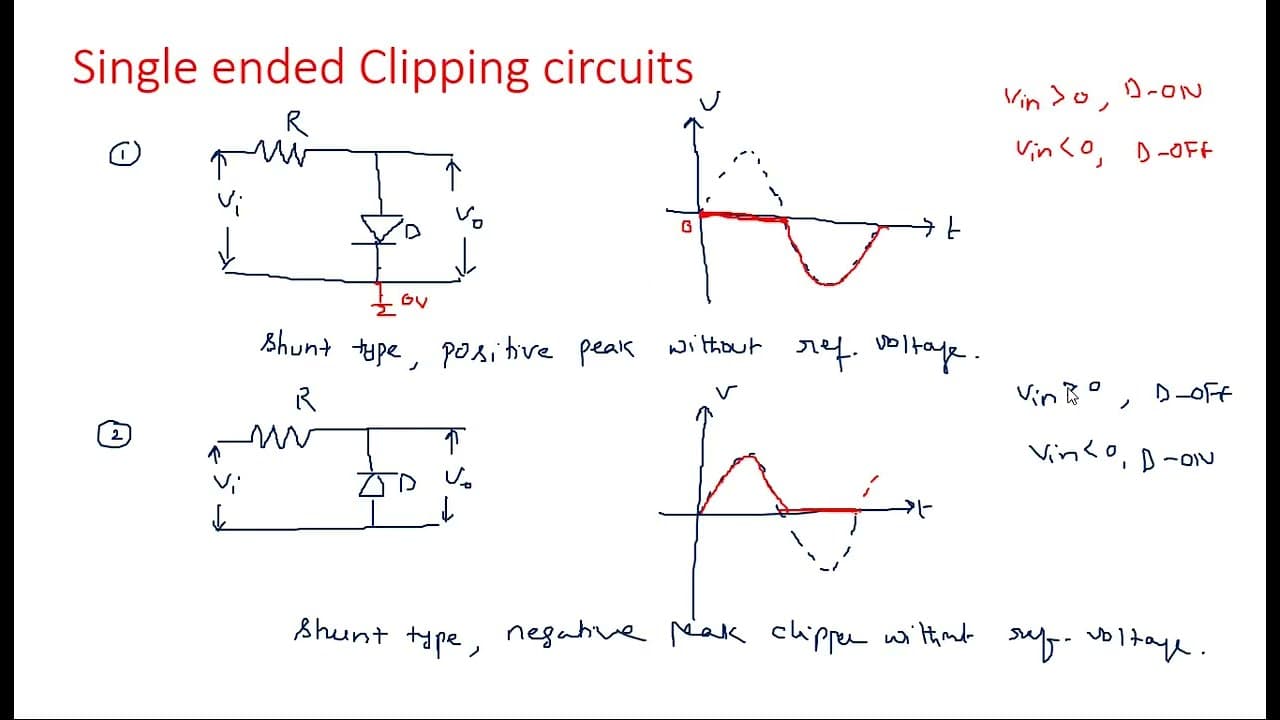
This video explains various single-ended clipping circuits and their output behavior based on the diode's state.
Transcript
hi everyone in the previous video I have started this is a single ended clipping circuits and discussed about six different circuits with their operation now so in this video I am going to explain few more singly ended circuits so we know it consists of a clipping circuit consists of a diode resistor and a reference Supply depending upon the positi... Read More
Key Insights
- 📋 Diode orientation is crucial in defining clipping behavior, impacting whether the output tracks the input or clips at a defined reference voltage.
- 🔠 When the input voltage is below the reference, the output reflects the reference level rather than the input signal, leading to waveform clipping.
- ❤️🩹 Different circuit configurations result in varied output waveforms, demonstrating the versatility of single-ended clipping circuits in electronic applications.
- 📡 Understanding the diode's conduction states is essential in predicting and drawing the output waveform for any given input signal.
- 👋 Non-linear wave shaping alters the waveform significantly, showcasing the contraction in amplitude based on input conditions and circuit design.
- 📋 The concept of clipping circuits is fundamental in electronics, applicable in audio processing, signal modulation, and protective circuits.
- 🧑🎓 The series and shunt configurations of clipping circuits offer insights into broader circuit analysis fundamentals for engineers and students.
Install to Summarize YouTube Videos and Get Transcripts
Explore YouTube Video Summarizer or Get YouTube Transcript Extractor
Questions & Answers
Q: What is the primary function of a single-ended clipping circuit?
A single-ended clipping circuit primarily modifies input waveforms, often sinusoidal waves, by limiting the output signal to predefined voltage levels determined by the diode's orientation and reference voltage. This results in distinctive clipping shapes, which serve various applications in electronics like signal processing and waveform shaping.
Q: How does the position of the diode affect the clipping behavior of the circuit?
The diode's position, whether it is in the forward or reverse direction, critically influences the clipping behavior by determining when the diode is in the "on" or "off" state. In the "on" state, the diode allows current to pass, resulting in an output that mirrors the input. In contrast, in the "off" state, the diode blocks current, causing the output to be limited to the reference voltage.
Q: What role does the reference voltage play in these circuits?
The reference voltage serves as a threshold that the input waveform is compared against. Depending on whether the input voltage is greater or lesser than the reference voltage, the diode either allows or blocks the current. This behavior results in the clipping of the waveform at the reference voltage level, shaping the output.
Q: Can you explain the importance of diode state in these circuits?
The state of the diode—whether it is "on" or "off"—is critical because it determines the conduction path between the input and output. In the "on" state, the diode conducts, creating an output equal to the input voltage. Conversely, in the "off" state, the diode prevents current flow, leading the output to equal the reference voltage, thereby clipping the waveform.
Summary & Key Takeaways
-
The video builds on previously discussed single-ended clipping circuits, focusing on various configurations utilizing diodes, resistors, and reference voltages to manipulate input waveforms.
-
It covers two key cases for diode operation—when the diode is in the "on" state allowing current flow, and when it's in the "off" state leading to clipping at the reference voltage level.
-
Different circuit configurations are analyzed, showing how altering the diode positioning and reference voltage affects the output waveforms, emphasizing the principles behind non-linear wave shaping.
Read in Other Languages (beta)
Share This Summary 📚
Summarize YouTube Videos and Get Video Transcripts with 1-Click
Try YouTube Summary with ChatGPT & Claude or YouTube Transcript Generator