Simultaneous eigenstates and quantization of angular momentum
TL;DR
This content discusses the concept of simultaneous eigenstates, the simplification of the Schrödinger equation, and the quantization of the magnitude of angular momentum.
Transcript
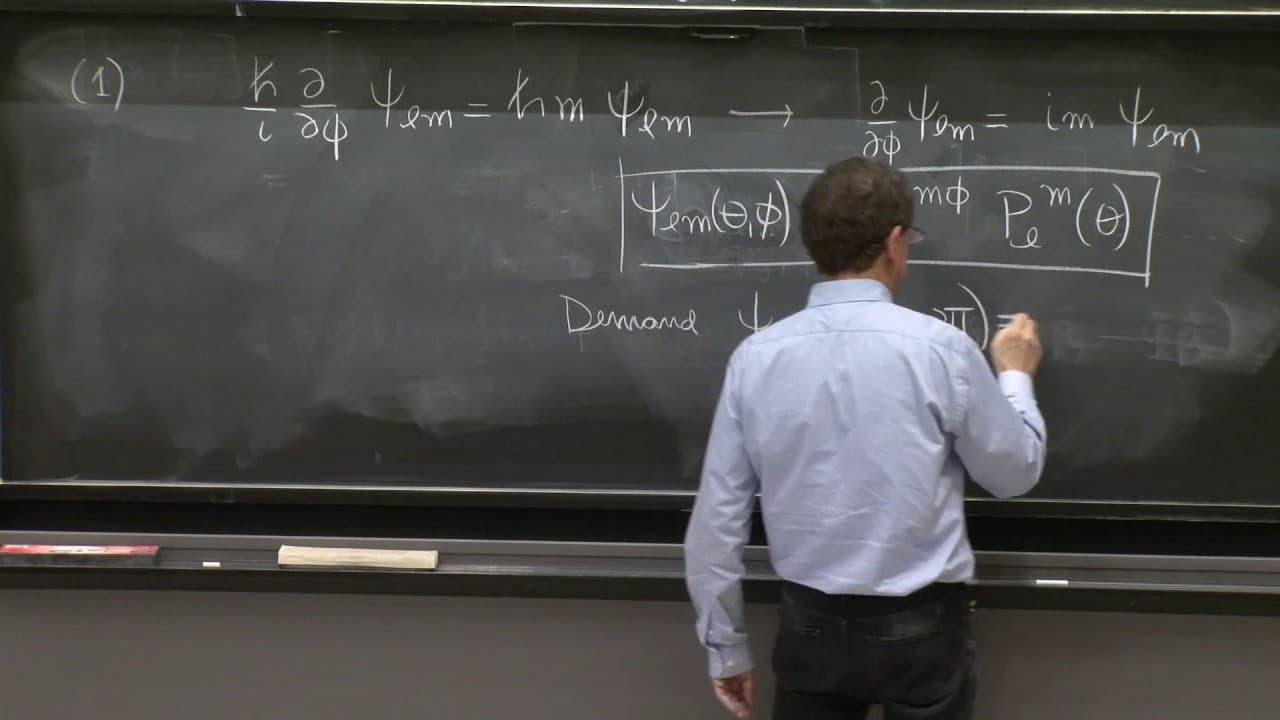
PROFESSOR: Simultaneous eigenstates. So let's begin with that. We decided that we could pick 1 l and l squared, and they would commute. And we could try to find functions that are eigenstates of both. So if we have functions that are eigenstates of those, we'll try to expand in terms of those functions. And all this operator will become a number ac... Read More
Key Insights
- ❓ Simultaneous eigenstates are chosen by finding functions that are eigenstates of operators like Lz and L^2.
- 😀 The eigenvalues of L^2 are quantized and can be represented by l(l+1), where l is a positive integer or zero.
- ❓ The differential equation for the eigenvalues of L^2 can be simplified using the substitution of variables, resulting in a simpler equation involving the Legendre polynomials.
Install to Summarize YouTube Videos and Get Transcripts
Explore YouTube Video Summarizer or Get YouTube Transcript Extractor
Questions & Answers
Q: What is the significance of choosing Lz as the operator for simultaneous eigenstates?
Lz is chosen as the operator for simultaneous eigenstates because of its simplicity. By finding eigenstates for Lz, which are represented by psi(l,m), we can simplify the differential equation and reduce it to a radial equation.
Q: Why does the eigenvalue for L^2 have the form l(l+1)?
The eigenvalue for L^2 is of the form l(l+1) because it is positive. By analyzing the positive nature of the operator and considering the sum of certain positive terms, it is concluded that lambda (eigenvalue) must be positive. Therefore, l(l+1) is a reasonable representation of the eigenvalue.
Q: What are the constraints on the eigenvalues of L^2?
The eigenvalues of L^2 have the constraint that l can be any positive integer or zero. This means that the magnitude of the angular momentum is quantized and can only take on specific values.
Q: What are the solutions to the differential equation for the eigenvalues of L^2 called?
The solutions to the differential equation for the eigenvalues of L^2 are known as Legendre polynomials. These polynomials satisfy the differential equation and have specific properties and constraints.
Summary & Key Takeaways
-
Simultaneous Eigenstates: The content explains the concept of simultaneous eigenstates and how the operators for angular momentum (L) and its square (L^2) are chosen for eigenstate analysis.
-
Quantization of Angular Momentum: The content explores the quantization of the magnitude of angular momentum by solving the differential equation for the eigenvalues of L^2 and finding that it is of the form l(l+1), where l can be any positive integer or zero.
-
Legendre Polynomials: The content mentions that the solutions to the differential equation for the eigenvalues of L^2 are known as Legendre polynomials, which satisfy the equation and have specific constraints.
Read in Other Languages (beta)
Share This Summary 📚
Summarize YouTube Videos and Get Video Transcripts with 1-Click
Try YouTube Summary with ChatGPT & Claude or YouTube Transcript Generator
Explore More Summaries from MIT OpenCourseWare 📚



Summarize YouTube Videos and Get Video Transcripts with 1-Click
Try YouTube Summary with ChatGPT & Claude or YouTube Transcript Generator