The Mosquito Factory
TL;DR
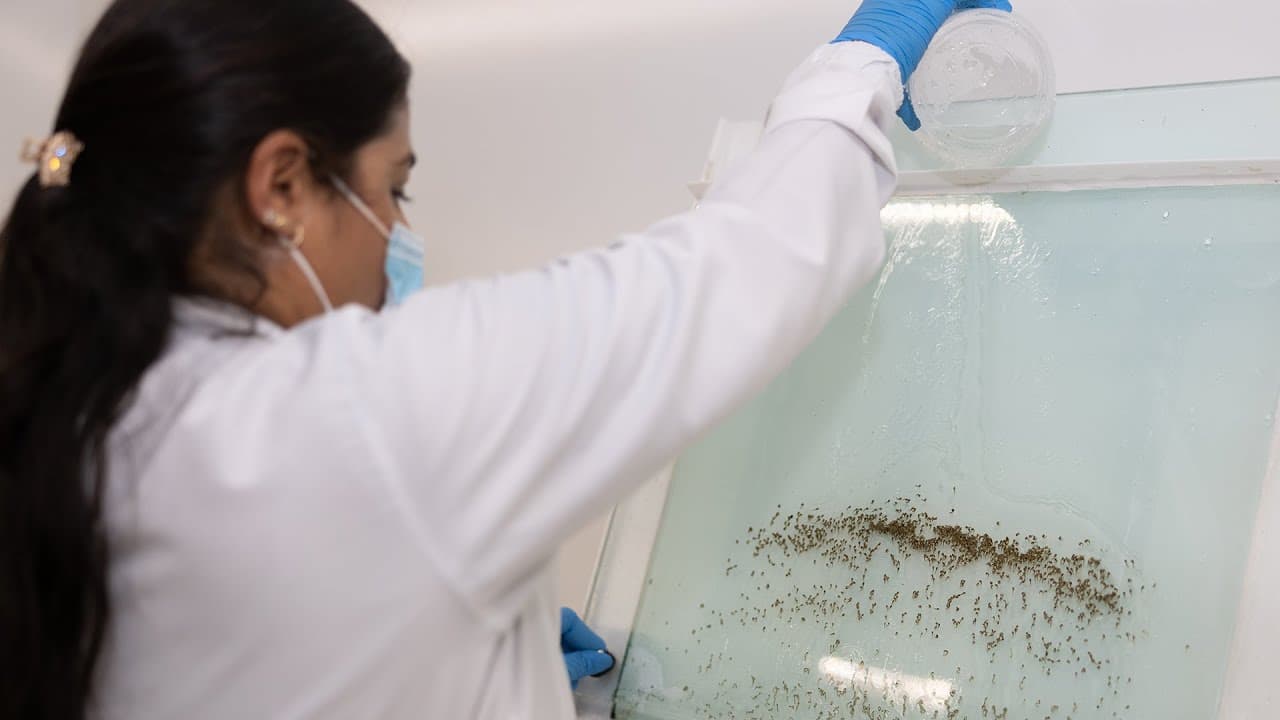
The World Mosquito Program in Medellin, Colombia is producing 30 million mosquitoes per week with a bacteria called Wolbachia to help control mosquito-borne diseases like dengue, zika, and chikungunya.
Transcript
hi i'm scott o'neill here in medellin colombia today and i'm at the world's biggest mosquito factory for the world mosquito program we're making in here 30 million mosquitoes a week come have a look we're doing it for a very serious reason cities like medellin have suffered from diseases like dengue zika chikungunya for decades but not anymore we'v... Read More
Key Insights
- 🦟 Mosquitoes carrying the bacteria Wolbachia can help control diseases like Dengue, Zika, and Chikungunya in tropical cities like Medellin, Colombia.
Install to Summarize YouTube Videos and Get Transcripts
Explore YouTube Video Summarizer or Get YouTube Transcript Extractor
Questions & Answers
Q: How does Wolbachia help control mosquito-borne diseases?
Wolbachia is a bacteria introduced into mosquitoes that inhibits their ability to transmit diseases like dengue, zika, and chikungunya. When these mosquitoes mate with the wild population, the bacteria spreads, reducing the transmission of diseases.
Q: How do they sort the mosquitoes by sex?
The World Mosquito Program sorts the mosquitoes by sex to manipulate the sex ratio in the cages. They want more female mosquitoes, so they separate the males and females by placing the boys at the bottom and the girls at the top of the cages.
Q: How are the mosquitoes released into the field?
There are two methods of releasing the mosquitoes. One way is to package the mosquito eggs in a gelatin capsule with food and drop them into water. The other approach is to release the adults themselves, either by hand or by packaging them into a drone for aerial release.
Q: What is the goal of the World Mosquito Program?
The goal of the World Mosquito Program is to scale up the production of Wolbachia-infected mosquitoes and deliver them to communities around the world that are at risk of mosquito-borne diseases. Over half the world's population is currently suffering or at risk of contracting these diseases, and the program aims to provide a solution.
Summary & Key Takeaways
-
The World Mosquito Program in Medellin, Colombia is addressing the issue of mosquito-borne diseases by producing 30 million mosquitoes per week.
-
They use Wolbachia, a bacteria that stops mosquitoes' ability to transmit dengue, to control the disease in the wild mosquito population.
-
The production process involves breeding and sorting the mosquitoes, feeding them with blood, and releasing them either through gelatin capsules or drones.
Read in Other Languages (beta)
Share This Summary 📚
Summarize YouTube Videos and Get Video Transcripts with 1-Click
Try YouTube Summary with ChatGPT & Claude or YouTube Transcript Generator
Explore More Summaries from Bill Gates 📚






Summarize YouTube Videos and Get Video Transcripts with 1-Click
Try YouTube Summary with ChatGPT & Claude or YouTube Transcript Generator