What Is the Squeeze Theorem in Calculus?
TL;DR
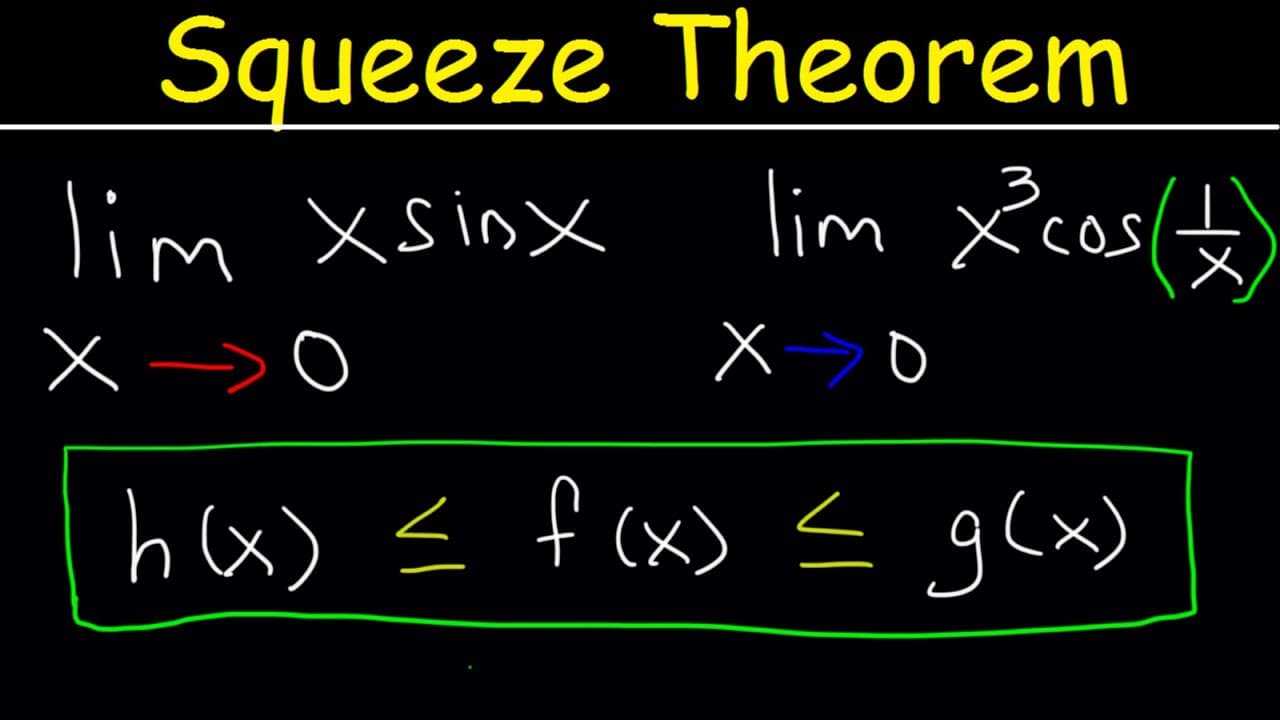
The squeeze theorem states that if a function f(x) is bounded between two other functions H(x) and G(x), and both H(x) and G(x) approach the same limit as x approaches a, then f(x) must also approach that limit. It is a valuable method for determining limits when direct evaluation is challenging.
Transcript
now let's talk about the squeeze term the main idea behind a squeeze term is that let's say that f ofx is greater than or equal to H of X but less than or equal to G of X so f is between H and G now if the limit as X approaches some number let's say a of H of X is the same as the limit as X approaches a of G of X and let's say that value is L then ... Read More
Key Insights
- 👻 The squeeze theorem allows us to determine the limit of a function by comparing it to other functions that bound it.
- ⛔ By comparing the limits of the bounding functions, we can conclude the limit of the middle function.
- ⛔ The squeeze theorem can be used to solve for limits when explicit evaluation is not possible or practical.
- ⚾ Bounding functions can be chosen based on the behavior or properties of the function of interest.
- 🔨 The squeeze theorem is a powerful tool in calculus for evaluating limits in various contexts.
- ❓ It is important to ensure that the conditions for using the squeeze theorem are met before applying it.
- 💨 The squeeze theorem provides a way to indirectly evaluate limits by establishing upper and lower bounds for the function of interest.
Install to Summarize YouTube Videos and Get Transcripts
Explore YouTube Video Summarizer or Get YouTube Transcript Extractor
Questions & Answers
Q: What is the main idea behind the squeeze theorem?
The main idea behind the squeeze theorem is that if a function is bounded between two other functions, and the limits of those bounding functions are equal, then the limit of the middle function must also be equal to that common limit. This allows us to determine the limit of a function by comparing it to other functions.
Q: How can the squeeze theorem be applied in solving for limits?
To apply the squeeze theorem, you need to identify two bounding functions that enclose the function of interest. By taking the limits of these bounding functions as x approaches a and determining that they are equal, you can conclude that the limit of the middle function must also be equal to that common limit.
Q: What conditions must be met for the squeeze theorem to apply?
In order to use the squeeze theorem, the function of interest must be bounded between two other functions. Additionally, the limits of the bounding functions as x approaches a must be equal.
Q: Can the squeeze theorem be used to find the limit of any function?
No, the squeeze theorem can only be applied when the function of interest is bounded between two other functions. If the function is not bounded, or if there are no suitable bounding functions, the squeeze theorem cannot be used to find the limit.
Summary & Key Takeaways
-
The squeeze theorem states that if a function f(x) is between two other functions H(x) and G(x), and the limits of H(x) and G(x) as x approaches a are equal, then the limit of f(x) as x approaches a must also be equal to that common limit.
-
By applying the squeeze theorem, you can determine the limit of a function by comparing it to functions that both bound it.
-
Examples are provided to demonstrate the application of the squeeze theorem in solving for limits.
Read in Other Languages (beta)
Share This Summary 📚
Summarize YouTube Videos and Get Video Transcripts with 1-Click
Try YouTube Summary with ChatGPT & Claude or YouTube Transcript Generator
Explore More Summaries from The Organic Chemistry Tutor 📚




Summarize YouTube Videos and Get Video Transcripts with 1-Click
Try YouTube Summary with ChatGPT & Claude or YouTube Transcript Generator