Lecture 20: Failure of Welfare Theorems
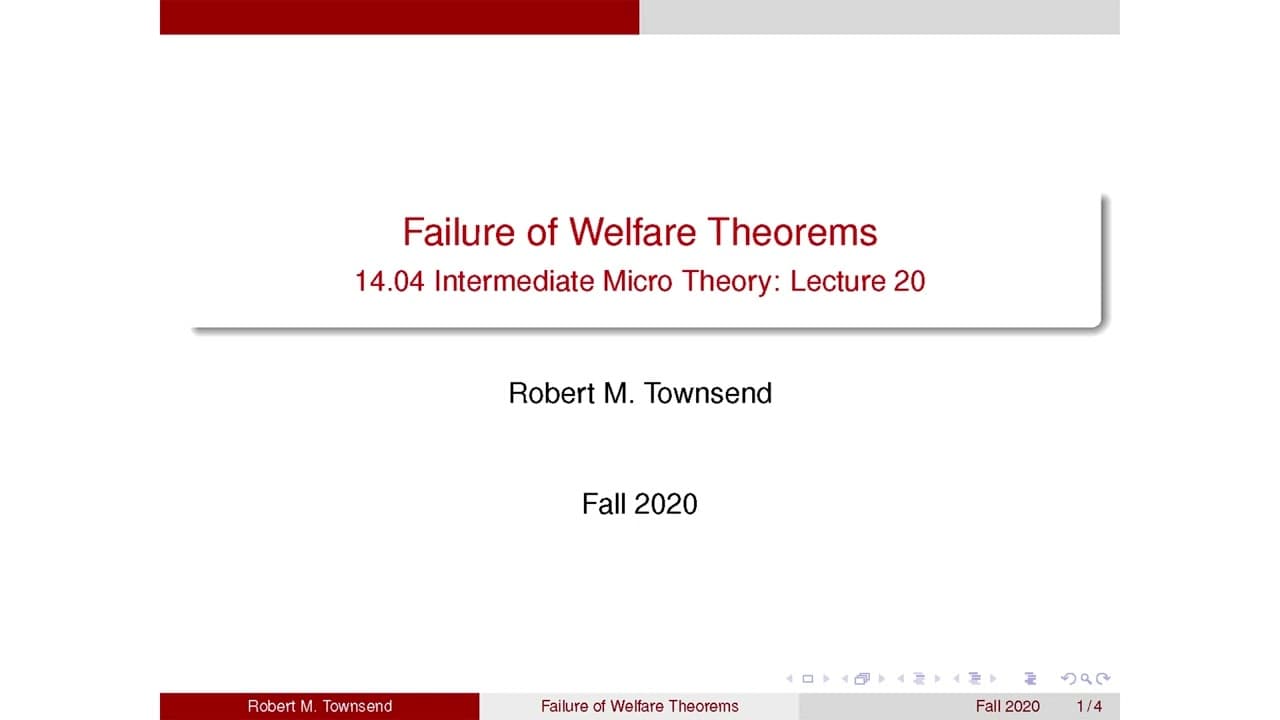
TL;DR
Failure of welfare theorems in economic models can be remedied by the introduction of market structures that internalize externalities.
Transcript
[SQUEAKING] [RUSTLING] [CLICKING] ROBERT TOWNSEND: So let me catch us all back up. We have one more week of classes consisting of two lectures. They're pretty exciting because in effect, everything comes together at the end. The one today is the failure of the welfare theorems, but not just that a theorem doesn't work, but why it doesn't work and a... Read More
Key Insights
- ❓ The failure of the welfare theorems can occur due to various reasons, including local satiation, incomplete markets, and externalities.
- 🗯️ New market structures, such as pollution rights or pricing mechanisms, can help internalize externalities and improve market outcomes.
- 🥺 The introduction of market structures that address externalities can lead to Pareto-optimal outcomes and better welfare for individuals.
- ❓ Externalities related to concerns about the consumption and production of others can have significant impacts on market efficiency and the failure of welfare theorems.
Install to Summarize YouTube Videos and Get Transcripts
Explore YouTube Video Summarizer or Get YouTube Transcript Extractor
Questions & Answers
Q: What are the main reasons for the failure of the welfare theorems?
The failure of welfare theorems can occur due to various reasons, such as local satiation in preferences, incomplete markets, externalities like pollution, and the concerns of households regarding the consumption and production of others.
Q: How can new market structures remedy the failure of welfare theorems?
New market structures, such as the introduction of pollution rights or pricing the right to participate in a platform according to utility type, can help internalize externalities and ensure that market outcomes are Pareto-optimal.
Q: Can you provide an example of a market structure that can address the failure of welfare theorems?
One example is the introduction of pollution rights, where firms can buy and sell rights to pollute. By internalizing the cost of pollution, this market structure ensures that pollution is reduced and market outcomes are more efficient.
Q: How do externalities, such as concerns about the consumption and production of others, contribute to the failure of welfare theorems?
Externalities, like concerns about the consumption and production of others, can lead to market inefficiencies and failures of welfare theorems. For example, if households care about what others are consuming, it may affect their own utility and lead to suboptimal outcomes.
Summary & Key Takeaways
-
The content discusses the failure of the welfare theorems in economic models and explores remedies through new market structures.
-
The first welfare theorem states that any competitive equilibrium is Pareto-optimal, but this can fail when certain conditions are not met, such as local satiation or incomplete markets.
-
Pollution and externalities, as well as the concerns of households regarding consumption and production of others, also contribute to the failure of welfare theorems.
-
The introduction of new market structures, such as pollution rights or pricing the right to participate in a platform according to utility type, can help overcome these failures and achieve Pareto optimality.
Read in Other Languages (beta)
Share This Summary 📚
Summarize YouTube Videos and Get Video Transcripts with 1-Click
Try YouTube Summary with ChatGPT & Claude or YouTube Transcript Generator
Explore More Summaries from MIT OpenCourseWare 📚


Summarize YouTube Videos and Get Video Transcripts with 1-Click
Try YouTube Summary with ChatGPT & Claude or YouTube Transcript Generator