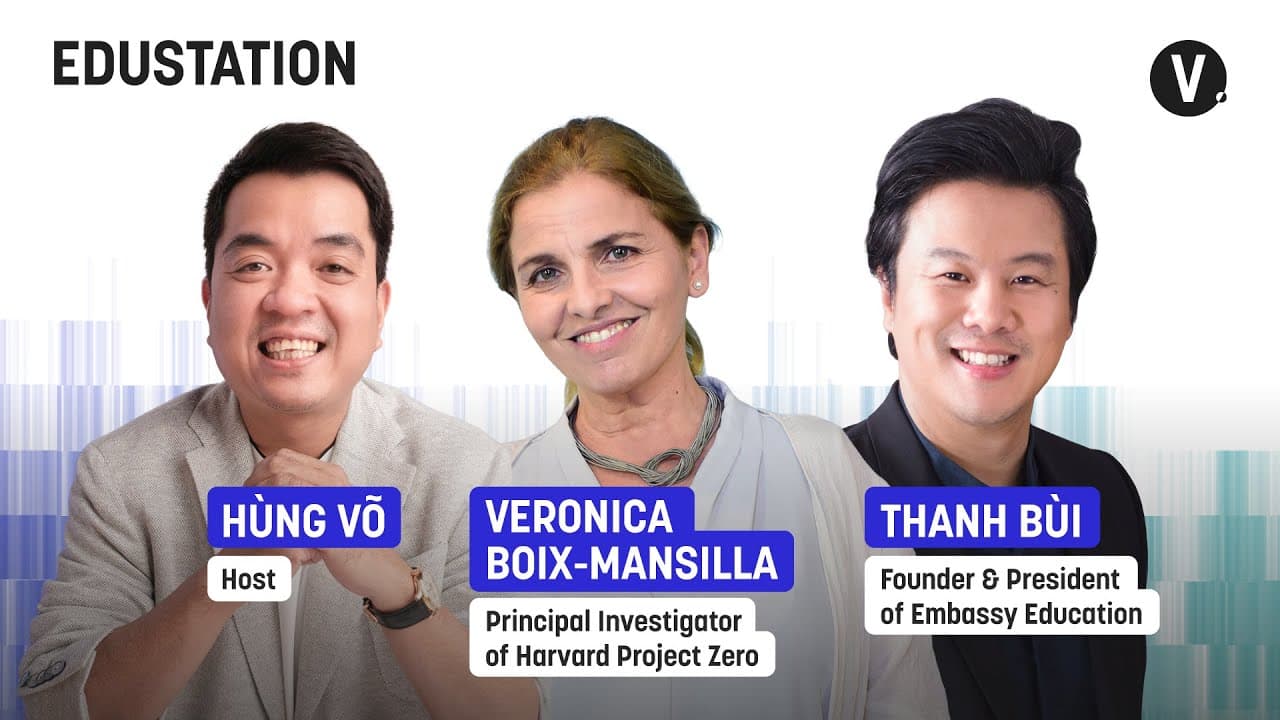
Hãy quay lại điều cốt lõi trong giáo dục - Thanh Bùi, T.S Veronica, Viện Trưởng Harvard Project Zero
TL;DR
Education must adapt to nurture creativity and global citizenship.
Transcript
foreign foreign hello very nice to be here yeah very nice to meet you and we are very grateful to have you on education and uh thank you for organizing your time although i understand that you are on holiday now and and again we are very grateful for for the effort to have booth to share with education and the vietnamese audience about the importan... Read More
Key Insights
- Education should focus on nurturing human potential and societal well-being, adapting to contemporary changes and challenges.
- Students must be prepared to live and work in uncertain and rapidly changing environments, moving beyond traditional textbook knowledge.
- Creativity is essential for addressing local and global issues, requiring collaboration and empathy among individuals.
- Globalization highlights our interdependence, making it crucial for education to foster global competence and environmental stewardship.
- Project Zero aims to understand the cognitive processes involved in art and creativity, emphasizing empirical research.
- Creativity involves working within constraints, requiring both imaginative solutions and an understanding of existing parameters.
- Ethics and creativity must go hand in hand to ensure that creative solutions contribute positively to society.
- Educators should create environments that foster creativity, encouraging experimentation and diverse perspectives.
Install to Summarize YouTube Videos and Get Transcripts
Explore YouTube Video Summarizer or Get YouTube Transcript Extractor
Questions & Answers
Q: How should education adapt to the changing world?
Education must focus on nurturing human potential and societal well-being, adapting to contemporary changes and challenges. It should prepare students to live and work in uncertain and rapidly changing environments, moving beyond traditional textbook knowledge and fostering creativity and problem-solving skills.
Q: Why is creativity important in education?
Creativity is essential for addressing local and global issues, requiring individuals to collaborate and empathize. It allows for imaginative solutions to complex problems and is crucial in fostering a sense of agency and empowerment among students, enabling them to contribute positively to society.
Q: What role does globalization play in education?
Globalization highlights our interdependence, making it crucial for education to foster global competence and environmental stewardship. Students must understand their interconnectedness and the impact of their actions on a global scale, preparing them to be responsible global citizens.
Q: What is Project Zero's focus in education?
Project Zero aims to understand the cognitive processes involved in art and creativity, emphasizing empirical research. It seeks to explore how the mind works when engaging with art and how creativity can be nurtured across different domains, contributing to a more comprehensive understanding of human potential.
Q: How can creativity be nurtured in students?
Creativity can be nurtured by creating environments that foster experimentation and diverse perspectives. Educators should encourage students to work within constraints, providing opportunities for imaginative solutions while also understanding existing parameters. This approach helps develop both creative and critical thinking skills.
Q: What is the relationship between ethics and creativity?
Ethics and creativity must go hand in hand to ensure that creative solutions contribute positively to society. Educating for creativity without ethics may lead to harmful outcomes, whereas nurturing creativity with ethical considerations promotes responsible and beneficial innovation.
Q: How can teachers foster creativity in the classroom?
Teachers can foster creativity by creating a culture of creativity in the classroom, where diverse perspectives and imaginative solutions are encouraged. They should experiment with teaching practices, create engaging environments, and use language that values creativity, helping students develop a creative disposition.
Q: What is the significance of creating a culture of creativity in education?
Creating a culture of creativity in education is significant because it fosters an environment where students feel empowered to explore and express their ideas. It encourages a mindset of innovation and problem-solving, preparing students to navigate and contribute to a rapidly changing world with confidence and creativity.
Summary & Key Takeaways
-
The discussion emphasizes the need for education to adapt to the fast-paced and interconnected world, focusing on nurturing human potential and societal well-being. It highlights the importance of preparing students for uncertainty and change, moving beyond traditional textbook knowledge.
-
Creativity is identified as a key component in addressing local and global issues, requiring individuals to collaborate and empathize. The conversation stresses the significance of fostering global competence and environmental stewardship in education, given our interconnected world.
-
Project Zero's work on understanding the cognitive processes in art and creativity is discussed, emphasizing the role of empirical research. The conversation also highlights the importance of ethics in creativity, ensuring that creative solutions contribute positively to society.
Read in Other Languages (beta)
Share This Summary 📚
Summarize YouTube Videos and Get Video Transcripts with 1-Click
Try YouTube Summary with ChatGPT & Claude or YouTube Transcript Generator
Explore More Summaries from Vietcetera 📚



Summarize YouTube Videos and Get Video Transcripts with 1-Click
Try YouTube Summary with ChatGPT & Claude or YouTube Transcript Generator