Calculus of Variation Type 1 Problem 5 - Calculus of Variation - Engineering Mathematics - 4
TL;DR
Solving a complex calculus of variation problem with initial conditions using integration and Euler's equation.
Transcript
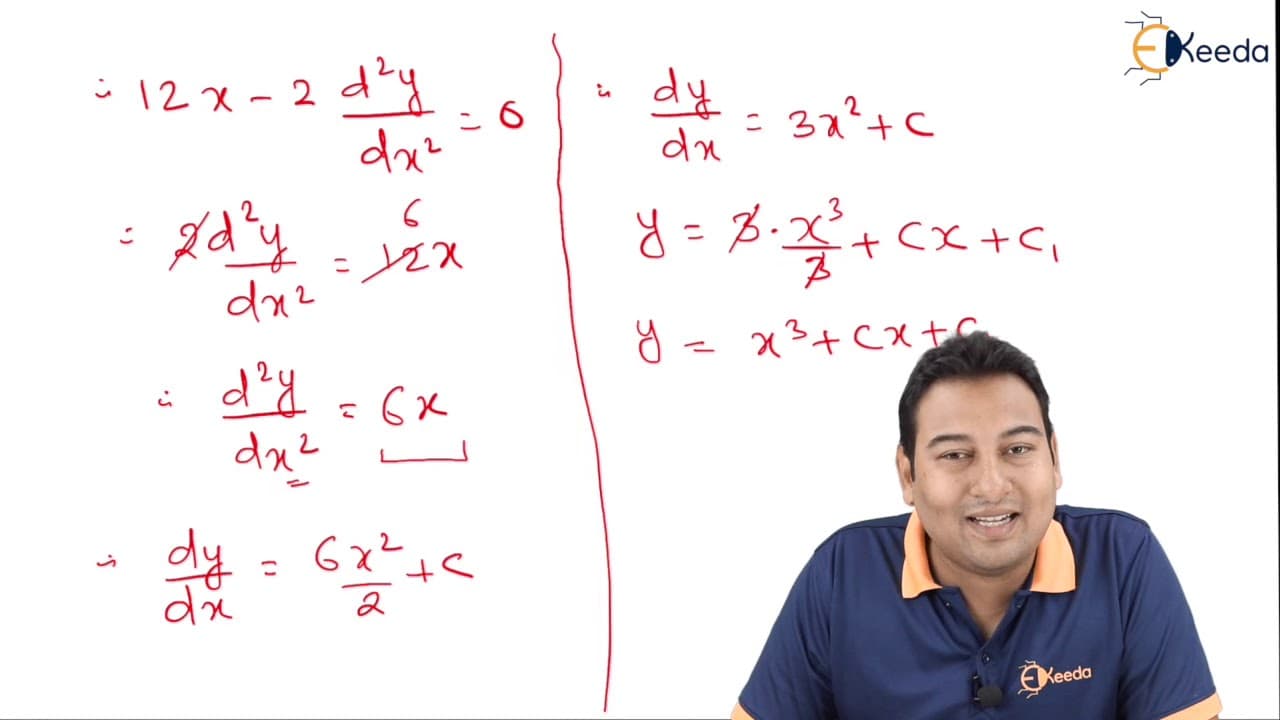
hello friends in this video we'll be discussing calculus of variation type number one problem number five welcome back friends let's have a look on the given problem this is our fifth problem here this is the functional given to us functional F is y dash square plus twelve X Y if you see this functional we do have all the terms see here we do have ... Read More
Key Insights
- 🍉 Calculus of variation problems can have complex equations involving multiple terms with X and Y.
- 🆘 The application of Euler's equation helps to derive the original equation for solving such problems.
- 🍵 Integration is crucial in handling double derivatives and solving calculus of variation problems effectively.
- 🖐️ Initial conditions play a significant role in determining the constants and obtaining accurate solutions in these problems.
Install to Summarize YouTube Videos and Get Transcripts
Explore YouTube Video Summarizer or Get YouTube Transcript Extractor
Questions & Answers
Q: How does this calculus of variation problem differ from previous ones?
This problem includes multiple terms with X and Y, requiring the use of Euler's equation and integration, unlike previous problems that were independent of X or Y.
Q: What is the significance of initial conditions in solving this calculus of variation problem?
Initial conditions provide specific values for X and Y, helping to determine the constants in the solution through substitution and ensuring accuracy in the final result.
Q: Why is the differentiation and integration process repeated in this problem?
The repeated process of differentiation and integration is necessary to handle the double derivative and integrate both the terms with respect to X in calculus of variation problems.
Q: How is the final solution obtained in this calculus of variation problem?
By integrating twice, applying initial conditions, and solving for the constants, the final solution Y = X^3 is derived in this problem, showcasing the importance of thorough calculation steps.
Summary & Key Takeaways
-
Explained the concept of solving calculus of variation problems with multiple terms involving X and Y.
-
Demonstrated the application of Euler's equation to derive the original equation for solving.
-
Illustrated the step-by-step process of integrating and applying initial conditions to obtain the final solution.
Read in Other Languages (beta)
Share This Summary 📚
Summarize YouTube Videos and Get Video Transcripts with 1-Click
Try YouTube Summary with ChatGPT & Claude or YouTube Transcript Generator
Explore More Summaries from Ekeeda 📚




Summarize YouTube Videos and Get Video Transcripts with 1-Click
Try YouTube Summary with ChatGPT & Claude or YouTube Transcript Generator