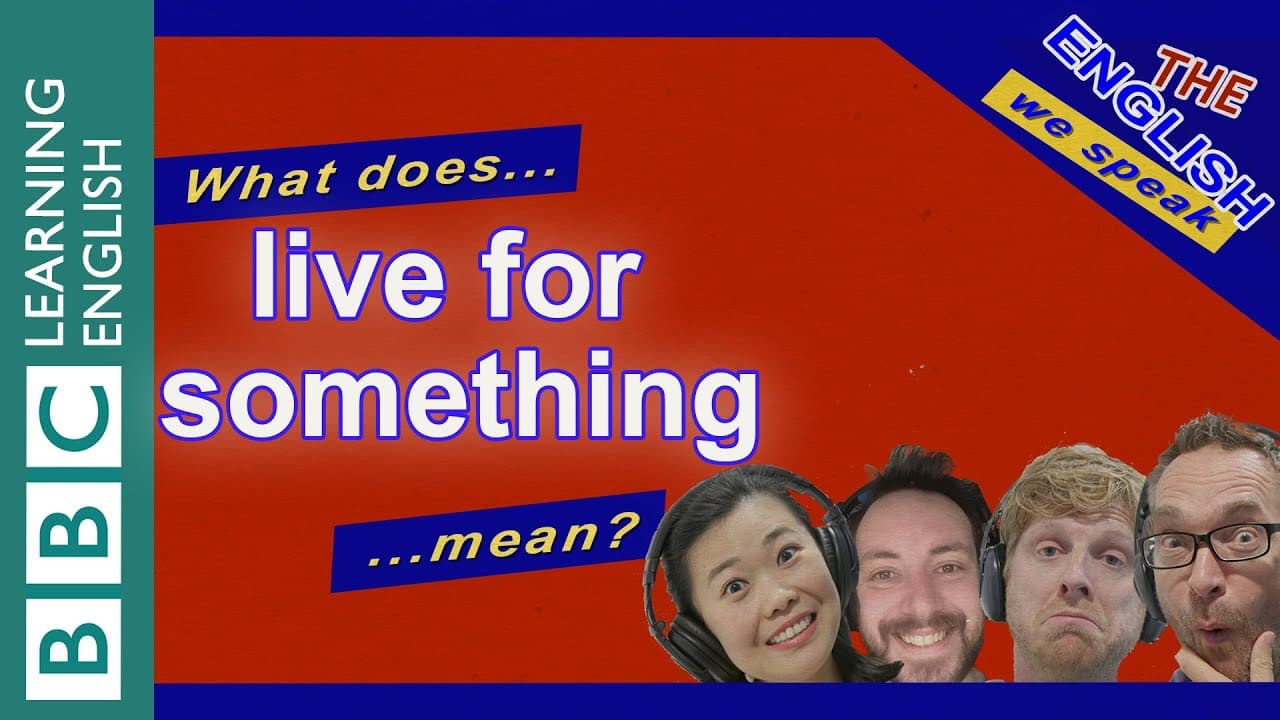
Live for something: The English We Speak
TL;DR
Learn the phrase 'live for' to express passion.
Transcript
Hello and welcome to The English We Speak with me, Feifei and me, Roy. We may sound a little different – that’s because we are not able to record in our normal studios during the coronavirus outbreak. In this programme we have an expression that means ‘you enjoy something more than anything else you do'. Roy, you love video games, don’t you? Yes,... Read More
Key Insights
- The phrase 'live for' is used to express a deep enjoyment or passion for something, often more than any other activity.
- In the context of the conversation, Roy is described as someone who 'lives for video games', indicating his strong passion for gaming.
- Feifei uses the phrase 'live for music' to describe her love for music, humorously suggesting she listens to it while Roy speaks.
- The expression can also convey excitement for upcoming events, such as 'living for the weekend' or 'living for a party'.
- The conversation humorously touches on misunderstandings, like Roy attending a wedding in a costume, highlighting cultural nuances in language use.
- Virtual parties are mentioned as an adaptation during the coronavirus outbreak, reflecting changes in social interactions.
- The episode emphasizes informal English learning, focusing on practical vocabulary used in everyday conversations.
- BBC Learning English provides resources, including audio and transcripts, to aid in learning English expressions effectively.
Install to Summarize YouTube Videos and Get Transcripts
Explore YouTube Video Summarizer or Get YouTube Transcript Extractor
Questions & Answers
Q: What does the expression 'live for' mean?
The expression 'live for' is used to indicate a strong passion or enjoyment for something, often more than any other activity. It can describe a person's deep interest or excitement about a particular hobby, activity, or event, showcasing their enthusiasm and dedication.
Q: How is the phrase 'live for' used in the conversation?
In the conversation, Roy is described as someone who 'lives for video games', highlighting his passion for gaming. Feifei humorously claims she 'lives for music', suggesting her love for music is so strong that she listens to it even while Roy speaks, showcasing the phrase's usage in expressing personal interests.
Q: Can 'live for' be used to express excitement for events?
Yes, the expression 'live for' can also convey excitement for upcoming events. For example, one might say 'I'm living for the weekend' or 'I'm living for a party', indicating anticipation and eagerness for these events, which adds another layer to the phrase's versatility in expressing enthusiasm.
Q: What humorous example is used in the conversation?
A humorous example in the conversation is Roy attending a wedding dressed as Frankenstein's monster, due to a misunderstanding of the invite as a fancy-dress party. This anecdote highlights cultural nuances and the potential for misinterpretations in language and social situations, adding humor to the discussion.
Q: How does the episode address changes during the coronavirus outbreak?
The episode mentions virtual parties as an adaptation during the coronavirus outbreak, reflecting changes in social interactions. This adaptation showcases how people have adjusted their social gatherings to maintain connections while adhering to safety measures, demonstrating the flexibility and creativity in socializing.
Q: What resources does BBC Learning English offer for language learning?
BBC Learning English offers a variety of resources for language learning, including audio recordings, transcripts, and videos. These materials aim to teach informal English expressions and vocabulary, like 'live for', through practical examples and engaging content, helping learners improve their language skills effectively.
Q: Why is the episode useful for English learners?
The episode is useful for English learners as it introduces an informal expression, 'live for', with practical examples and relatable scenarios. Through the conversation between Feifei and Roy, learners can understand the expression's usage in different contexts, enhancing their vocabulary and comprehension of everyday English.
Q: What is the main focus of 'The English We Speak' episode?
The main focus of 'The English We Speak' episode is to teach the expression 'live for', which describes a strong passion or enjoyment for something. Through humorous dialogue and relatable examples, the episode aims to enhance learners' understanding of informal English vocabulary and its application in daily conversations.
Summary & Key Takeaways
-
The episode of 'The English We Speak' introduces the phrase 'live for', which means having a strong passion or enjoyment for something. The hosts, Feifei and Roy, discuss their interests and use humorous examples to illustrate the expression's use in everyday language.
-
Feifei and Roy explore how 'live for' can describe excitement for events, like parties or weekends. They humorously discuss misunderstandings and virtual parties during the coronavirus outbreak, showcasing the phrase's versatility in expressing enthusiasm.
-
BBC Learning English offers this episode as part of its resources to teach informal English. The conversation between Feifei and Roy provides practical examples of using 'live for' in different contexts, enhancing vocabulary learning through relatable scenarios.
Read in Other Languages (beta)
Share This Summary 📚
Summarize YouTube Videos and Get Video Transcripts with 1-Click
Try YouTube Summary with ChatGPT & Claude or YouTube Transcript Generator
Explore More Summaries from BBC Learning English 📚
Summarize YouTube Videos and Get Video Transcripts with 1-Click
Try YouTube Summary with ChatGPT & Claude or YouTube Transcript Generator