SMCR Session 8
TL;DR
Explains moderation analysis using regression with categorical moderators.
Transcript
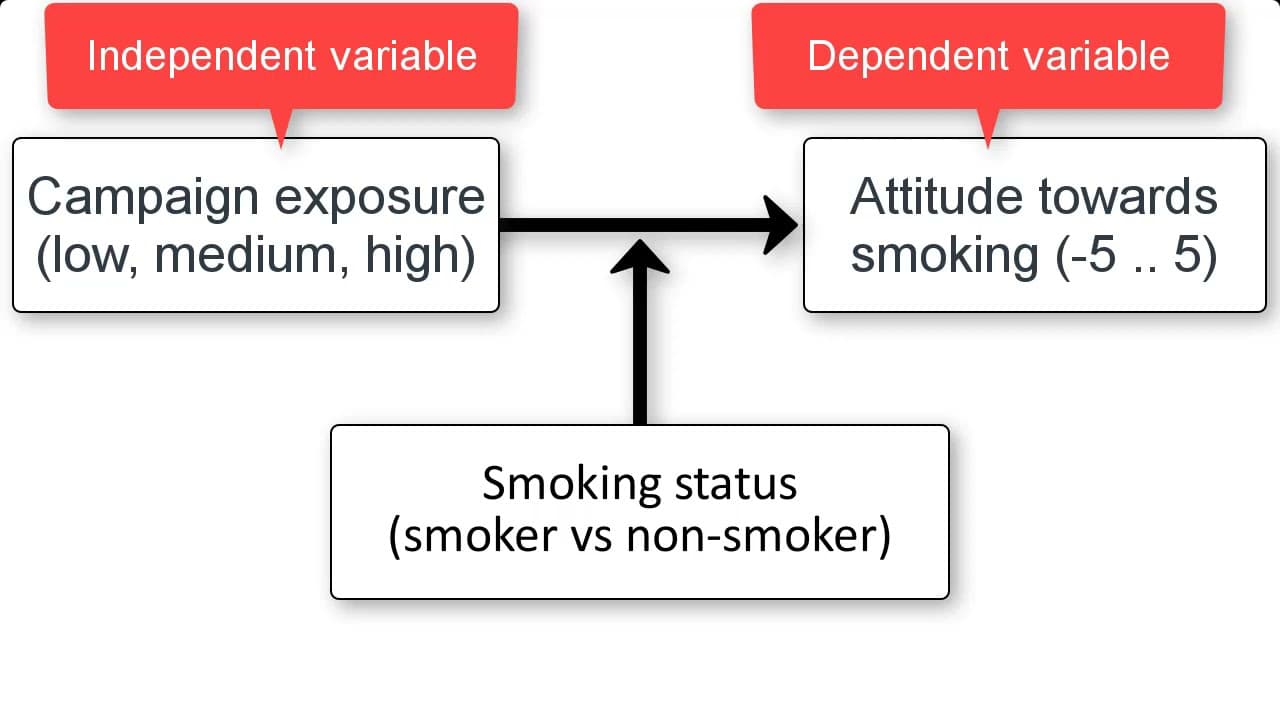
in the previous chapter you learned to test a moderation model using anova here you see an example of a conceptual model of moderation exposure to an anti-smoking campaign is expected to affect someone's attitude towards smoking this effect is expected to be different for smokers and non-smokers the independent variable here is exposure to ... Read More
Key Insights
- Moderation models assess how the relationship between two variables changes across levels of a third variable, known as the moderator.
- ANOVA is suitable for categorical independent variables, but regression analysis is required for numerical independent variables.
- A simple regression equation predicts a dependent variable using a constant and an independent variable, with coefficients estimated by software like SPSS.
- The regression coefficient represents the slope of the line and indicates the effect size of the independent variable on the dependent variable.
- In regression with a categorical predictor, the dichotomy is coded as one versus zero to predict group averages.
- Moderation models involve interaction effects, requiring an interaction variable created by multiplying the predictor by the moderator.
- Different regression equations are needed for each group in moderation analysis to compare effects across groups.
- Graphical representation of different slopes for different groups helps illustrate the essence of moderation in regression analysis.
Install to Summarize YouTube Videos and Get Transcripts
Explore YouTube Video Summarizer or Get YouTube Transcript Extractor
Questions & Answers
Q: What is the main focus of this session?
The main focus of this session is to explain how to conduct moderation analysis using regression, particularly when dealing with numerical independent variables and categorical moderators. It covers the theoretical and practical aspects of constructing and interpreting regression equations in the context of moderation.
Q: How does a regression model differ from ANOVA?
Regression models differ from ANOVA in that they are used when dealing with numerical independent variables, whereas ANOVA is suitable for categorical independent variables. Regression allows for the estimation of effects in a more flexible manner, accommodating both numerical and categorical predictors within the same model.
Q: What role does the regression coefficient play in the analysis?
The regression coefficient plays a crucial role in regression analysis as it represents the slope of the regression line, indicating the effect size of the independent variable on the dependent variable. It quantifies the change in the dependent variable for a one-unit change in the independent variable.
Q: How is moderation tested in regression analysis?
Moderation is tested in regression analysis by incorporating an interaction effect, which requires creating an interaction variable. This variable is the product of the predictor and the moderator, allowing for the assessment of how the relationship between the independent and dependent variables changes across different levels of the moderator.
Q: What is the significance of interaction effects in moderation models?
Interaction effects are significant in moderation models as they reveal how the effect of the independent variable on the dependent variable varies by levels of the moderator. They provide insights into whether the relationship between the primary variables changes across different groups, which is the essence of moderation.
Q: How are different groups compared in moderation analysis?
Different groups are compared in moderation analysis by constructing separate regression equations for each group based on the moderator variable. This allows for the examination of simple slopes or effects for each group, facilitating the comparison of how the independent variable's effect differs across groups.
Q: What is the importance of graphical representation in moderation analysis?
Graphical representation is important in moderation analysis as it visually illustrates the different slopes for different groups, highlighting the moderation effects. Plots can effectively show how the relationship between variables changes across levels of the moderator, making it easier to interpret complex interaction effects.
Q: How can SPSS be used in moderation analysis?
SPSS can be used in moderation analysis by providing tools to estimate regression coefficients and construct interaction terms. It allows users to execute and interpret regression models with categorical moderators, facilitating the examination of moderation effects through statistical tests and graphical outputs.
Summary & Key Takeaways
-
This session covers the basics of moderation analysis using regression, focusing on how the relationship between exposure and attitude towards smoking is moderated by smoking status. It explains the use of regression analysis when dealing with numerical independent variables and categorical moderators.
-
The session highlights the difference between ANOVA and regression analysis, emphasizing the importance of understanding the regression equation and the role of interaction effects in moderation models. It provides a detailed explanation of how to interpret regression coefficients in the context of moderation.
-
Various examples are provided to illustrate the application of regression analysis with categorical moderators, demonstrating how to construct regression equations for different groups and interpret the results. The session concludes with guidance on executing and interpreting moderation analysis in SPSS.
Read in Other Languages (beta)
Share This Summary 📚
Summarize YouTube Videos and Get Video Transcripts with 1-Click
Try YouTube Summary with ChatGPT & Claude or YouTube Transcript Generator