What Is a Single Nucleotide Polymorphism (SNP)?
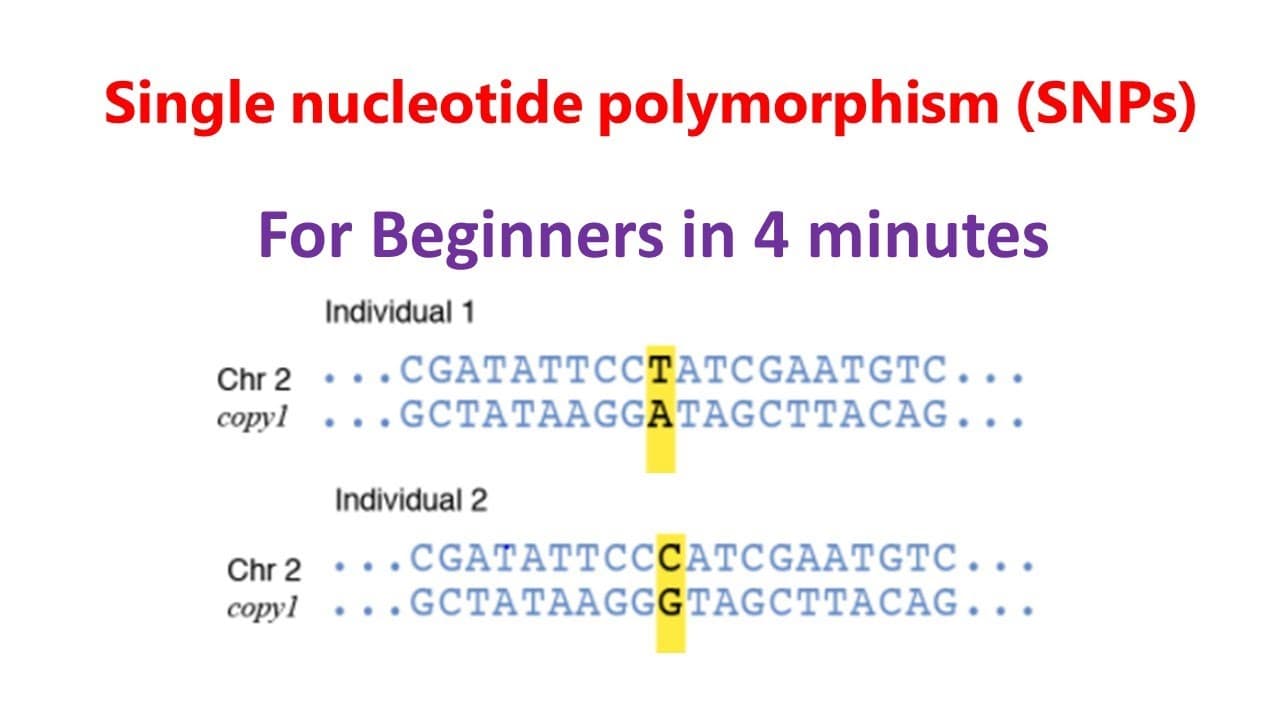
TL;DR
A Single Nucleotide Polymorphism (SNP) is a variation in a single nucleotide in DNA, identified among individuals. SNPs can be found in both coding and non-coding regions, and while not all are linked to diseases, some can indicate an individual's risk for specific health conditions.
Transcript
hello everyone welcome to today's lecture in this lecture today i'm going to talk to you about single nucleotide polymorphism or snips a single nucleotide polymorphism or snp or pronounced as snip is a variation at a single a nucleotide position a or z or c or t in a dna sequence among individuals okay so why it's a single nucleotide polymorphism b... Read More
Key Insights
- 🧘 Single Nucleotide Polymorphism (SNP) is a variation at a single position in the DNA sequence.
- 🧘 SNPs are classified as such if more than one percent of a population doesn't have the same nucleotide at a specific position.
- 💁 SNPs can occur in coding and non-coding regions, providing valuable information about genetic predispositions to diseases.
- ❓ Not all SNPs cause diseases, but some are associated with certain disorders.
- 🧑🔬 By studying SNPs, scientists can evaluate an individual's genetic predisposition to develop a disease.
- ❓ SNPs can be categorized as substitutions, deletions, or insertions.
- 🧬 The variation in SNPs can be identified by comparing DNA sequences between individuals.
Install to Summarize YouTube Videos and Get Transcripts
Explore YouTube Video Summarizer or Get YouTube Transcript Extractor
Questions & Answers
Q: What is a Single Nucleotide Polymorphism (SNP)?
SNPs are variations at a single nucleotide position in DNA, where the nucleotide can be A, C, G, or T. They can occur in coding and non-coding regions of the genome.
Q: How are SNPs associated with diseases?
Although not all SNPs cause diseases, certain ones are linked to specific disorders. Scientists use SNP associations to assess an individual's genetic predisposition to develop a disease.
Q: What are the different types of SNPs?
There are three types of SNPs: substitutions (changes in nucleotide bases), deletions (removal of a nucleotide), and insertions (addition of a new nucleotide to the sequence).
Q: Can SNPs occur in both coding and non-coding regions of DNA?
Yes, SNPs can occur in both exons (coding regions) and introns (non-coding regions) of genes. They can also be found in other non-coding regions of the genome.
Key Insights:
- Single Nucleotide Polymorphism (SNP) is a variation at a single position in the DNA sequence.
- SNPs are classified as such if more than one percent of a population doesn't have the same nucleotide at a specific position.
- SNPs can occur in coding and non-coding regions, providing valuable information about genetic predispositions to diseases.
- Not all SNPs cause diseases, but some are associated with certain disorders.
- By studying SNPs, scientists can evaluate an individual's genetic predisposition to develop a disease.
- SNPs can be categorized as substitutions, deletions, or insertions.
- The variation in SNPs can be identified by comparing DNA sequences between individuals.
- Different nucleotide bases (A, C, G, T) can be present at a single position, indicating a SNP.
Summary & Key Takeaways
-
Single Nucleotide Polymorphism (SNP) is a variation at a single nucleotide position in DNA among individuals.
-
SNPs can occur in both coding and non-coding regions of the genome.
-
Certain SNPs are associated with diseases, allowing scientists to evaluate genetic predisposition.
Read in Other Languages (beta)
Share This Summary 📚
Summarize YouTube Videos and Get Video Transcripts with 1-Click
Try YouTube Summary with ChatGPT & Claude or YouTube Transcript Generator
Explore More Summaries from Biology Lectures 📚


Summarize YouTube Videos and Get Video Transcripts with 1-Click
Try YouTube Summary with ChatGPT & Claude or YouTube Transcript Generator