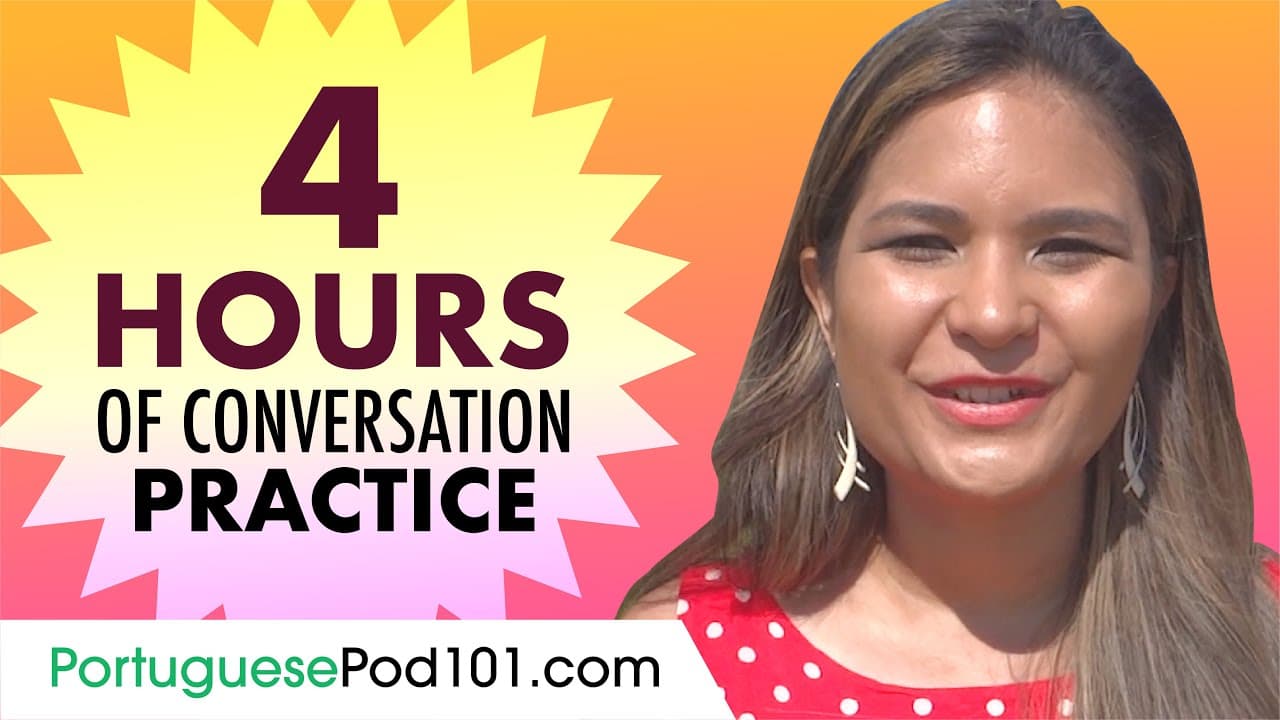
4 Hours of Portuguese Conversation Practice - Improve Speaking Skills
TL;DR
Learn Portuguese through common phrases and practical conversation tips.
Transcript
want to speak real portuguese from your first lesson sign up for your free lifetime account at portuguesepod101.com in this video you'll learn 20 of the most common words and phrases in portuguese hello everybody my name is jade furuta welcome to the 800 core portuguese wars and phrases video series this series will teach you the 800 most common wo... Read More
Key Insights
- The video emphasizes learning Portuguese through practical conversation, focusing on common phrases and vocabulary.
- Reviewing previously learned material is crucial for language retention and mastery.
- Preparation is key to speaking more in your target language, especially for beginners.
- Portuguese uses a similar sentence structure to English, with subject-verb-object order.
- Negative sentences in Portuguese are formed by placing 'não' before the verb.
- Direct questions in Portuguese often start with a question word followed by the sentence.
- Portuguese is a null subject language, meaning the subject can often be omitted.
- Adjectives in Portuguese typically follow the noun, unlike in English.
Install to Summarize YouTube Videos and Get Transcripts
Explore YouTube Video Summarizer or Get YouTube Transcript Extractor
Questions & Answers
Q: How does the video suggest you can prepare to speak more in Portuguese?
The video suggests preparing by using audio and video lessons to learn practical conversations, downloading audio dialogue tracks for review, saving lesson notes, and using free PDF conversation cheat sheets. It emphasizes the predictability of conversations and the importance of preparing relevant phrases and vocabulary in advance.
Q: What is the basic sentence structure in Portuguese?
Portuguese uses a subject-verb-object (SVO) sentence structure, similar to English. This means that in a basic sentence, the subject comes first, followed by the verb, and then the object. This structure can be used for forming statements, negative sentences, and questions.
Q: How are negative sentences formed in Portuguese?
Negative sentences in Portuguese are formed by placing the word 'não' before the verb. This structure is straightforward and does not require changes to the verb or sentence order, unlike in English where auxiliary verbs are often used.
Q: What are some key tips for beginners to start speaking Portuguese?
Beginners are encouraged to start with basic phrases like introducing themselves, talking about the weather, and giving compliments. Practicing these common conversational topics can help build confidence and fluency. The video also recommends using the 25 questions you need to know lesson series and printable conversation cheat sheets for additional practice.
Q: How can you use adjectives in Portuguese sentences?
In Portuguese, adjectives typically follow the noun they describe, which is different from English where adjectives usually precede the noun. For example, 'a casa bonita' means 'the beautiful house,' with 'bonita' (beautiful) following 'casa' (house).
Q: What is a unique feature of Portuguese regarding the subject in sentences?
Portuguese is a null subject language, meaning that the subject can often be omitted if it is clear from the context or verb conjugation. This is different from English, where the subject is usually explicitly stated. For example, 'estou feliz' means 'I am happy,' with the subject 'I' being implicit.
Q: How can you form questions in Portuguese?
Questions in Portuguese can be formed by simply adding a question mark at the end of a statement and raising the intonation. For direct questions, a question word such as 'o que' (what) or 'onde' (where) is placed at the beginning of the sentence.
Q: What resources are recommended for learning Portuguese vocabulary?
The video recommends using the 800 most common words and phrases series, creating flashcards for spaced repetition learning, and accessing the full list of vocabulary at portuguesepod101.com. These resources help learners build a solid vocabulary foundation for daily conversations.
Summary & Key Takeaways
-
The video provides a comprehensive guide to learning Portuguese, focusing on the most common words and phrases. It emphasizes the importance of reviewing previously learned material for language mastery.
-
Practical tips are given for preparing to speak more in Portuguese, such as using audio and video lessons, creating flashcards, and utilizing conversation cheat sheets.
-
The video also covers basic Portuguese grammar, including sentence structure, forming negative sentences, and asking questions. It highlights the importance of preparation for effective communication in Portuguese.
Read in Other Languages (beta)
Share This Summary 📚
Summarize YouTube Videos and Get Video Transcripts with 1-Click
Try YouTube Summary with ChatGPT & Claude or YouTube Transcript Generator
Explore More Summaries from Learn Portuguese with PortuguesePod101.com 📚




Summarize YouTube Videos and Get Video Transcripts with 1-Click
Try YouTube Summary with ChatGPT & Claude or YouTube Transcript Generator