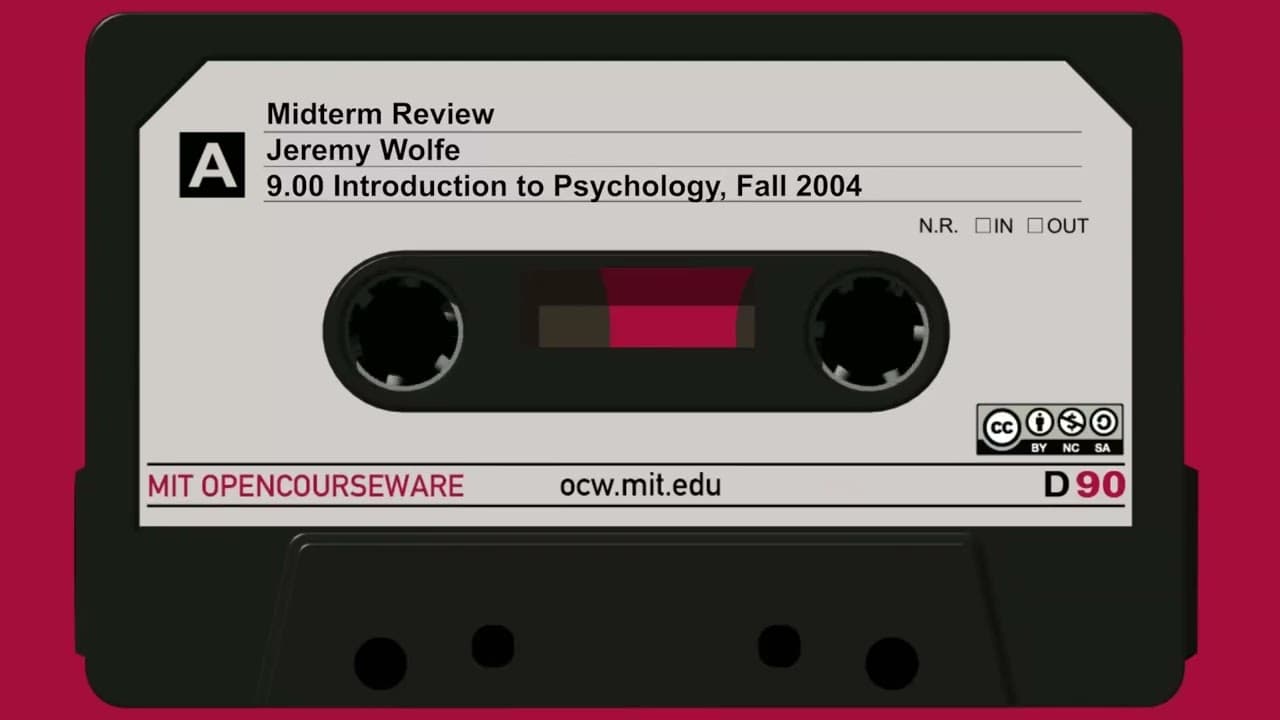
Midterm Review (audio only)
TL;DR
Brain function and perception involve various cues, including depth cues, memory processing, and sensory integration.
Transcript
The following content is provided by MIT OpenCourseWare under a Creative Commons license. Additional information about our license, and MIT OpenCourseWare in general, is available at ocw.mit.edu. PROFESSOR: Well, it looks like it's 7:00, more or less. It looks like there's some people here. Ooh, this is very-- I haven't lectured in here for years. ... Read More
Key Insights
- 🧠 Memories involve various brain regions and processes, including encoding, consolidation, and retrieval.
- ⛑️ Perception is influenced by various depth cues, including binocular disparity, motion parallax, linear perspective, and texture gradients.
- 🧠 Brain damage or trauma can result in various memory and perception deficits, such as anterograde and retrograde amnesia.
Install to Summarize YouTube Videos and Get Transcripts
Explore YouTube Video Summarizer or Get YouTube Transcript Extractor
Questions & Answers
Q: What are the main differences between anterograde and retrograde amnesia?
Anterograde amnesia refers to the inability to form new memories after an event, while retrograde amnesia is the loss of memories that occurred before an event. Anterograde amnesia is often seen in cases of brain injury or trauma, while retrograde amnesia can be caused by various factors, including brain damage, illness, or psychological trauma.
Q: How do depth cues play a role in our perception of the world?
Depth cues, such as binocular disparity, motion parallax, and linear perspective, provide visual information that helps us perceive the depth and distance of objects in our environment. These cues are used by the brain to create a three-dimensional representation of the world. For example, binocular disparity, which is the slight difference between the images seen by each eye, allows us to perceive depth and judge distances accurately.
Q: How does brain damage or trauma affect memory and perception?
Brain damage or trauma can disrupt memory and perception by interfering with the normal functioning of brain regions involved in these processes. Depending on the location of the damage, it can result in either anterograde amnesia, retrograde amnesia, or both. Additionally, brain damage or trauma can also affect other cognitive functions, such as attention, language, and executive functions.
Q: What is the role of memory processing in brain function?
Memory processing is a crucial aspect of brain function as it allows us to store and retrieve information about past events and experiences. It involves various processes, such as encoding, consolidation, and retrieval. The hippocampus plays a vital role in the consolidation of short-term memories into long-term memories.
Summary & Key Takeaways
-
The brain is responsible for processing and integrating information from the senses to create perceptions and memories.
-
Various cues, such as depth cues, semantic priming, and motion parallax, play a role in shaping our perceptions.
-
Brain damage, such as that resulting from trauma or disease, can disrupt memory, perception, and other cognitive functions.
Read in Other Languages (beta)
Share This Summary 📚
Summarize YouTube Videos and Get Video Transcripts with 1-Click
Try YouTube Summary with ChatGPT & Claude or YouTube Transcript Generator
Explore More Summaries from MIT OpenCourseWare 📚


Summarize YouTube Videos and Get Video Transcripts with 1-Click
Try YouTube Summary with ChatGPT & Claude or YouTube Transcript Generator