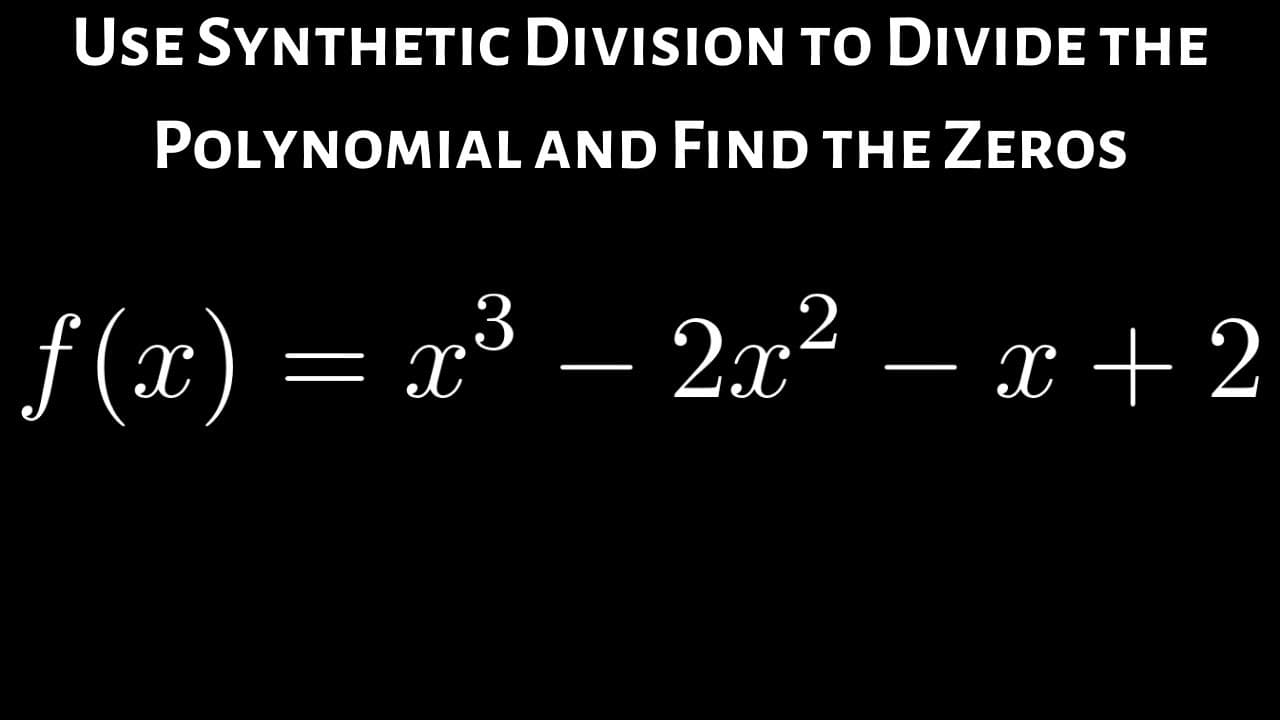
How to use Synthetic Division to Divide a Polynomial Function and then Find the Remaining Zeros
TL;DR
Learn to divide a polynomial using synthetic division, find zeros, and apply the factor theorem.
Transcript
in this problem the question is to use synthetic division to divide this polynomial by x plus one and then we want to find all of the zeros let's go ahead and go through it so we'll start by dividing by x plus one using synthetic so step one is to switch the sign here so because it's a plus one i'll put a little bracket here and then put a negative... Read More
Key Insights
- ➗ Synthetic division simplifies polynomial division by linear factors efficiently.
- 🧑🏭 The factor theorem connects remainders, factors, and zeros in polynomial functions.
- 😑 Factoring a polynomial helps in finding its zeros and simplifying the expression.
- 🧑🏭 Quadratic polynomials can be factored using methods like trial and error or grouping.
- 0️⃣ Zeros of a polynomial are the solutions that make the polynomial function equal to zero.
- 🦻 Understanding synthetic division and factoring techniques aids in solving polynomial equations.
- 🧑🏭 The factor theorem is a fundamental concept in identifying factors and zeros of polynomials.
Install to Summarize YouTube Videos and Get Transcripts
Explore YouTube Video Summarizer or Get YouTube Transcript Extractor
Questions & Answers
Q: What is synthetic division used for in polynomial division?
Synthetic division is a method used to divide polynomials, particularly when dividing by a linear factor like x + 1. It simplifies the process by avoiding long division and efficiently finding the quotient and remainder.
Q: How does the factor theorem relate to finding zeros of a polynomial?
The factor theorem states that if a polynomial divided by (x - a) gives a remainder of zero, then (x - a) is a factor and a is a zero of the polynomial. This theorem is crucial in identifying factors and zeros of polynomials.
Q: Why is it important to factor a polynomial to find its zeros?
Factoring a polynomial helps in simplifying the expression and identifying its roots or zeros. By factoring, we can easily determine the values of the variable that make the polynomial equal to zero, aiding in graphing and further analysis.
Q: How are quadratic polynomials factored to find zeros?
Quadratic polynomials can be factored by finding two numbers that multiply to the constant term and add up to the coefficient of the linear term. The factored form helps in identifying the zeros, which are the solutions to the equation f(x) = 0.
Summary & Key Takeaways
-
Learn to divide a polynomial using synthetic division by x + 1 and find all zeros.
-
Understand the factor theorem, where a remainder of zero indicates a factor and zero of the function.
-
Apply polynomial factoring techniques to get the zeros of the polynomial function.
Read in Other Languages (beta)
Share This Summary 📚
Summarize YouTube Videos and Get Video Transcripts with 1-Click
Try YouTube Summary with ChatGPT & Claude or YouTube Transcript Generator
Explore More Summaries from The Math Sorcerer 📚



Summarize YouTube Videos and Get Video Transcripts with 1-Click
Try YouTube Summary with ChatGPT & Claude or YouTube Transcript Generator