L24.6 A Numerical Example - Part I
TL;DR
This content explains how to calculate transition probabilities in a two-state Markov chain and discusses the convergence properties of the chain.
Transcript
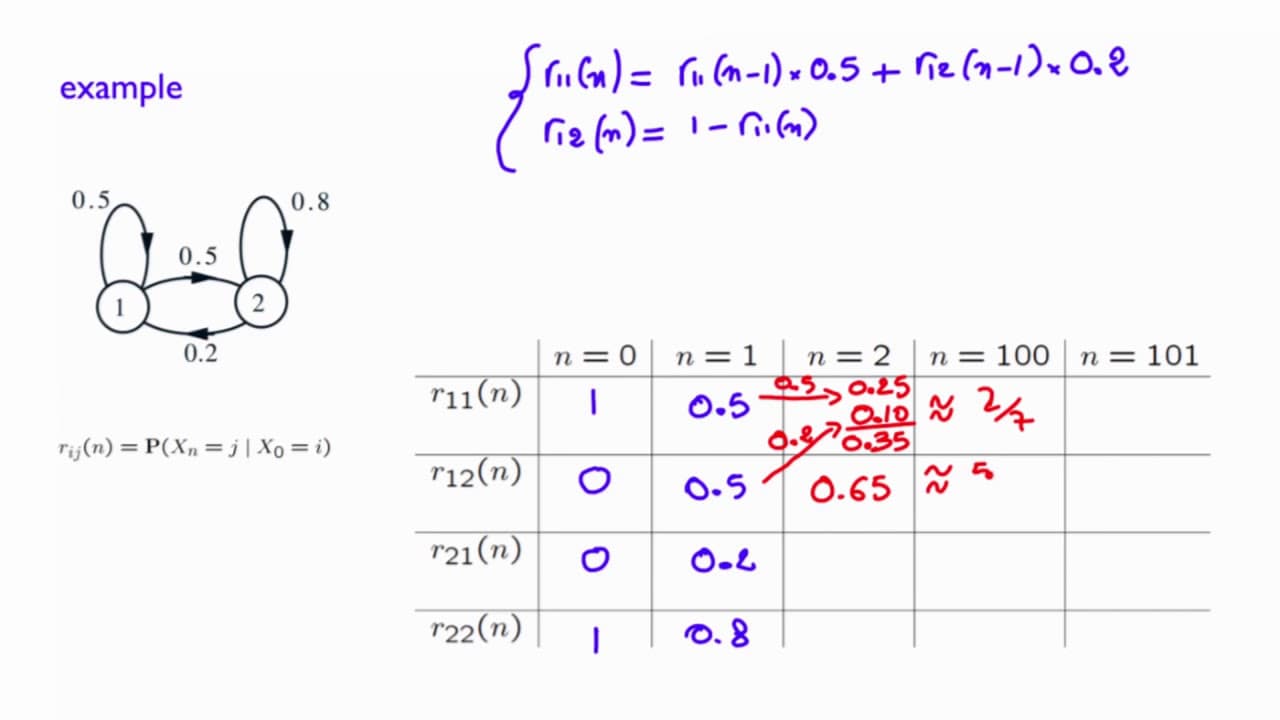
Let us now illustrate, with an example, the calculations of n step transition probabilities that we have just discussed. In this example, we are given a two state Markov chain, and as part of the input, the one step transition probabilities between these two states. So, given that you are in state one, the probability that you will next go to state... Read More
Key Insights
- ⛓️ Transition probabilities in a two-state Markov chain can be calculated using given one-step transition probabilities and a recursion formula.
- ⌛ The probabilities of being in each state converge to constant values after a long period of time.
- 🍉 The initial state becomes insignificant in determining the long term probabilities of being in each state.
Install to Summarize YouTube Videos and Get Transcripts
Explore YouTube Video Summarizer or Get YouTube Transcript Extractor
Questions & Answers
Q: How do you calculate the transition probabilities in a two-state Markov chain?
To calculate the transition probabilities, you start with the given one-step transition probabilities for each state. Then, you use a recursion formula to propagate the probabilities as a function of the number of transitions.
Q: Do the probabilities of being in each state converge to a constant value?
Yes, the probabilities of being in each state after a long period of time seem to converge to constant values. In this example, the probability of being in state one converges to 2/7, while the probability of being in state two converges to 5/7.
Q: What is the significance of the initial state in the long term probabilities?
In the long term, the importance of the initial state vanishes. Regardless of whether we start in state one or state two, the probability of being in state one after a long period of time converges to the same constant value.
Q: What happens when the Markov chain enters a steady state?
When the Markov chain enters a steady state, the probabilities that describe the system become steady. After entering the steady state, if you take a snapshot of the system, the probability of being in each state will remain constant. In this example, the probability of being in state one is 2/7.
Summary & Key Takeaways
-
The content discusses the calculation of transition probabilities in a two-state Markov chain based on given one-step transition probabilities.
-
It demonstrates how to calculate the probabilities of being in each state after a certain number of transitions.
-
The content also explores the convergence properties of the Markov chain, showing that the probabilities eventually reach steady-state values.
Read in Other Languages (beta)
Share This Summary 📚
Summarize YouTube Videos and Get Video Transcripts with 1-Click
Try YouTube Summary with ChatGPT & Claude or YouTube Transcript Generator
Explore More Summaries from MIT OpenCourseWare 📚



Summarize YouTube Videos and Get Video Transcripts with 1-Click
Try YouTube Summary with ChatGPT & Claude or YouTube Transcript Generator