Mars: Mysteries of the Red Planet - 6 Minute English
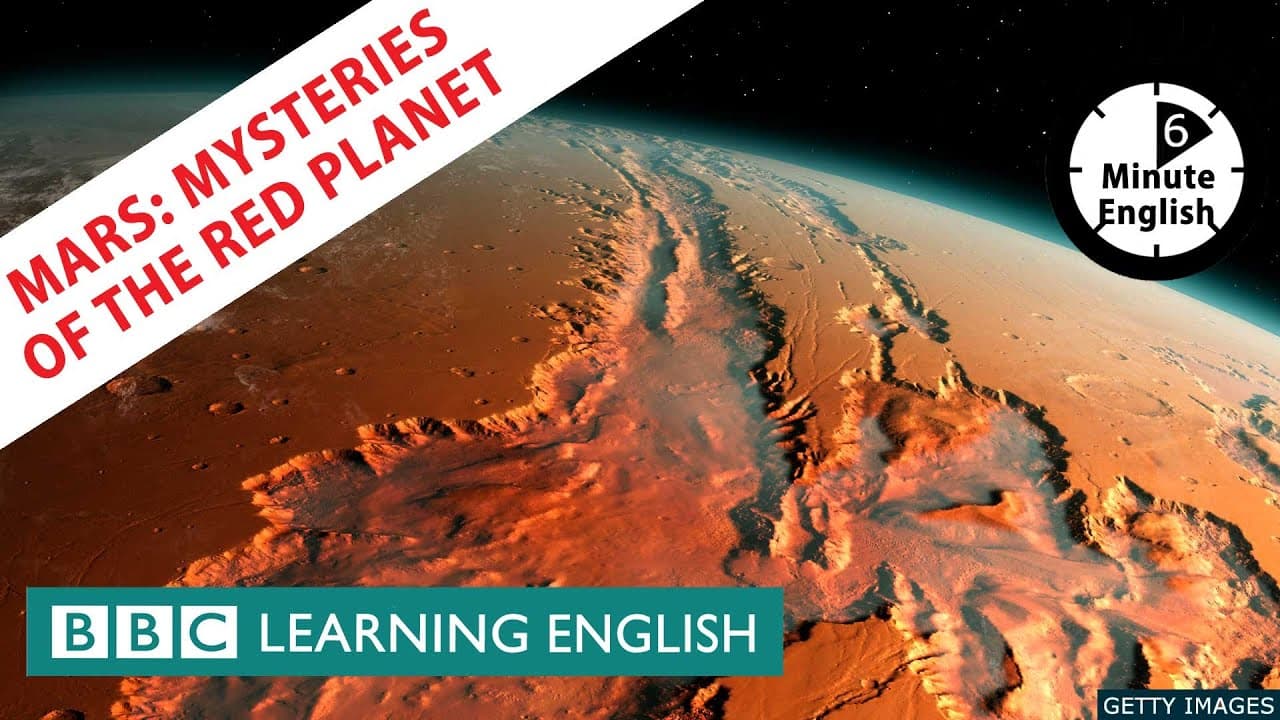
TL;DR
Mars exploration reveals insights into potential habitability and ancient fascination.
Transcript
Hello. This is 6 Minute English from BBC Learning English. I'm Neil. And I'm Sam. In this programme we'll be discussing our closest neighbour in the solar system - the planet Mars. Often called the 'Red Planet', Mars has been in the news a lot recently with three separate missions being sent to explore the planet's surface in 2021. Our fascination ... Read More
Key Insights
- Mars, often called the 'Red Planet', has been a subject of fascination with recent missions exploring its surface in 2021.
- The planet's red color, caused by iron oxide or rust, has intrigued both ancient civilizations and modern scientists.
- Ancient Romans considered Mars the god of war, reflecting the planet's historical significance in human culture.
- Dr. Michael Meyer from NASA explains that Mars' color can change due to dust storms, affecting its appearance from red to orange.
- Finding liquid water on Mars is crucial for determining its potential habitability and the possibility of supporting life.
- Modern astronomers have sent satellites to Mars, gathering extensive data about its surface and conditions.
- Life's adaptability suggests that if water is found, Mars could potentially support life forms, raising the possibility of Martian life.
- Vocabulary related to Mars includes terms like astronomer, distinctive, rust, immutable, adaptable, and habitable.
Install to Summarize YouTube Videos and Get Transcripts
Explore YouTube Video Summarizer or Get YouTube Transcript Extractor
Questions & Answers
Q: Why is Mars referred to as the 'Red Planet'?
Mars is called the 'Red Planet' due to its distinctive red color, which is caused by iron oxide or rust on its surface. This reddish hue makes it easily recognizable and has fascinated both ancient civilizations and modern scientists, contributing to its cultural and scientific significance.
Q: What historical significance does Mars have?
Mars has been significant throughout history, with ancient civilizations like the Maya and Romans observing it. The Romans even considered Mars the god of war, reflecting its influence on human culture. Its bright red appearance in the night sky has intrigued astronomers and inspired art and mythology over the centuries.
Q: How does Mars' color change and why?
Mars' color can change due to dust storms, as explained by Dr. Michael Meyer from NASA. While the planet is typically red due to iron oxide, dust storms can alter its appearance, making it look more orange. These changes might have unsettled ancient observers who believed celestial bodies were immutable.
Q: What role does water play in determining Mars' habitability?
Water is crucial in assessing Mars' habitability because life, as we know it, requires water to survive. Discovering liquid water on Mars would indicate a potentially habitable environment, capable of supporting life. This possibility fuels ongoing exploration efforts to determine if Mars could have, or still does, support life.
Q: What are some key vocabulary terms related to Mars?
Key vocabulary terms related to Mars include 'astronomer', referring to someone who studies celestial bodies; 'distinctive', meaning easily recognizable; 'rust', the reddish substance on Mars' surface; 'immutable', meaning never changing; 'adaptable', indicating the ability to change; and 'habitable', meaning suitable for living.
Q: What scientific efforts have been made to explore Mars?
Scientific efforts to explore Mars have included launching satellites and missions to study its surface and conditions. In 2021, three separate missions were sent to gather data. These efforts aim to answer questions about Mars' color, surface marks, and potential for life, contributing to our understanding of the planet.
Q: What are the implications of finding life on Mars?
Finding life on Mars would have profound implications, suggesting that life can exist beyond Earth. It would expand our understanding of biology, adaptability, and the conditions necessary for life. This discovery could also influence future space exploration and the search for life on other planets, reshaping our perception of the universe.
Q: How does Mars' exploration impact our understanding of the universe?
Exploring Mars enhances our understanding of the universe by providing insights into planetary formation, the potential for life, and the conditions necessary for habitability. It challenges our perceptions of life beyond Earth and inspires technological advancements in space exploration, contributing to our broader knowledge of the cosmos.
Summary & Key Takeaways
-
Mars, known as the 'Red Planet', has been a focus of exploration with three missions launched in 2021. Ancient civilizations, including the Romans, were fascinated by Mars, considering it a god. Modern science continues to explore its surface, seeking answers to questions about its color, surface marks, and potential for life.
-
Dr. Michael Meyer from NASA explains Mars' distinctive red color is due to iron oxide, or rust. The planet's color can change, as seen during dust storms, which may have unsettled ancient astronomers. Modern missions aim to find liquid water, crucial for determining Mars' habitability and potential for supporting life.
-
Mars' exploration raises questions about its potential to support life. Finding water is key, as life is adaptable but requires water. The Red Planet's historical and scientific significance continues to captivate, with vocabulary terms like astronomer, distinctive, rust, immutable, adaptable, and habitable being essential for understanding Mars.
Read in Other Languages (beta)
Share This Summary 📚
Summarize YouTube Videos and Get Video Transcripts with 1-Click
Try YouTube Summary with ChatGPT & Claude or YouTube Transcript Generator
Explore More Summaries from BBC Learning English 📚

Summarize YouTube Videos and Get Video Transcripts with 1-Click
Try YouTube Summary with ChatGPT & Claude or YouTube Transcript Generator