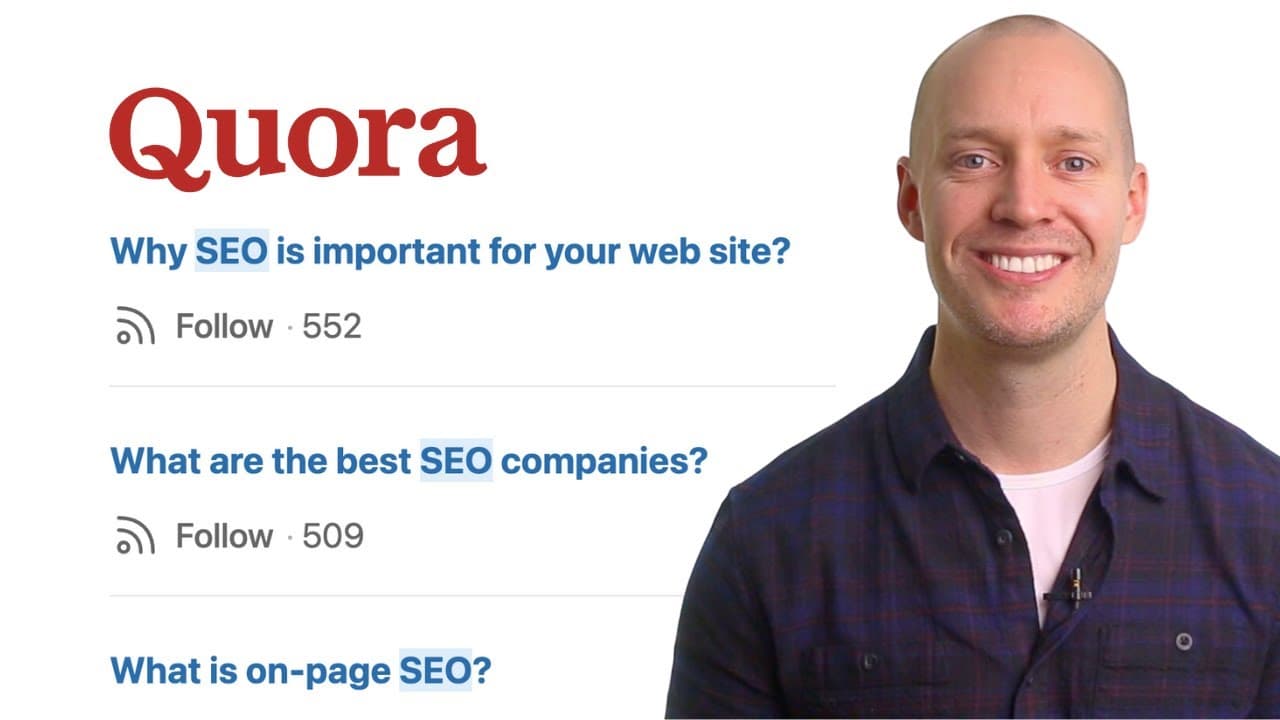
I Answered Every SEO Question on Quora
TL;DR
The video answers 30 SEO questions from Quora in under 30 minutes.
Transcript
- In this video, I'm gonna answer 30 SEO questions from Quora in less than 30 minutes. And watch until the end because there's a super weird question about the FBI. (splashing water) So question number one is, which SEO tool is best for Google keyword research? So if price is taken out of the equation, then ahrefs is the best in my opinion. Their k... Read More
Key Insights
- Ahrefs is considered the best tool for Google keyword research due to its superior keyword difficulty feature compared to SEMrush.
- Keyword research aims to find hyper-relevant, high-intent keywords that a website can rank for based on its authority.
- The number of keywords in a blog post depends on competitive analysis, with tools like Surfer providing guidance on keyword usage.
- Demographics from tools like Google Analytics can help profile users searching for specific keywords, though exact identities remain unknown.
- Keyword cannibalization occurs when multiple pages target the same keyword, and should be avoided by consolidating content.
- Targeting keywords with zero search volume can be beneficial if validated through user engagement on platforms like Quora or Reddit.
- On-page SEO is foundational, but off-page signals like backlinks are crucial for ranking competitive keywords.
- Link building is challenging but valuable, with backlinks from .gov and .edu sites being highly beneficial due to their trustworthiness.
Install to Summarize YouTube Videos and Get Transcripts
Explore YouTube Video Summarizer or Get YouTube Transcript Extractor
Questions & Answers
Q: Which SEO tool is best for Google keyword research?
Ahrefs is recommended as the best tool for Google keyword research. It offers a comprehensive keyword index and a superior keyword difficulty feature compared to SEMrush, making it highly effective for identifying relevant keywords with high transactional intent.
Q: What is the goal of keyword research?
The goal of keyword research is to identify hyper-relevant keywords with high transactional intent that a website can rank for. This involves considering the website's current age, authority, and trust to ensure that the selected keywords are achievable and can drive business results.
Q: How can I find out who is searching for a specific keyword?
While it's not possible to identify specific individuals searching for a keyword, demographic data can be used to create profiles of website visitors. Tools like Google Analytics provide insights into user characteristics such as gender, device type, and location, helping to understand the audience better.
Q: What is keyword cannibalization?
Keyword cannibalization occurs when multiple pages on a website target the same keyword or slight variations, leading to competition among the pages. This can dilute the website's authority and negatively impact rankings. Consolidating content into a single, comprehensive page is recommended to avoid this issue.
Q: Should I target keywords with zero search volume?
Targeting keywords with zero search volume can be worthwhile if there is evidence of user engagement on platforms like Quora or Reddit. These platforms can validate the potential interest in a topic, offering untapped opportunities for content creation and audience engagement.
Q: Is on-page SEO more important than off-page SEO?
On-page SEO is essential for optimizing pages around qualified keywords, but off-page SEO, including backlinks, is crucial for ranking competitive keywords. External signals of trust, such as backlinks, are necessary to boost a website's authority and improve its search engine rankings.
Q: Why is link building so hard?
Link building is intentionally challenging because valuable links should be difficult to obtain. This difficulty ensures that only high-quality content receives backlinks. Successful link building requires producing unique, link-worthy content and often becomes easier for well-known brands within their industry.
Q: Are backlinks from .gov and .edu websites beneficial?
Yes, backlinks from .gov and .edu websites are highly beneficial due to their inherent trust and authority. These top-level domains are considered some of the most reliable sources, making their backlinks valuable for improving a website's search engine rankings and perceived authority.
Summary & Key Takeaways
-
The video provides answers to 30 SEO-related questions sourced from Quora, covering topics like keyword research, on-page SEO, and link building. It offers practical advice on using tools like Ahrefs and Surfer to optimize SEO strategies.
-
Key points include the importance of avoiding keyword cannibalization, leveraging demographic data for audience insights, and understanding the role of backlinks and social media links in SEO.
-
The video also addresses common misconceptions about SEO, such as the impact of multiple SEO experts working on a single website and the limited value of social media backlinks, while offering strategic advice for improving search rankings.
Read in Other Languages (beta)
Share This Summary 📚
Summarize YouTube Videos and Get Video Transcripts with 1-Click
Try YouTube Summary with ChatGPT & Claude or YouTube Transcript Generator
Explore More Summaries from Nathan Gotch 📚




Summarize YouTube Videos and Get Video Transcripts with 1-Click
Try YouTube Summary with ChatGPT & Claude or YouTube Transcript Generator