Wave analyzer | Harmonic distortion analyzer | Electrical Instruments ( EIM ) | Lec - 21
TL;DR
This video explains wave analyzers and harmonic distortion analyzers, detailing their functions and applications.
Transcript
hi everyone in this video we will introduce what is a wave analyzer and harmonic distortion analyzer so what do you mean by wave analyzer what do you mean by analyzer it analyzes something it analyzes something here wave analyzer analyzes the amplitude of a selected waveform suppose 10 number of waveforms are there in your signal all these 10 numbe... Read More
Key Insights
- 👋 Wave analyzers are essential tools for measuring specific frequency components within complex waveforms, enhancing signal analysis.
- 🖐️ Harmonic distortion analyzers play a crucial role in assessing the quality of signals by quantifying distortion levels caused by harmonic frequencies.
- 👋 The selection of frequency components in wave analyzers is achieved through LC circuits, which can be tuned for precise measurements.
- 🏑 Both types of analyzers find applications in various fields, including telecommunications, audio engineering, and electrical engineering.
- 👻 The capability to filter out unwanted signals allows wave analyzers to provide clearer insights into the behavior of complex waveforms.
- ✋ Harmonic distortion analysis contributes to the overall understanding of signal integrity, which is vital for high-performance electronic systems.
- 👋 The design of wave analyzer circuits typically includes primary detectors, rectifiers, and indicating devices for effective measurements.
Install to Summarize YouTube Videos and Get Transcripts
Explore YouTube Video Summarizer or Get YouTube Transcript Extractor
Questions & Answers
Q: What is the primary function of a wave analyzer?
The primary function of a wave analyzer is to measure the amplitude of specific frequency components within complex waveforms. By selecting a particular frequency from an array of signals, the analyzer quantifies the amplitude, providing valuable data for electrical and signal measurements.
Q: How does a harmonic distortion analyzer operate?
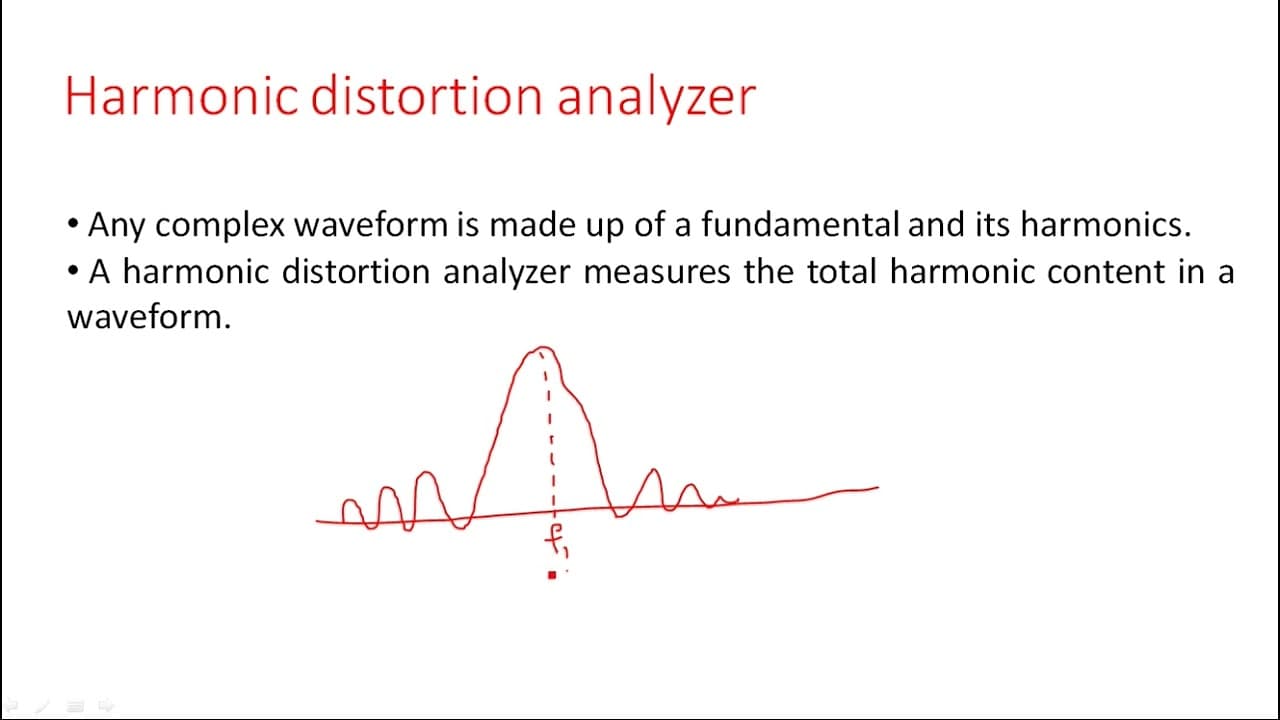
A harmonic distortion analyzer operates by measuring the total harmonic distortion in a signal. It identifies the presence of unwanted harmonic frequencies alongside the fundamental frequency, calculating the distortion using a specific formula to provide insights into the signal's purity and quality.
Q: Why are wave analyzers referred to as frequency selective voltmeters?
Wave analyzers are called frequency selective voltmeters because they select a specific frequency component from a signal and measure its amplitude, effectively functioning like a voltmeter tailored to distinct frequency responses for precise amplitude analysis.
Q: What components are typically found in a basic wave analyzer circuit?
A basic wave analyzer circuit consists of several components, including a primary detector (usually an LC network), a rectifier to convert the AC signal to DC, and an indicating device like a voltmeter that displays the measured amplitude of the selected frequency.
Q: What types of measurements can wave analyzers perform?
Wave analyzers can perform various measurements, including electrical, sound, and vibration measurements. Their capability to isolate and measure specific frequency components makes them essential tools in audio and vibration analysis applications.
Q: What is the significance of measuring harmonic distortion in a signal?
Measuring harmonic distortion in a signal is significant because it helps identify the presence of unwanted components that can affect the signal's clarity and performance. Understanding distortion levels allows for better design and troubleshooting of electronic and audio equipment.
Q: How does the adjustment of the LC circuit in a wave analyzer affect its performance?
Adjusting the LC circuit in a wave analyzer alters its resonance frequency, allowing the device to tune into specific frequency components. This capability enhances the performance of the analyzer by enabling it to effectively filter out unwanted signals and accurately measure the desired amplitude.
Summary & Key Takeaways
-
A wave analyzer is an instrument that measures the amplitude of a selected frequency component in complex waveforms, allowing users to focus on specific signal aspects.
-
The harmonic distortion analyzer quantifies the total harmonic distortion present in a signal, helping to identify unwanted harmonics alongside the fundamental frequency.
-
Wave analyzers operate by filtering and measuring selected frequency components, while harmonic distortion analyzers assess the overall distortion from harmonic frequencies within complex waveforms.
Read in Other Languages (beta)
Share This Summary 📚
Summarize YouTube Videos and Get Video Transcripts with 1-Click
Try YouTube Summary with ChatGPT & Claude or YouTube Transcript Generator