Tri - State TTL | Truth Table TTL Inverter | PDC | Lec-105
TL;DR
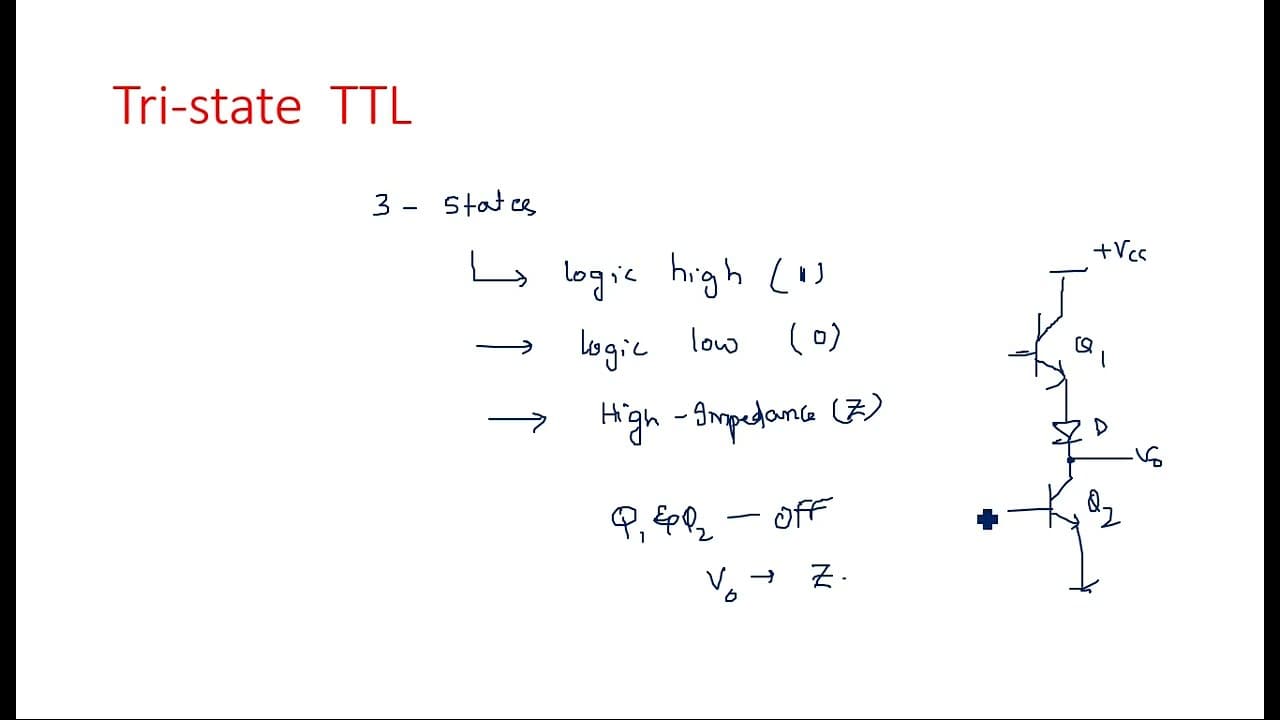
Tri-State Logic operates in high, low, and high-impedance states.
Transcript
hi everyone in this video I'm going to explain about trate dtl trate TL is quite important and uh interesting also to study about this trate ETL so Tri State tri state is nothing but it is having three states tri state is nothing but three states what are the three states one is logic High second one is logic low and the third stage is high impeden... Read More
Key Insights
- 🎮 Tri-State Logic is essential for managing digital signals in electronics, providing versatility in circuit control.
- 👻 The totem pole output configuration allows efficient driving of the output states while minimizing power consumption.
- ✋ The high-impedance state enables multiple devices to share the same circuit without signal interference.
- 💐 The diode connected to the multi-emitter transistor helps regulate current flow and enables effective switching between states.
- 👨💼 Tri-State Logic is often used in bus systems where multiple devices need to communicate without interference.
- 🎨 Understanding the relationship between enable signals and circuit outputs is vital for digital logic design.
- 🧑🏭 TTL circuits can act as controlled NOT gates, adding functionality in integrated circuits.
Install to Summarize YouTube Videos and Get Transcripts
Explore YouTube Video Summarizer or Get YouTube Transcript Extractor
Questions & Answers
Q: What are the three states of Tri-State Logic?
Tri-State Logic operates in three primary states: logic high, where the output is '1'; logic low, where the output is '0'; and high impedance, an inactive state where the output neither drives high nor low, allowing other devices to control the circuit without interference.
Q: How does the totem pole configuration work in TTL?
In a totem pole configuration, two transistors are used in a push-pull arrangement. When one transistor is on, it pulls the output to either logic high or low. If both transistors are off, the output enters a high-impedance state, effectively disconnecting it from the circuit and allowing other components to influence the signal.
Q: What role does the enable pin play in Tri-State TTL?
The enable pin controls the operation of the inverter within the Tri-State TTL circuit. When the enable signal is high, the circuit behaves like an inverter, producing an output based on the input state. Conversely, when the enable signal is low, the output enters a high-impedance state, effectively disconnecting the inverter from the circuit.
Q: Can you explain the interaction between the transistors in a Tri-State TTL circuit?
In a Tri-State TTL circuit, specific transistors are designed to turn on or off based on the enable signal and the input state. For example, when the enable is high, one transistor switches on while the others turn off, allowing the circuit to produce a specific output. If the enable signal is low, all output-related transistors can go into a non-conducting state, creating high impedance.
Summary & Key Takeaways
-
Tri-State Logic (TTL) consists of three states: logic high, logic low, and high impedance, crucial for digital circuit design.
-
The video explores the totem pole configuration in TTL, highlighting how the transistors interact to produce the desired output states.
-
The enable pin plays a significant role, controlling whether the inverter operates normally or enters a high-impedance state based on the input.
Read in Other Languages (beta)
Share This Summary 📚
Summarize YouTube Videos and Get Video Transcripts with 1-Click
Try YouTube Summary with ChatGPT & Claude or YouTube Transcript Generator