Student Video: Hooke's Law in Cubic Solids
TL;DR
This video discusses Hooke's Law and how it can be applied to model the behavior of springs in cubic solids using the Lennard-Jones potential.
Transcript
STUDENT: Today we're going to look at Hooke's Law in Cubic Solids. Hooke's law describes behavior of springs. What we're going to do is we're going to model the solid as a collection of springs connecting a whole bunch of atoms in a cubic lattice. Now, disclaimer-- I'm probably going to do this all wrong. But what's science if we don't make a few m... Read More
Key Insights
- 🫀 The Lennard-Jones potential describes the interaction between atoms and provides information about their equilibrium distances.
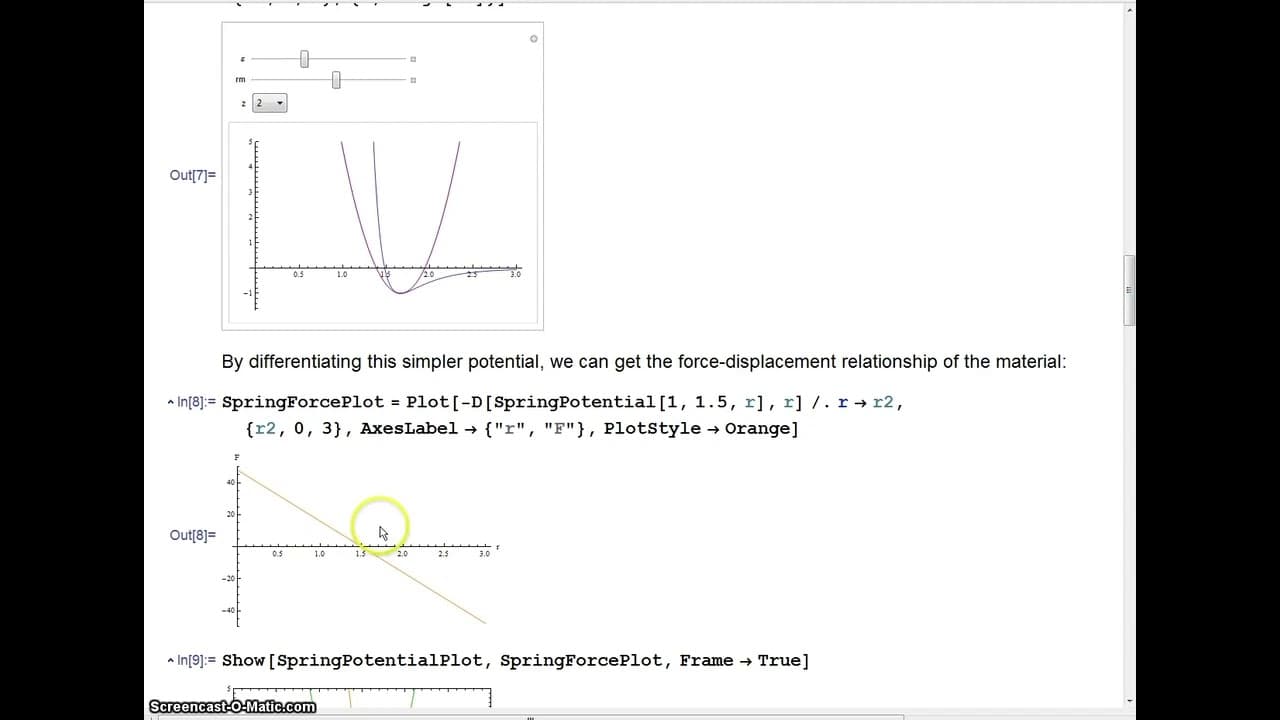
- 👻 The Taylor expansion allows for the approximation of the Lennard-Jones potential as a parabola, which is necessary for applying Hooke's Law.
- 🫀 By modeling atomic bonds as springs in cubic solids, Hooke's Law can be used to determine the relationship between stress and strain.
- 🌸 The spring constant, obtained from the Lennard-Jones potential approximation, is crucial in applying Hooke's Law and calculating the forces in the solid.
Install to Summarize YouTube Videos and Get Transcripts
Explore YouTube Video Summarizer or Get YouTube Transcript Extractor
Questions & Answers
Q: What is Hooke's Law?
Hooke's Law states that the force exerted by a spring is directly proportional to the displacement of the spring from its equilibrium position. This relationship is linear.
Q: How is the Lennard-Jones potential used in modeling atomic interactions?
The Lennard-Jones potential describes the attractive and repulsive forces between two atoms. It has terms that account for how the forces change as the atoms get closer or farther apart, and it helps determine the equilibrium positions of the atoms.
Q: Why is the Taylor expansion used in approximating the Lennard-Jones potential?
The Lennard-Jones potential has a complex shape that is not conducive to modeling spring behavior. By using the Taylor expansion, a parabolic approximation can be obtained, which allows for the application of Hooke's Law and the modeling of spring bonds.
Q: How is Hooke's Law applied to cubic solids?
In cubic solids, the atomic bonds are modeled as springs. The spring constant is determined by simplifying the Lennard-Jones potential using the Taylor expansion and finding the slope of the approximation. Hooke's Law can then be used to calculate the stress and strain in the solid.
Summary & Key Takeaways
-
Hooke's Law is used to model the atomic bonds in cubic solids as springs, with the force being proportional to the spring constant times the displacement.
-
The Lennard-Jones potential, which describes the interaction between atoms, is used to determine the force on the particles and their equilibrium positions.
-
The Taylor expansion is used to approximate the Lennard-Jones potential as a parabola, which allows for the application of Hooke's Law in modeling spring bonds.
Read in Other Languages (beta)
Share This Summary 📚
Summarize YouTube Videos and Get Video Transcripts with 1-Click
Try YouTube Summary with ChatGPT & Claude or YouTube Transcript Generator
Explore More Summaries from MIT OpenCourseWare 📚



Summarize YouTube Videos and Get Video Transcripts with 1-Click
Try YouTube Summary with ChatGPT & Claude or YouTube Transcript Generator