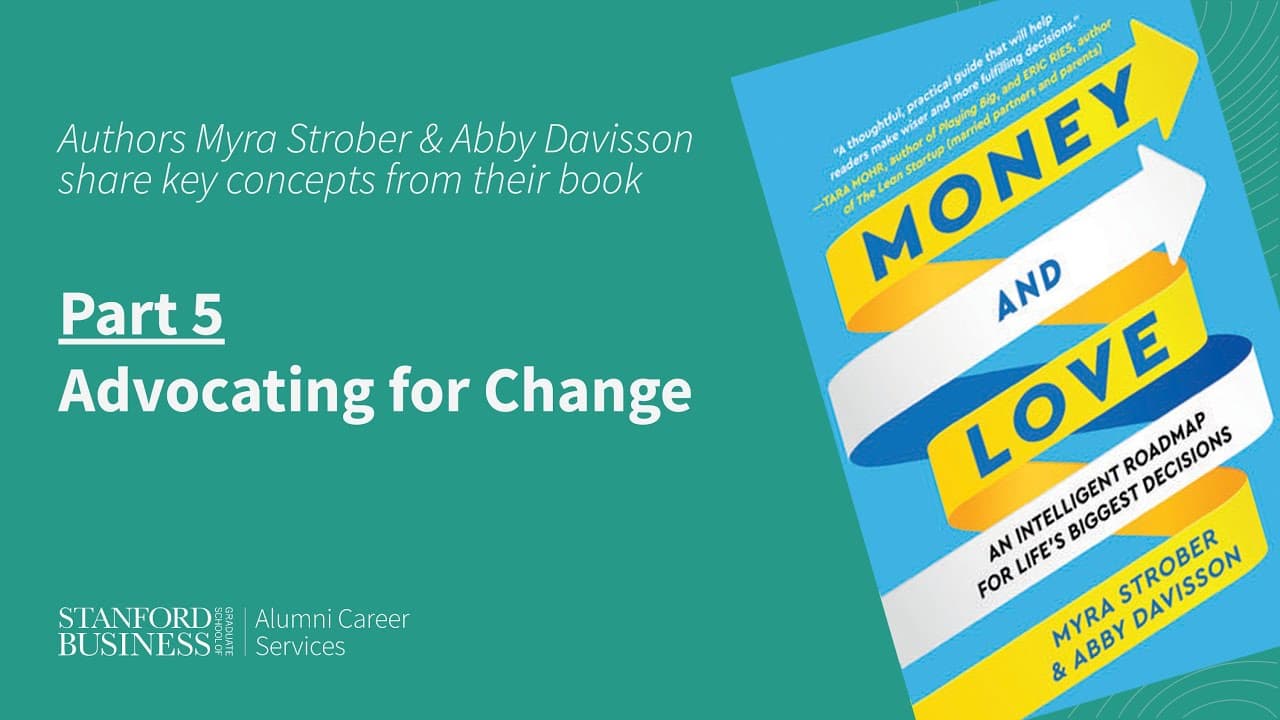
Money and Love — Advocating for Change
TL;DR
The last chapter of the book discusses the importance of becoming change agents to address the challenges of pursuing both money and love in a society that undervalues caregiving and family time.
Transcript
[MUSIC] Abby, the last chapter in our book talks about becoming a change agent. Why did we put that in our book on Money and Love? >> Well, it really came out of realizing that the choices that we have are not great ones when it comes to pursuing money and love. Our society, particularly in the United States, is not set up well to support people wh... Read More
Key Insights
- 🥰 Pursuing both money and love is challenging due to societal systems that do not value caregiving or family time.
- 💱 Change agents are necessary for creating systemic change and offering better choices to individuals.
- 💦 Change agents can make a significant impact by working within organizations or institutions to address societal issues.
- 👥 Assembling a larger group of allies amplifies the effectiveness of change agent efforts.
- 💱 Initiatives started by change agents can endure beyond their own involvement, creating long-lasting change.
- 🛄 The authors consider themselves "tempered radicals," aiming to make change from within the system.
- 🥰 Individual solutions to money and love challenges are not sufficient; broader systemic change is required.
Install to Summarize YouTube Videos and Get Transcripts
Explore YouTube Video Summarizer or Get YouTube Transcript Extractor
Questions & Answers
Q: Why did the authors include a chapter on becoming change agents in their book?
The authors recognized that pursuing both money and love comes with limited choices in our society, and they believed that to create real change, individuals needed to work beyond their families for broader systemic change.
Q: How did the authors become change agents themselves?
One author started the Stanford Center for Research on Women as a new assistant professor, successfully making a business case to the administration. The other author helped start the first employee resource group for parents at Gap Inc., working alongside a working dad on the legal team.
Q: How did the authors' efforts as change agents create lasting change?
Their initiatives, the Stanford Center for Research on Women and the employee resource group for parents, continue to exist and address the challenges they set out to solve. They believe that everyone has the power to be a change agent and contribute to advancing society.
Q: How can being a change agent in pursuing money and love benefit society as a whole?
Change agents play a crucial role in pushing institutions to adapt to a rapidly changing society. By empowering individuals to solve their own money and love challenges while also contributing to broader societal advancement, better choices can be created for everyone.
Summary & Key Takeaways
-
Pursuing both money and love in our society is challenging due to a lack of support for caregiving and family time.
-
Becoming change agents is necessary for systems to change and provide better choices for everyone.
-
The authors share their experiences as change agents within their organizations, highlighting the power of assembling a larger group to create enduring change.
Read in Other Languages (beta)
Share This Summary 📚
Summarize YouTube Videos and Get Video Transcripts with 1-Click
Try YouTube Summary with ChatGPT & Claude or YouTube Transcript Generator
Explore More Summaries from Stanford Graduate School of Business 📚




Summarize YouTube Videos and Get Video Transcripts with 1-Click
Try YouTube Summary with ChatGPT & Claude or YouTube Transcript Generator