Building an Open Assistant API
TL;DR
Exploring a local, customizable 12 billion parameter model with real-time training and reinforcement learning for diverse applications.
Transcript
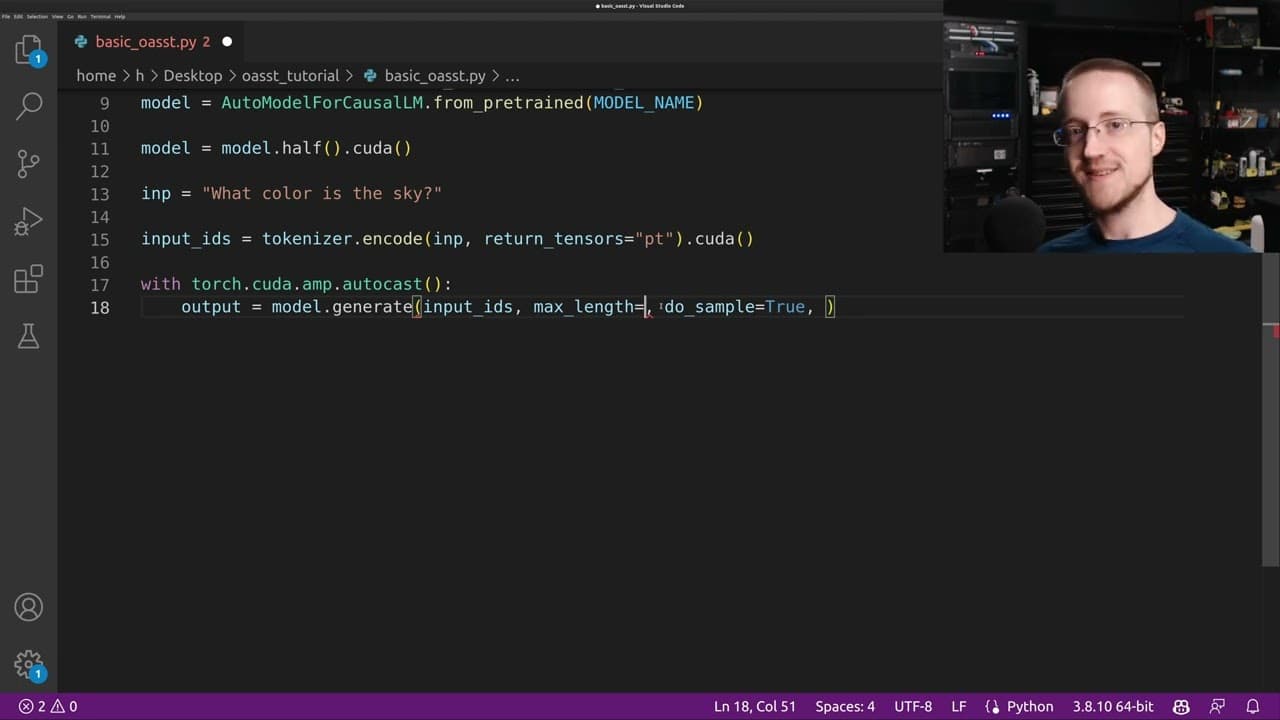
what is going on everybody and welcome to a bit of an R D video with open assistance pythia 12 b or 12 billion parameter model this is a model that you can run completely locally you can download the weights and use it however you please it's been trained with open assistance through our lhf or reinforcement learning through human feedback and in m... Read More
Key Insights
- 🈸 The Pythia 12 billion parameter model offers local deployment flexibility and customizability for diverse AI applications.
- 🤗 Real-time training via open assistance and reinforcement learning enhances model accuracy and responsiveness.
- ❓ Memory constraints and GPU availability impact the performance and usage of the model, requiring careful configuration for optimal functionality.
- 👊 Building an AI API with Flask facilitates seamless interaction with the Pythia model for developing responsive chat systems.
- 👊 Effective context length management is crucial to prevent exceeding token input limits and optimize AI chat experiences.
- 👨🔬 Encouragement to explore OpenAssistant's initiatives in AI research and leveraging advanced models for innovative applications.
- 🤗 Transparency in open-source model development, training data, and real-time feedback mechanisms enable collaborative AI advancements.
Install to Summarize YouTube Videos and Get Transcripts
Explore YouTube Video Summarizer or Get YouTube Transcript Extractor
Questions & Answers
Q: How does the Pythia 12 billion parameter model leverage open assistance and reinforcement learning for training?
The model is trained using open assistance technology, enabling human feedback-driven reinforcement learning to enhance its responses.
Q: What are the memory requirements and challenges associated with running the model locally?
The model requires 24GB of memory in half Precision mode or 48GB in full Precision, posing challenges for systems with limited resources due to memory limitations and GPU constraints.
Q: What steps are involved in setting up an AI API using Flask for interaction with the Pythia model?
The setup includes importing necessary libraries, defining app routes, setting GPU visibility, tokenizing input text, and handling response generation for a seamless AI chat system.
Q: How can context length management be optimized to prevent exceeding the model's token input limit?
By setting limits on the context length and allowing a buffer for responses, the model trims the context size to prevent exceeding the maximum token input capacity for efficient chat interactions.
Summary & Key Takeaways
-
Utilizing an extensive 12 billion parameter Pythia model for customizable AI applications through local deployment.
-
Model training involves open assistance technology and reinforcement learning through human feedback.
-
Code examples included for setup, input preparation, interaction with the model, and building a responsive chat system.
Read in Other Languages (beta)
Share This Summary 📚
Summarize YouTube Videos and Get Video Transcripts with 1-Click
Try YouTube Summary with ChatGPT & Claude or YouTube Transcript Generator
Explore More Summaries from sentdex 📚
Summarize YouTube Videos and Get Video Transcripts with 1-Click
Try YouTube Summary with ChatGPT & Claude or YouTube Transcript Generator