Bar graph | Survey for Women working or not | DI | Reasoning | Part - 11 | Bharath Kumar
TL;DR
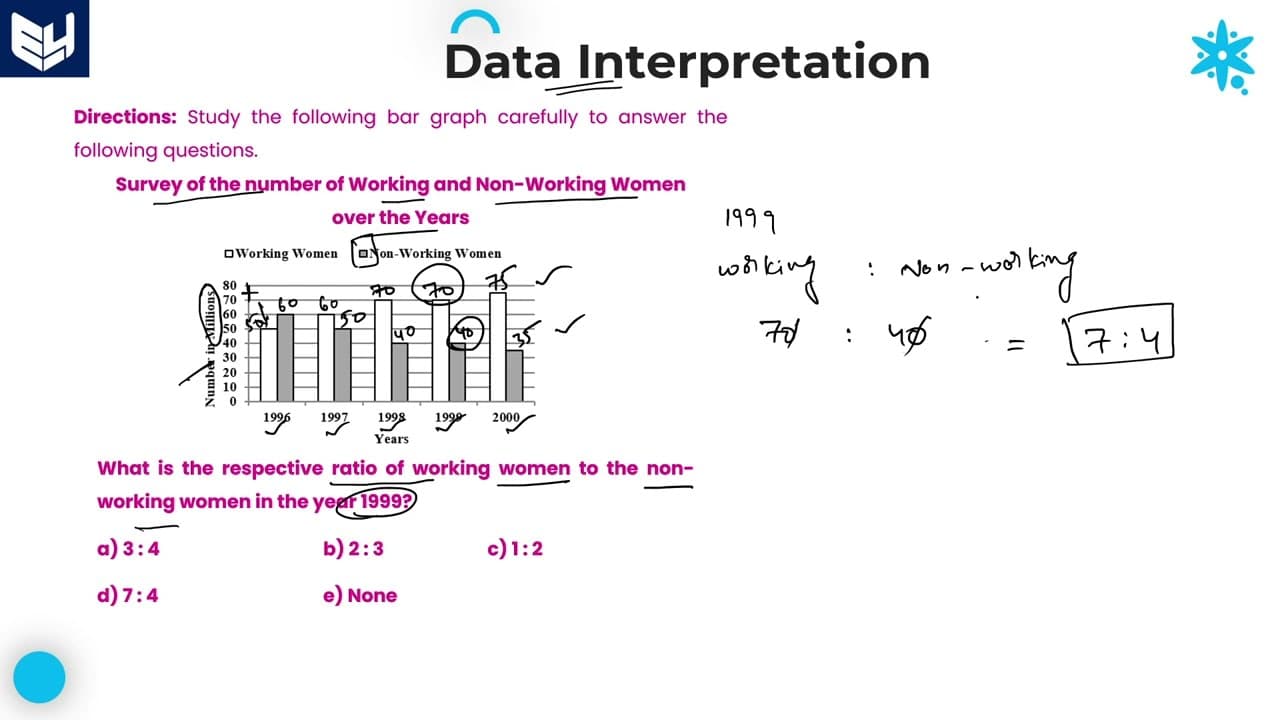
The content discusses survey data on working and non-working women from 1996 to 2000.
Transcript
hi everyone welcome to the session in this session I am continuing bar graph data and repetition here first of all we need to read the information carefully and then we need to solve the questions according to the given information here the information is about a survey of number of working and non-working women over the years here the information ... Read More
Key Insights
- 👩⚕️ The data reflects significant growth in the number of working women from 1996 to 2000, signaling changing societal norms concerning employment.
- 😫 The survey highlights the importance of visual representation in understanding complex data sets and making informed calculations.
- 👩⚕️ Observations suggest that the year 2000 marked a pivotal moment in workforce dynamics, exemplified by the highest difference between working and non-working women.
- 😒 When analyzing demographic shifts, the use of ratios can provide instant clarity on changes in workforce participation.
- 🚱 Calculation of percentages from survey data requires careful attention to totals and appropriateness of context, offering deeper insight into non-working demographics.
- 👩⚕️ In year 1999, the evaluated ratio indicates a balanced view of the working women's proportion compared to non-working women during that period.
- 🧑🏫 The method of breaking down percentages and differences in values underscores the pedagogical approach to teaching data analysis.
Install to Summarize YouTube Videos and Get Transcripts
Explore YouTube Video Summarizer or Get YouTube Transcript Extractor
Questions & Answers
Q: What trend is observed in the number of working women from 1996 to 2000?
The trend shows an increase in working women from 50 million in 1996 to 75 million in 2000. This suggests a gradual rise in female workforce participation over four years, indicating potential social changes in gender roles or economic factors encouraging more women to enter the labor market.
Q: How is the ratio of working to non-working women calculated for 1999?
For 1999, the number of working women was 70 million, and non-working women were 40 million. By adjusting for the scale displayed in the graph, the ratio is found as 7:4 after simplifying the values, effectively demonstrating workforce participation shifts for that year.
Q: What year had the highest difference between working and non-working women?
The highest difference occurred in the year 2000, where working women numbered 75 million and non-working women at 35 million yielded a gap of 40 million. This significant difference illustrates the growing trend of female employment in the final year of the survey.
Q: How is the approximate percentage of non-working women in 2000 determined?
In 2000, non-working women were approximately 35 million. The percentage of non-working women relative to the total (working + non-working of 110 million) is calculated as (35/110) * 100, resulting in around 32%. This calculation highlights the relative size of the non-working demographic in the context of the overall working population.
Q: What is the ratio of working women in 1996 compared to 2000?
The ratio of working women in 1996 (50 million) to those in 2000 (75 million) simplifies to 2:3 after dividing both values by 25. This ratio indicates a proportional analysis of workforce changes between these two critical years.
Q: If 30% of non-working women in 1996 began working, what would the new total of working women be?
In 1996, there were 60 million non-working women. Calculating 30% gives 18 million who started working. Adding this to the existing 50 million working women results in a total of 68 million working women for that year.
Q: Why is careful observation of the graph important in this analysis?
Careful observation of the graph allows for quick insights into trends, differences, and ratios without lengthy calculations. It is vital for efficient problem-solving during examinations, making it a skillful approach to understanding workforce data.
Summary & Key Takeaways
-
The content focuses on a survey analyzing the number of working versus non-working women between the years 1996 and 2000, detailing trends and observations made from the provided bar graph.
-
Key questions are posed regarding the ratio and differences in employment status over the timeframe, emphasizing the importance of careful observation in solving the problems presented by the graph.
-
Practical calculations are provided to derive percentages and ratios, alongside the methodologies applied to analyze changes in the workforce, particularly shifts in non-working women becoming employed.
Read in Other Languages (beta)
Share This Summary 📚
Summarize YouTube Videos and Get Video Transcripts with 1-Click
Try YouTube Summary with ChatGPT & Claude or YouTube Transcript Generator