What Did Kant Get Wrong About Reality?
TL;DR
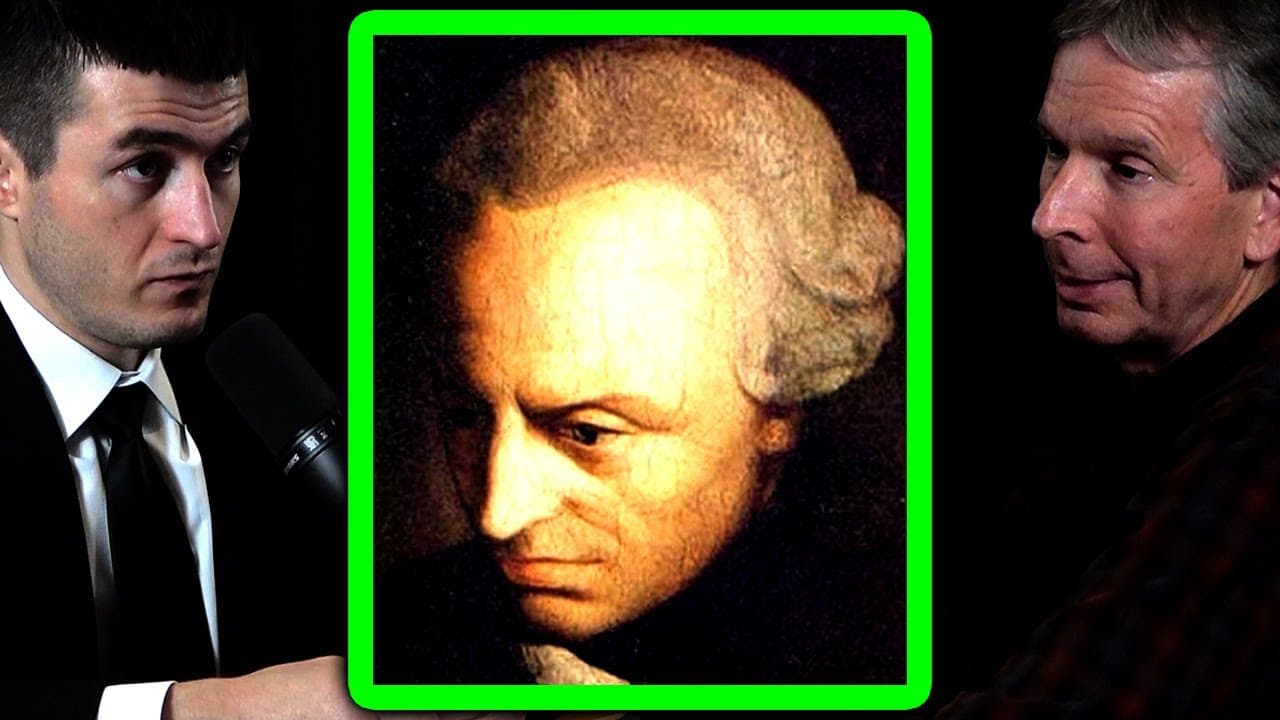
Kant's philosophy aligns with the speaker's conscious realism in recognizing that we impose structure on nature rather than perceiving it objectively. However, the speaker disagrees with Kant's belief in the a priori status of Euclidean space-time, advocating a more nuanced understanding of consciousness and its relation to reality.
Transcript
it's just interesting looking at the philosophical tradition of this difficult ideas you struggle with if you look like somebody like emmanuel kant what are some interesting agreements and disagreements you have uh with a guy about the nature of reality so there's a lot in agreement right so kant was an idealist transcendental ideas and he he basic... Read More
Key Insights
- 🍵 Kant's idealism and the speaker's conscious realism agree on the subjective nature of perception and the imposition of structure on nature.
- 👾 The speaker diverges from Kant by rejecting the a priori nature of Euclidean space-time.
- 👾 Berkeley's philosophy shares similarities with the speaker's conscious realism in terms of the unsolvability of the hard problem of consciousness and the existence of entities beyond space and time.
- 🙈 Leibniz's monadology also recognizes the limitations of solving the hard problem, and the speaker sees potential overlaps and intellectual synergy between Leibniz and their own ideas.
- 🇦🇬 The speaker aims to distance conscious realism from the anti-science and anti-realism associations of idealism.
- 🤯 Conscious realism and the various philosophical traditions discussed involve complex ideas about the nature of reality and mind perception.
- 🔇 The speaker's conscious realism proposes a theory of conscious agents as a basis for understanding reality.
- 🎙️ More videos with Donald Hoffman:
Install to Summarize YouTube Videos and Get Transcripts
Explore YouTube Video Summarizer or Get YouTube Transcript Extractor
Questions & Answers
Q: What are some key agreements between the speaker's conscious realism and Kant's idealism?
Both perspectives recognize that we impose structure on nature and do not perceive it as it is. They share a belief in the subjective nature of perception and the limitations of our understanding of reality.
Q: In what way does the speaker's conscious realism differ from Kant's idealism?
The speaker disagrees with Kant's view that Euclidean space-time is a priori. They argue that space and time are not fundamental but rather forms of perception that emerge from conscious agents.
Q: How does the speaker's conscious realism align with Berkeley's philosophy?
Both the speaker and Berkeley reject the solvability of the hard problem of consciousness. They also share the concept of entities that exist outside space and time, with Berkeley's monads and the speaker's conscious agents.
Q: What does the speaker suggest about Leibniz's perspective on consciousness?
The speaker believes that Leibniz, in his monadology, understood the unsolvability of the hard problem of consciousness. While the speaker's approach differs, they perceive an overlap in the spirit of their ideas.
Summary & Key Takeaways
-
The speaker's conscious realism aligns with Kant's idealism in the belief that we impose structure on nature and do not perceive it as it is.
-
However, the speaker disagrees with Kant on the a priori nature of Euclidean space-time.
-
The speaker notes similarities between their conscious realism and Berkeley's perspective, particularly in their rejection of solving the hard problem and the existence of entities outside space and time.
Read in Other Languages (beta)
Share This Summary 📚
Summarize YouTube Videos and Get Video Transcripts with 1-Click
Try YouTube Summary with ChatGPT & Claude or YouTube Transcript Generator
Explore More Summaries from Lex Clips 📚

Summarize YouTube Videos and Get Video Transcripts with 1-Click
Try YouTube Summary with ChatGPT & Claude or YouTube Transcript Generator