Linearity and nonlinear theories. Schrödinger's equation
TL;DR
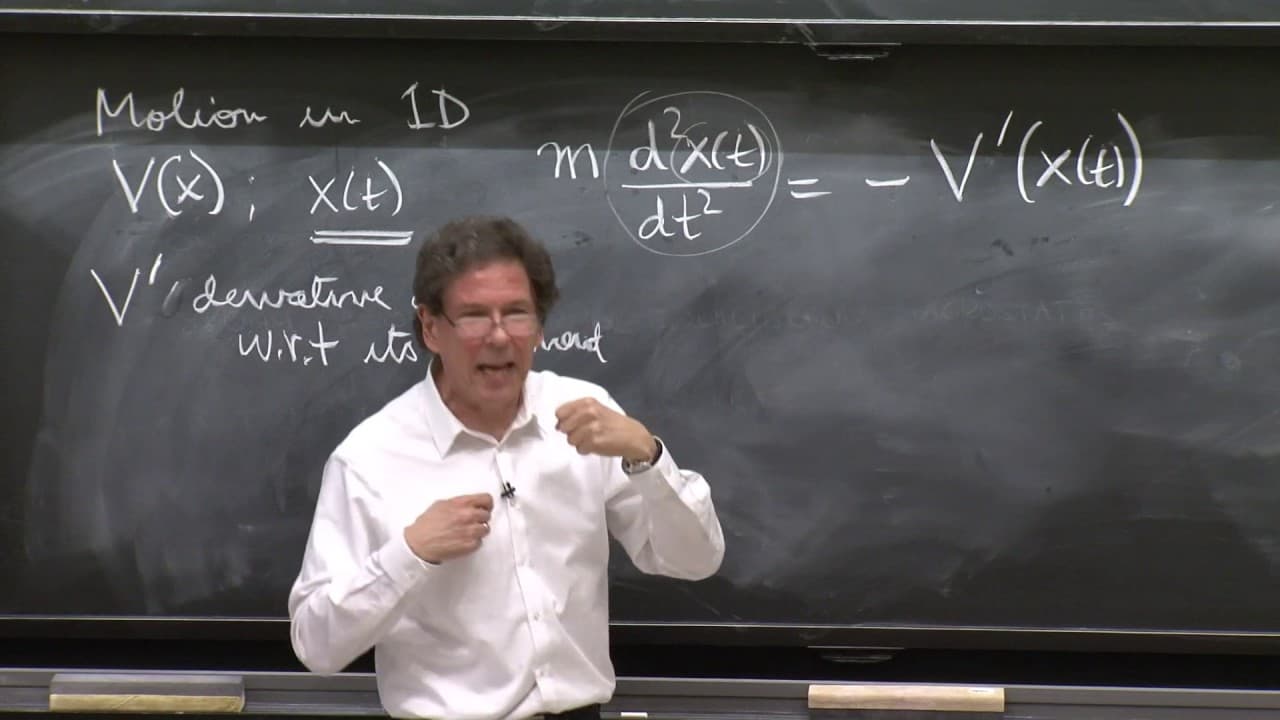
Linear theories are simpler than non-linear theories, and classical mechanics is non-linear, while quantum mechanics is linear.
Transcript
PROFESSOR: So here is of something funny. You might say, OK, what is simpler? A theory that is linear or a theory that is not linear? And the answer, of course, a linear theory is much simpler. General-- Maxwell's equations are linear. Einstein's theory of relativity is very nonlinear, very complicated. How about classical mechanics? Is classical m... Read More
Key Insights
- 👻 Linear theories, such as quantum mechanics, are simpler and allow for scaling, superpositions, and the discovery of new solutions.
- 🦾 Classical mechanics, despite being considered simpler, is actually non-linear and cannot solve the three-body problem.
- 🦾 Quantum mechanics, introduced by Schrodinger's equation, is linear and relies on complex numbers to represent probabilities.
- 💦 The wave function in quantum mechanics can depend on time and other variables, with its interpretation as probabilities coming later through Max Born's work.
- 👋 Complex numbers are essential in quantum mechanics to represent the complex-valued wave function and capture interference phenomena.
- ❓ Linearity in physics has significant implications for the simplicity and elegance of mathematical formulations.
- 🦾 The necessity of complex numbers in quantum mechanics reflects the inherent complexity and probabilistic nature of quantum phenomena.
Install to Summarize YouTube Videos and Get Transcripts
Explore YouTube Video Summarizer or Get YouTube Transcript Extractor
Questions & Answers
Q: What is the difference between linear and non-linear theories in physics?
Linear theories in physics are simpler because they can be superposed and scaled, while non-linear theories, like Maxwell's equations and Einstein's theory of relativity, are more complicated and do not have these properties.
Q: Why is classical mechanics considered non-linear?
Classical mechanics is non-linear because Newton's equations cannot solve the three-body problem, where three bodies interact simultaneously. This inability to superpose solutions makes classical mechanics complicated.
Q: What is the equation that describes dynamics in quantum mechanics?
Schrodinger's equation, formulated in 1925, describes the dynamics of quantum systems. It is a linear equation, with the wave function as the dynamical variable, dependent on time and possibly other variables.
Q: Why are complex numbers necessary in quantum mechanics?
Complex numbers are necessary in quantum mechanics because the wave function, described by Schrodinger's equation, can be complex-valued. The complex nature of the wave function allows for the representation of probabilities and interference effects.
Summary & Key Takeaways
-
Linear theories are simpler than non-linear theories, such as Maxwell's equations and Einstein's theory of relativity being non-linear.
-
Classical mechanics is also non-linear, as Newton's equations cannot solve the three-body problem due to the inability to superpose solutions.
-
Quantum mechanics, on the other hand, is linear and described by Schrodinger's equation, which allows for scaling, superpositions, and the discovery of new solutions.
Read in Other Languages (beta)
Share This Summary 📚
Summarize YouTube Videos and Get Video Transcripts with 1-Click
Try YouTube Summary with ChatGPT & Claude or YouTube Transcript Generator
Explore More Summaries from MIT OpenCourseWare 📚



Summarize YouTube Videos and Get Video Transcripts with 1-Click
Try YouTube Summary with ChatGPT & Claude or YouTube Transcript Generator