What Is an Operational Amplifier and How Does It Work?
TL;DR
An operational amplifier (op-amp) amplifies input signals and performs mathematical operations like addition and subtraction. Key characteristics include infinite input impedance and zero output impedance, making it versatile for applications such as active filters and oscillators. However, practical op-amps have limitations like output saturation and finite gain.
Transcript
Hey friends, welcome to the Youtube Channel ALL ABOUT ELECTRONICS. So, in this video, we are going to talk about the basics of the operational amplifier. And in the upcoming videos, we will talk more about this operational amplifier. And we will see, how we can design the different circuits using this operational amplifier. So, as its name suggests... Read More
Key Insights
- 🎭 Operational amplifiers are amplifiers used to amplify input signals and perform mathematical operations in electronic circuits.
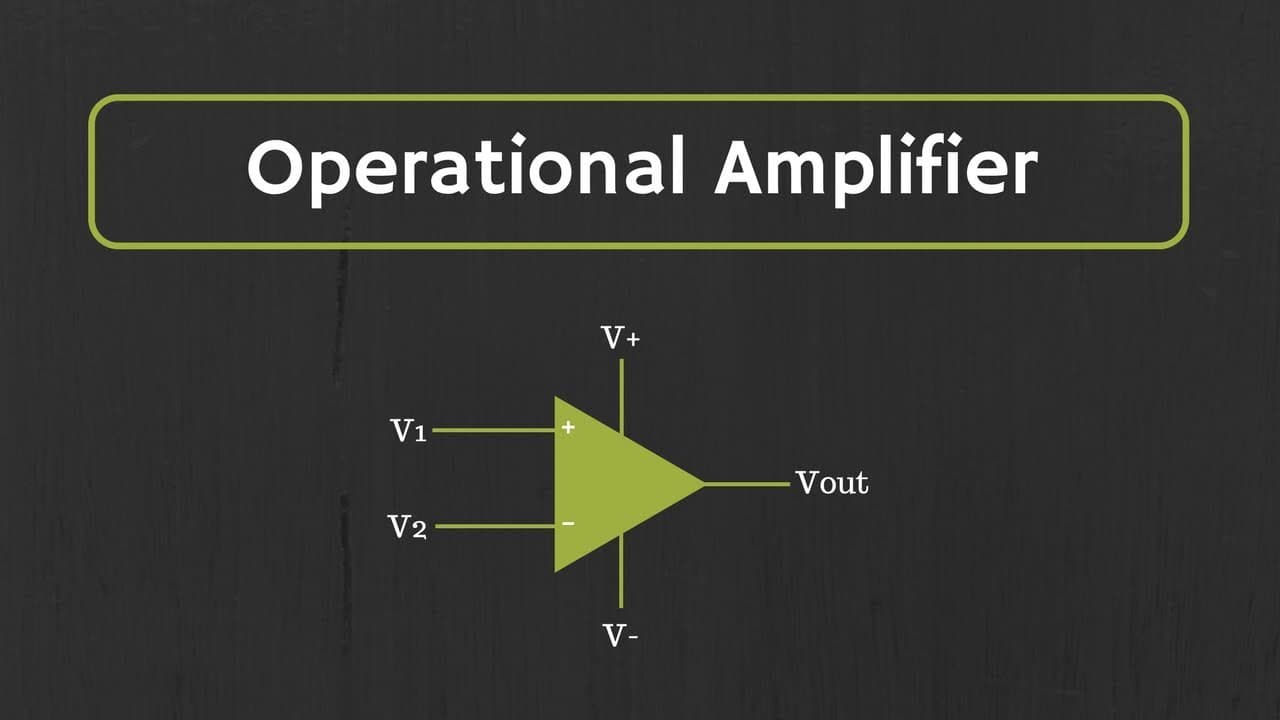
- 🚱 They have different input and output terminals, including non-inverting and inverting terminals.
- 🤗 Op-amps have an open loop gain that determines the amplification factor for input signals.
- ⚡ They have limitations such as output saturation and the need for biasing voltages to regulate the output voltage range.
- 🈸 Op-amps are versatile ICs used in various applications, including active filters, oscillators, and analog to digital converters.
- 🍾 The characteristics of an ideal op-amp include infinite input impedance, zero output impedance, and infinite bandwidth, gain, and common mode rejection ratio.
Install to Summarize YouTube Videos and Get Transcripts
Explore YouTube Video Summarizer or Get YouTube Transcript Extractor
Questions & Answers
Q: What is the purpose of an operational amplifier?
The purpose of an operational amplifier is to amplify input signals, perform mathematical operations, and serve as a building block for various electronic circuits.
Q: Why are the input terminals of an op-amp referred to as non-inverting and inverting?
The non-inverting input terminal is marked with a positive sign and does not alter the phase of the input signal, while the inverting input terminal, marked with a negative sign, provides an inverted output signal.
Q: What is the concept of open loop gain?
Open loop gain refers to the gain of an operational amplifier when there is no feedback from the output to the input terminal. It determines the amplification factor for input signals.
Q: What are the limitations of op-amps?
Op-amps have limitations such as output saturation, where the output voltage reaches a maximum value, and the need for biasing voltages to restrict the output voltage within a certain range.
Key Insights:
- Operational amplifiers are amplifiers used to amplify input signals and perform mathematical operations in electronic circuits.
- They have different input and output terminals, including non-inverting and inverting terminals.
- Op-amps have an open loop gain that determines the amplification factor for input signals.
- They have limitations such as output saturation and the need for biasing voltages to regulate the output voltage range.
- Op-amps are versatile ICs used in various applications, including active filters, oscillators, and analog to digital converters.
- The characteristics of an ideal op-amp include infinite input impedance, zero output impedance, and infinite bandwidth, gain, and common mode rejection ratio.
- Practical op-amps have finite input and output impedance, finite open loop gain, and non-zero offset voltage. The choice of op-amp depends on the specific application requirements.
Summary & Key Takeaways
-
The video introduces the concept of operational amplifiers as amplifiers used to amplify input signals and perform mathematical operations.
-
It explains the different input and output terminals of an op-amp and their respective functions, as well as the concept of open loop gain.
-
The video also discusses the limitations of op-amps, such as output saturation and the need for biasing voltages.
Read in Other Languages (beta)
Share This Summary 📚
Summarize YouTube Videos and Get Video Transcripts with 1-Click
Try YouTube Summary with ChatGPT & Claude or YouTube Transcript Generator
Explore More Summaries from ALL ABOUT ELECTRONICS 📚
Summarize YouTube Videos and Get Video Transcripts with 1-Click
Try YouTube Summary with ChatGPT & Claude or YouTube Transcript Generator