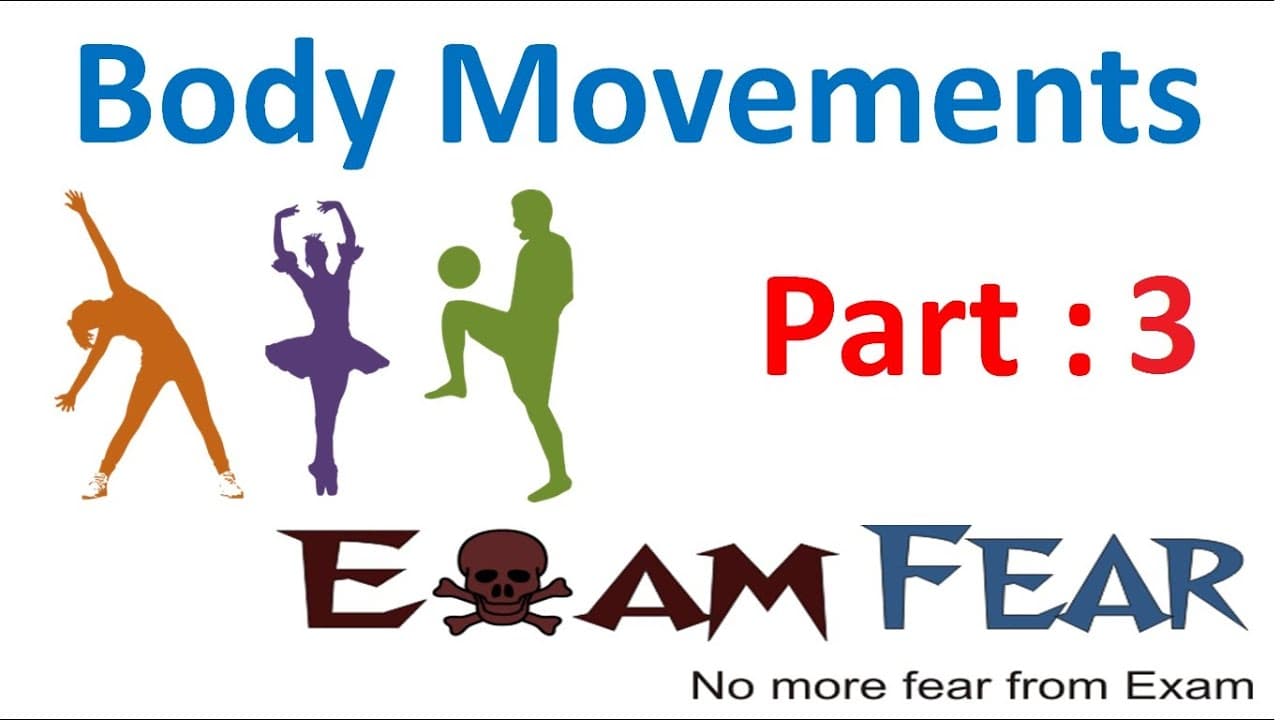
Biology Body Movements Part 3 (Movements in Humans) Class 6 VI
TL;DR
This video explains how different parts of the body move in various activities such as cricket, badminton, dancing, and more.
Transcript
hello friends this video on body movements part 3 is brought to you by example calm no more fear from exam movements let us now look in detail at movements in human beings how exactly different parts of our body moves think of the scenario have you ever seen to get match so how do a bowler bulls so when he moves you would have seen the movement of ... Read More
Key Insights
- ❣️ Different activities like cricket, badminton, dancing, and lifting heavy objects require different movements from our body.
- 🥳 Certain body parts, such as the shoulder and wrist, have the flexibility to rotate or move completely, while others like the neck and knee have limited flexibility.
- 🤕 Fingers have the ability to bend, while the back can bend and the head can lift up and down.
- 🤗 Gymnastics involves movements in various body parts including the neck, waist, hands, and legs.
- ❓ Our body has specific areas where movement is possible, and others where it is not.
- 🥳 Flexibility differs among body parts, allowing for different types of movements.
- 🥳 Some body parts do not move at all, while others have limited or full flexibility.
Install to Summarize YouTube Videos and Get Transcripts
Explore YouTube Video Summarizer or Get YouTube Transcript Extractor
Questions & Answers
Q: How do body movements in cricket differ from body movements in badminton?
In cricket, the arm rotates completely at the shoulder when bowling, while in badminton, only a specific part of the arm rotates. This difference in movement is due to the requirements of each sport.
Q: Why can we flexibly move our fingers but not our knees?
Fingers have more flexibility as they can be bent in various postures, while knees have limited movement, only being able to bend in specific directions to facilitate activities like kicking a football.
Q: Can we rotate our neck completely?
No, the neck can only rotate partially. It can move right and left but cannot rotate fully, which is why we say it has partial rotation.
Q: How does the flexibility of body movements vary in gymnastics?
In gymnastics, not only limbs like hands and legs have flexibility but also other body parts like the neck and waist. This allows gymnasts to perform various moves requiring different types of movement.
Summary & Key Takeaways
-
The video discusses the different ways our body moves in activities such as cricket, badminton, dancing, and lifting heavy objects.
-
It highlights that certain body parts have full flexibility to rotate or move, while others have limited flexibility.
-
Specific examples are given for body parts like the shoulder, fingers, neck, knee, head, back, and wrist.
Read in Other Languages (beta)
Share This Summary 📚
Summarize YouTube Videos and Get Video Transcripts with 1-Click
Try YouTube Summary with ChatGPT & Claude or YouTube Transcript Generator
Explore More Summaries from LearnoHub - Class 11, 12 📚


Summarize YouTube Videos and Get Video Transcripts with 1-Click
Try YouTube Summary with ChatGPT & Claude or YouTube Transcript Generator