CRITICAL THINKING - Fundamentals: Validity [HD]
TL;DR
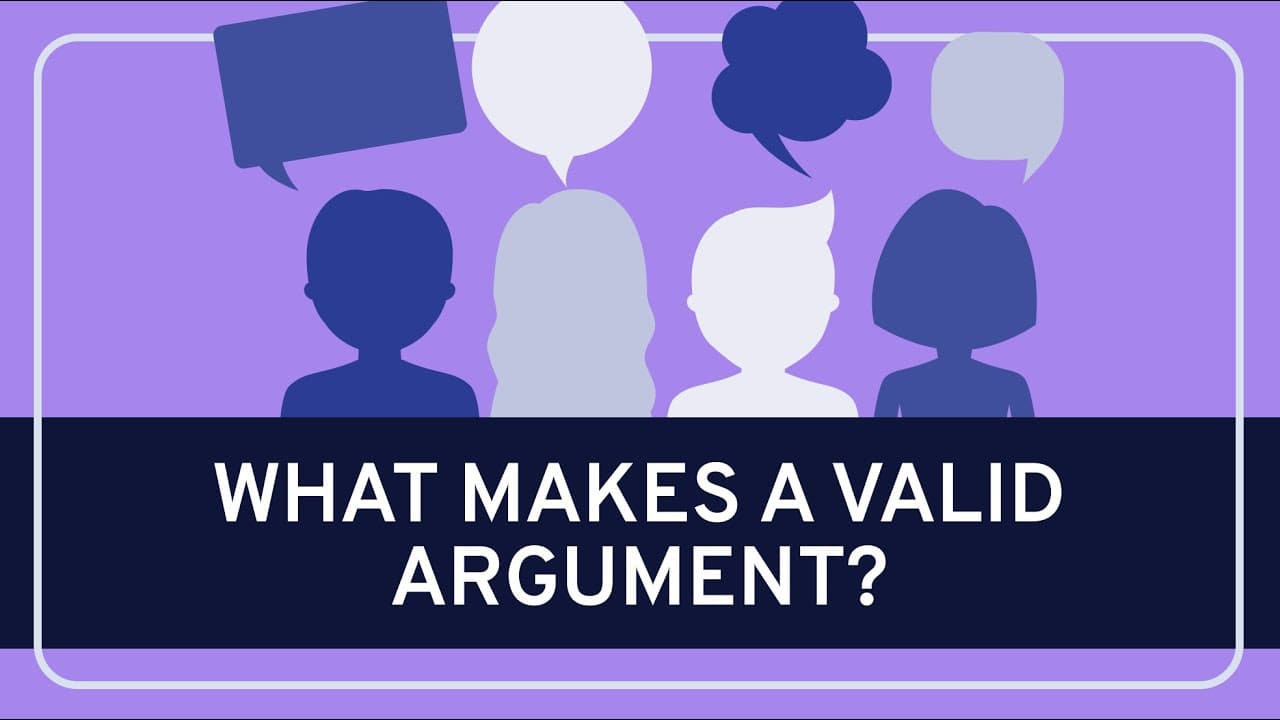
Validity ensures argument premises guarantee the conclusion.
Transcript
(intro music) Hello, I'm Paul Henne and I'm a philosophy graduate student at Duke University. And in this video I'm going to discuss validity, an important tool for evaluating deductive arguments. You've probably heard someone say "that's a valid point," or maybe in an argument you've heard a friend say something like "that's valid, but..." In thes... Read More
Key Insights
- Validity in arguments means that if the premises are true, the conclusion must also be true, regardless of the actual truth of the premises.
- An argument's validity does not imply the truthfulness of its premises or conclusion; it only indicates a logical structure.
- Even arguments with false premises can be valid if the premises logically lead to the conclusion.
- The concept of validity is crucial in deductive reasoning, ensuring arguments follow logical inference rules.
- An invalid argument occurs when the truth of the premises does not logically guarantee the truth of the conclusion.
- The distinction between validity and truth is important; validity focuses on logical form, not the content of statements.
- Examples of valid arguments include hypothetical scenarios where premises are assumed true for logical examination.
- Understanding validity aids in evaluating the soundness of arguments and the quality of inferences made.
Install to Summarize YouTube Videos and Get Transcripts
Explore YouTube Video Summarizer or Get YouTube Transcript Extractor
Questions & Answers
Q: What is the philosophical definition of validity?
In philosophy, validity refers to a property of deductive arguments where the truth of the premises guarantees the truth of the conclusion. It means that if the premises are true, the conclusion must necessarily be true, focusing on the logical structure rather than the actual truth of the premises or conclusion.
Q: Can an argument with false premises be valid?
Yes, an argument with false premises can still be valid. Validity is about the logical connection between premises and conclusion. If the premises were true, the conclusion would necessarily follow. The actual truth of the premises doesn't affect the argument's validity.
Q: How does validity differ from truth in arguments?
Validity differs from truth in that it concerns the logical structure of an argument, not the actual truth of its statements. An argument is valid if the truth of its premises logically ensures the truth of its conclusion, regardless of whether the premises or conclusion are true in reality.
Q: What makes an argument invalid?
An argument is invalid if the truth of its premises does not logically guarantee the truth of its conclusion. This means that it's possible for the premises to be true while the conclusion is false, indicating a flaw in the logical structure of the argument.
Q: Why is understanding validity important?
Understanding validity is important because it helps evaluate whether arguments adhere to logical inference rules. It ensures that conclusions follow logically from premises, which is essential for sound reasoning and effective argumentation, especially in deductive logic.
Q: What role does validity play in deductive logic?
In deductive logic, validity ensures that arguments follow correct inference rules. It checks whether the logical structure of an argument guarantees the conclusion if the premises are true, thus maintaining the integrity of logical reasoning and supporting sound conclusions.
Q: How can we determine if an argument is valid or invalid?
To determine if an argument is valid, check if the truth of the premises logically guarantees the truth of the conclusion. If it's impossible for the premises to be true and the conclusion false, the argument is valid. Otherwise, it's invalid, indicating a logical flaw.
Q: What is an example of a valid argument with false premises?
An example of a valid argument with false premises is: (P1) All humans are immortal. (P2) Iris Murdoch is a human. Conclusion: Therefore, Iris Murdoch is immortal. Despite the false premises, the argument is valid because if the premises were true, the conclusion would necessarily follow.
Summary & Key Takeaways
-
Paul Henne explains the philosophical notion of validity, emphasizing its role in evaluating deductive arguments. Validity ensures that if the premises are true, the conclusion must be true. He uses examples to illustrate valid and invalid arguments, highlighting that validity concerns logical structure, not truth.
-
The video distinguishes between everyday uses of 'valid' and its technical meaning in philosophy. Validity is not about the truth of statements but about the logical connection between premises and conclusion. The focus is on whether premises logically entail the conclusion.
-
Henne provides examples with varied premises to show how validity works. He concludes by stressing the importance of validity in ensuring arguments follow deductive logic rules. The video invites viewers to assess an argument's validity, reinforcing the concept's practical application.
Read in Other Languages (beta)
Share This Summary 📚
Summarize YouTube Videos and Get Video Transcripts with 1-Click
Try YouTube Summary with ChatGPT & Claude or YouTube Transcript Generator
Explore More Summaries from Wireless Philosophy 📚
Summarize YouTube Videos and Get Video Transcripts with 1-Click
Try YouTube Summary with ChatGPT & Claude or YouTube Transcript Generator