What Are the Most Common Business Analyst Interview Questions?
TL;DR
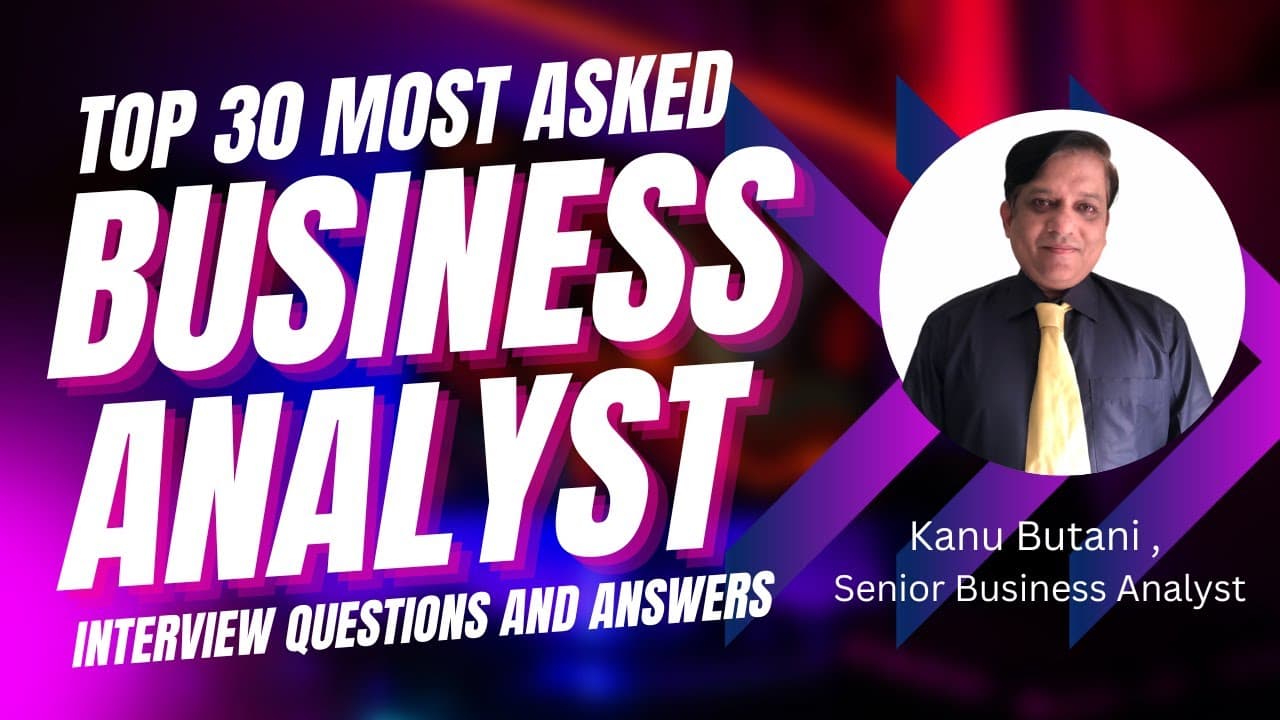
The video covers the top business analyst interview questions, focusing on the role's responsibilities, handling changing requirements, and essential tools. Key points include the importance of SMART criteria for good requirements, various documents used in the field, and the business analysis process flow. It also emphasizes risk management and the principles behind product development.
Transcript
okay Hello friends and welcome in career stock where we invite industry people to share their knowledge with us and today we have kanu bhutani with us he's a known face on our Channel he has done a lot of interviews with respect to business analysts in the past so welcome kanu and thanks for giving your time today thank you very much sun and it's n... Read More
Key Insights
- 👨💼 The role of a business analyst involves understanding organizational needs, solving problems, and suggesting suitable solutions.
- 👨💼 Business analysts handle changing requirements by assessing the impact, calculating costs and resources, and making necessary adjustments.
- 👨💼 Important tools used by business analysts include Microsoft Excel, PowerPoint, Word, and ERP systems like SAP.
- 👋 Good requirements should meet the SMART rule and be specific, measurable, attainable, relevant, and timely.
- 📜 Non-functional requirements should be captured using documents like DOD, acceptance criteria, and Excel sheets.
- 😒 Business analysts use various documents to capture and communicate requirements effectively.
- 👨💼 The business analysis process flow involves steps like enterprise analysis, requirement elicitation, requirement analysis, and solution validation.
- ✳️ Risk management is crucial, and business analysts identify, analyze, evaluate, treat, and monitor risks throughout the project.
- 👨💼 UML diagrams help visualize complex systems and are used by both software developers and business analysts.
- 👨💼 Business process modeling helps align operations with business strategies, improve communication, and increase control and consistency.
- 👨🔬 Product development involves steps like ideation, research, planning, prototyping, sourcing, and costing.
- 📽️ Scope creep can be avoided by documenting project requirements, setting up a change control process, creating a clear project schedule, verifying scope with stakeholders, and engaging project team members.
- ⌛ Critical path analysis helps identify the activities and time required to complete a task.
- 👨💼 Business modeling involves identifying products, target markets, and anticipated expenses to make a profit.
- 👣 Traceability matrices help track and manage technical requirements and test scenarios.
- 👨💼 Business analysts should distinguish between business requirements documents (BRD) and software requirement specifications (SRS).
Install to Summarize YouTube Videos and Get Transcripts
Explore YouTube Video Summarizer or Get YouTube Transcript Extractor
Questions & Answers
Q: What is the role of a business analyst in an organization?
The main role of a business analyst is to identify the needs and problems of an organization, predict future issues, and suggest suitable solutions. They may also have different roles like business planning, system analysis, data analysis, and more.
Q: How does a business analyst handle changing requirements during a project?
When faced with changing requirements, a business analyst should note down the changes, assess their impact on the project, and calculate the cost, timeline, and resources required. They then make necessary adjustments to the functional design documents, testing, and coding.
Q: What are the important tools used by business analysts?
Some important tools used by business analysts include Microsoft Excel, PowerPoint, Word, and sometimes MS Project. Knowledge of ERP systems like SAP can also be beneficial for providing estimations.
Q: How does a business analyst determine if a requirement is good or sufficient?
A good requirement should meet the SMART rule, which stands for Specific, Measurable, Attainable, Relevant, and Timely. It should be specific to understanding, measurable and testable, attainable with available resources, relevant to desired outcomes, and timely in completion.
Q: What are some tasks that are not part of a business analyst's job?
A business analyst should not perform coding or programming, execute test cases, be part of all project team meetings, or handle all project risks and issues. They should focus on their core responsibilities and avoid tasks outside their expertise.
Q: What are some important documents used by business analysts?
Business analysts use documents such as functional specification document, business requirements document, use case documents, requirement traceability matrix, and more to capture and communicate requirements effectively.
Q: How does a business analyst determine if requirements are done?
Requirements are considered done when they are aligned with project stakeholders' alignment and ideas, meet organizational criteria, can be done with available resources, and have obtained consent from all project stakeholders through sign-offs.
Q: What are non-functional requirements, and how do business analysts capture them?
Non-functional requirements include aspects like performance, scalability, security, and usability. Business analysts capture them by following the Definition of Done (DOD) or acceptance criteria, which are documented at the user story, task, and ticket level.
Key Insights:
- The role of a business analyst involves understanding organizational needs, solving problems, and suggesting suitable solutions.
- Business analysts handle changing requirements by assessing the impact, calculating costs and resources, and making necessary adjustments.
- Important tools used by business analysts include Microsoft Excel, PowerPoint, Word, and ERP systems like SAP.
- Good requirements should meet the SMART rule and be specific, measurable, attainable, relevant, and timely.
- Non-functional requirements should be captured using documents like DOD, acceptance criteria, and Excel sheets.
- Business analysts use various documents to capture and communicate requirements effectively.
- The business analysis process flow involves steps like enterprise analysis, requirement elicitation, requirement analysis, and solution validation.
- Risk management is crucial, and business analysts identify, analyze, evaluate, treat, and monitor risks throughout the project.
- UML diagrams help visualize complex systems and are used by both software developers and business analysts.
- Business process modeling helps align operations with business strategies, improve communication, and increase control and consistency.
- Product development involves steps like ideation, research, planning, prototyping, sourcing, and costing.
- Scope creep can be avoided by documenting project requirements, setting up a change control process, creating a clear project schedule, verifying scope with stakeholders, and engaging project team members.
- Critical path analysis helps identify the activities and time required to complete a task.
- Business modeling involves identifying products, target markets, and anticipated expenses to make a profit.
- Traceability matrices help track and manage technical requirements and test scenarios.
- Business analysts should distinguish between business requirements documents (BRD) and software requirement specifications (SRS).
- The six major steps in product development include ideation, research, planning, prototyping, sourcing, and costing.
Summary & Key Takeaways
-
Kanu Bhutani shares a compilation of frequently asked business analyst interview questions gathered from various sources.
-
He discusses the role and responsibilities of a business analyst, including finding organizational needs, problem-solving, and suggesting solutions.
-
Kanu explains how to handle changing requirements, the tools commonly used by business analysts, criteria for good requirements, and various documentation used in the field.
Read in Other Languages (beta)
Share This Summary 📚
Summarize YouTube Videos and Get Video Transcripts with 1-Click
Try YouTube Summary with ChatGPT & Claude or YouTube Transcript Generator
Explore More Summaries from CareersTalk 📚
![[𝐑𝐄𝐀𝐋 𝐖𝐎𝐑𝐋𝐃] scrum master interview questions and answers ⭐ agile interview questions⭐[𝑷𝑨𝑹𝑻-1/6] thumbnail](/_next/image?url=https%3A%2F%2Fi.ytimg.com%2Fvi%2Fc2wsCO1tEcU%2Fhqdefault.jpg&w=750&q=75)
![[5 Jobs - Top 40+] scrum master interview questions and answers ⭐ scrum master interview questions thumbnail](/_next/image?url=https%3A%2F%2Fi.ytimg.com%2Fvi%2FQVdKrKTqvSs%2Fhqdefault.jpg&w=750&q=75)
![[𝐑𝐄𝐀𝐋 ] scrum master interview questions and answers ⭐ scrum master interview questions 𝑷𝑨𝑹𝑻-1/6 thumbnail](/_next/image?url=https%3A%2F%2Fi.ytimg.com%2Fvi%2F3ZMjfHcfjrk%2Fhqdefault.jpg&w=750&q=75)
![[EY] Technical Project Manager Interview Questions & Answers I Project Manager Interview Questions thumbnail](/_next/image?url=https%3A%2F%2Fi.ytimg.com%2Fvi%2F3-nn-j3wQRo%2Fhqdefault.jpg&w=750&q=75)
Summarize YouTube Videos and Get Video Transcripts with 1-Click
Try YouTube Summary with ChatGPT & Claude or YouTube Transcript Generator