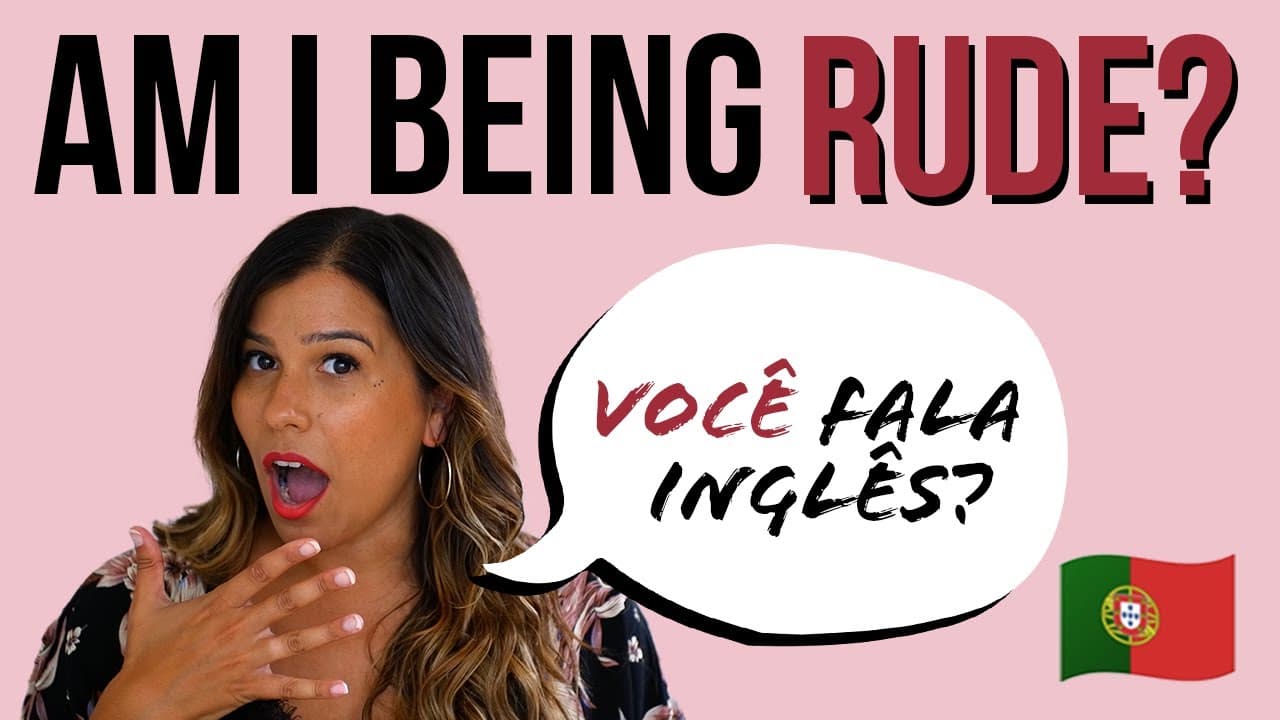
European Portuguese | How to Be Polite [Você FINALLY Explained!]
TL;DR
Learn when to use 'você' politely in European Portuguese.
Transcript
a question I get asked all the time which causes a lot of confusion among learners of Portuguese is is the word você rude? now if you're taking your first steps in learning the language then the last thing that you want to appear is rude so in today's video I am finally explaining what the deal is with this word você and how it should and shoul... Read More
Key Insights
- The word 'você' in European Portuguese can be perceived as rude due to historical social status implications.
- In Brazil, 'você' is commonly used without any negative connotations, unlike in Portugal.
- The pronunciation of 'você' is crucial, with stress on the closed 'e' sound, indicated by the accent.
- To avoid potential rudeness, learners can drop the pronoun and use verb conjugations directly in conversations.
- Using a person's name or titles like 'o senhor' or 'a senhora' is a polite alternative to using 'você'.
- The distinction between formal and informal pronouns is essential for speaking politely in Portuguese.
- A free guide is available to help with pronunciation challenges in European Portuguese.
- Understanding the cultural context of language use is vital for effective communication in Portugal.
Install to Summarize YouTube Videos and Get Transcripts
Explore YouTube Video Summarizer or Get YouTube Transcript Extractor
Questions & Answers
Q: Why is 'você' considered rude in Portugal?
The term 'você' is seen as potentially rude in Portugal because historically it was used to address people of lower social status. Over time, using 'você' instead of more formal titles like 'o senhor' or 'a senhora' implied that the person being addressed was beneath the speaker, leading to its perception as impolite.
Q: How is 'você' used differently in Brazilian Portuguese?
In Brazilian Portuguese, 'você' is a common pronoun used to mean 'you' without any negative connotations. Unlike in Portugal, where it can imply a lack of respect, in Brazil, it is widely accepted and used in both formal and informal contexts, making it a straightforward choice for addressing someone.
Q: What are alternative ways to address someone politely in Portuguese?
To address someone politely in Portuguese without using 'você', you can drop the pronoun and rely on verb conjugations, use the person's name, or employ formal titles such as 'o senhor' or 'a senhora'. These alternatives help maintain politeness and respect in conversation.
Q: How important is pronunciation in using 'você' correctly?
Pronunciation is crucial when using 'você' correctly. The accent on the 'e' indicates a closed sound, which is important for proper pronunciation. Mispronouncing 'você' can lead to misunderstandings or make it appear that you are not proficient in the language, affecting communication.
Q: What resources are available to help with Portuguese pronunciation?
Liz Sharma offers a free pronunciation guide that covers the seven most challenging sounds in European Portuguese. This resource is designed to help learners improve their pronunciation skills, making it easier to communicate effectively and politely in Portuguese.
Q: Why is understanding cultural context important in language learning?
Understanding cultural context is vital in language learning because it influences how language is used and perceived. In Portuguese, knowing when 'você' might be considered rude helps avoid social faux pas and ensures respectful communication, which is crucial for building relationships and integrating into the culture.
Q: What advice does Liz Sharma give to learners of European Portuguese?
Liz Sharma advises learners to avoid using 'você' to prevent potential rudeness. Instead, she suggests dropping the pronoun, using the person's name, or opting for formal titles. This approach simplifies communication and helps learners focus on mastering other aspects of the language.
Q: How can learners improve their conversation skills in Portuguese?
Learners can improve their conversation skills in Portuguese by practicing pronunciation, understanding cultural nuances, and using polite forms of address. Liz Sharma's resources, including free lessons and pronunciation guides, provide valuable support for beginners aiming to enhance their confidence and fluency in the language.
Summary & Key Takeaways
-
The video explains the complexities of using the pronoun 'você' in European Portuguese. It highlights that while 'você' is acceptable in Brazilian Portuguese, it can be considered impolite in Portugal due to historical class distinctions.
-
Liz Sharma offers practical advice for learners to avoid using 'você' by dropping the pronoun or using alternative forms of address like names or formal titles, ensuring polite communication in Portuguese.
-
The video provides resources for improving pronunciation and understanding cultural nuances in European Portuguese, helping learners navigate the language with confidence and politeness.
Read in Other Languages (beta)
Share This Summary 📚
Summarize YouTube Videos and Get Video Transcripts with 1-Click
Try YouTube Summary with ChatGPT & Claude or YouTube Transcript Generator
Explore More Summaries from Talk the Streets 📚




Summarize YouTube Videos and Get Video Transcripts with 1-Click
Try YouTube Summary with ChatGPT & Claude or YouTube Transcript Generator