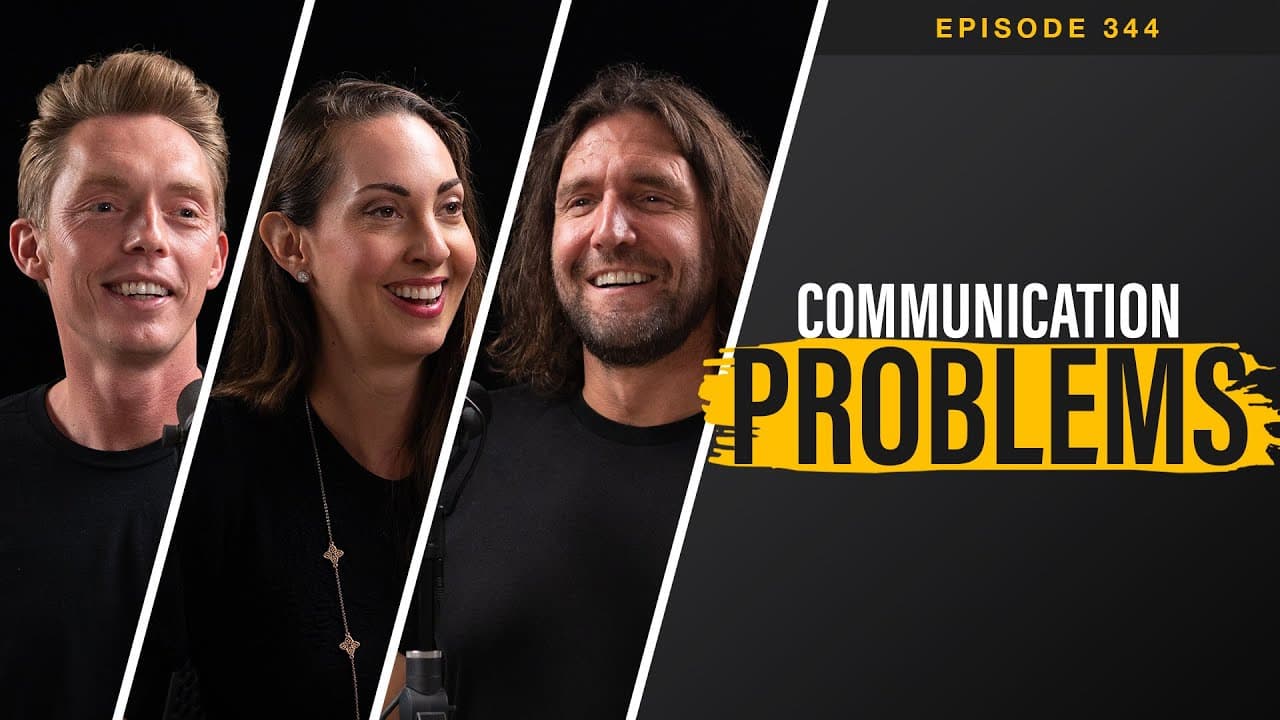
Ep. 344 | Communication Problems (with @Vvanedwards)
TL;DR
Explore the impact of non-verbal cues on effective communication.
Transcript
hello everybody Welcome to the minimalist podcast we discuss what it means to live a meaningful life with less my name is Joshua Fields Milburn and I'm Ryan Nicodemus and together we are the minimalists Ryan we all want to be appreciated yeah accepted acknowledged but instead we are often misunderstood and even offended because of poor communicatio... Read More
Key Insights
- Communication is not just verbal; it's a combination of verbal, non-verbal, vocal, and imagery cues. Non-verbal cues can account for 60-90% of communication.
- People often feel misunderstood because they focus too much on verbal communication, neglecting non-verbal cues which are harder to control and often more truthful.
- Charismatic individuals balance warmth and competence in their communication, using a mix of warm and competent words to convey trust and reliability.
- Mirroring another person's communication style, including their use of emojis or verbal cues, can enhance understanding and rapport, but should be done naturally to avoid seeming disingenuous.
- Eye contact is crucial but should not be constant. The ideal is 60-70% to maintain connection without overwhelming the other person.
- Resting Bothered Face (RBF) can unintentionally convey negative emotions like anger or sadness. Awareness and subtle changes can help mitigate misinterpretation.
- Phubbing, or phone snubbing, is a common issue where people prioritize digital interactions over face-to-face communication, creating a barrier to effective communication.
- Understanding a person's openness to change can guide how you communicate new ideas, either by emphasizing stability or innovation depending on their disposition.
Install to Summarize YouTube Videos and Get Transcripts
Explore YouTube Video Summarizer or Get YouTube Transcript Extractor
Questions & Answers
Q: How do I overcome the feeling of being chronically misunderstood?
To overcome feeling misunderstood, recognize the importance of non-verbal cues in communication. Often, we focus too much on the words we use, neglecting body language, vocal tone, and facial expressions, which can convey more than words alone.
Q: What are the four channels for cues?
The four channels for cues are verbal, non-verbal, vocal, and imagery. Verbal cues are the words we use, non-verbal cues include body language and facial expressions, vocal cues involve how we say words, and imagery encompasses visual elements like clothing and props.
Q: What is the importance of congruence in our communication?
Congruence in communication is vital as it ensures that our verbal and non-verbal cues align. When there's a mismatch, such as saying one thing but showing another through body language, it can lead to misunderstandings and a lack of trust.
Q: How are we most commonly misunderstood?
We are commonly misunderstood when there's an imbalance between warmth and competence in our communication. Using too many warm words can make us seem less competent, while overemphasizing competence can make us seem cold and unapproachable.
Q: How do we organically incorporate mirroring into our communication?
Mirroring can be incorporated by subtly matching the other person's communication style, such as their use of emojis or verbal expressions. It's essential to do this naturally to avoid appearing insincere, which can undermine communication.
Q: How can you tell if someone is actively listening to you?
Active listening can be gauged by observing if the person maintains eye contact, nods slowly, and gives vocalizations like 'uh-huh' or 'mm-hmm.' If they are looking away or giving quick nods, they might be distracted or processing their response.
Q: What are the two misconceptions about eye contact?
Two misconceptions about eye contact are that 100% eye contact is necessary and that looking up to the left indicates lying. In reality, 60-70% eye contact is ideal, and looking away often just means processing information, not deceit.
Q: What is 'Resting Bothered Face'?
Resting Bothered Face (RBF) occurs when people unconsciously display facial expressions that suggest negative emotions like anger or sadness. Being aware of this and making slight adjustments can help prevent misinterpretation by others.
Summary & Key Takeaways
-
Vanessa Van Edwards explains how non-verbal cues like body language and vocal inflections play a significant role in communication, often more so than words. Understanding these cues can improve how we connect with others.
-
Balancing warmth and competence in communication is key to being perceived as charismatic. This involves using a mix of warm and competent words and adapting to the communication style of others.
-
Misunderstandings often arise from focusing too much on verbal communication. By recognizing non-verbal cues and adjusting our approach based on the listener's openness to change, we can communicate more effectively.
Read in Other Languages (beta)
Share This Summary 📚
Summarize YouTube Videos and Get Video Transcripts with 1-Click
Try YouTube Summary with ChatGPT & Claude or YouTube Transcript Generator
Explore More Summaries from The Minimalists Podcast 📚





Summarize YouTube Videos and Get Video Transcripts with 1-Click
Try YouTube Summary with ChatGPT & Claude or YouTube Transcript Generator