High pass RC circuit | Pulse input | Pulse Digital Circuits | Lec-12
TL;DR
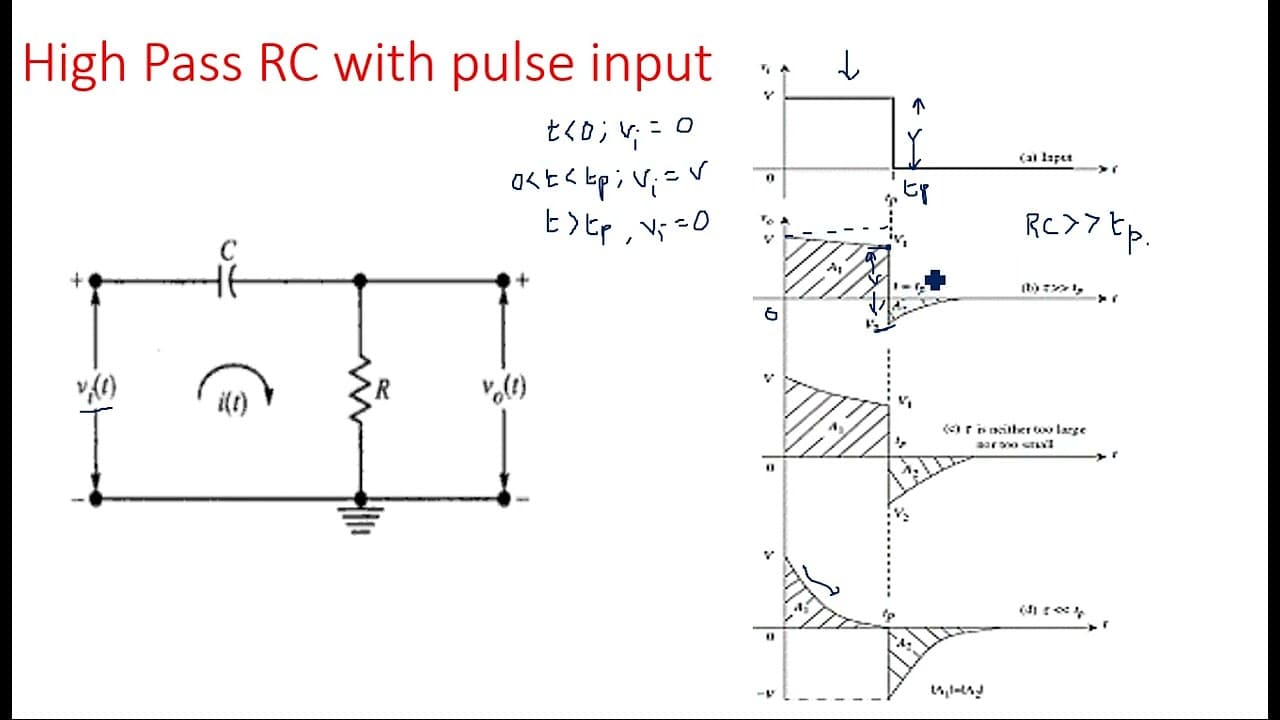
This video explains the behavior of a high pass RC circuit when a pulse input is applied.
Transcript
hi everyone in this video I am going to explain about the behavior of hyper searching circuit when a pulse input is applied in the previous video you have seen the behavior of hypers RC circuit when a sinusoidal signal is applied later we have seen a step input is also applied and the behavior of the high pass RC circuit is like decreasing the ampl... Read More
Key Insights
- 🔠 The high pass RC circuit reacts dynamically to pulse inputs, showcasing significant variations in output based on input changes.
- ⌛ Understanding the RC time constant is crucial for predicting the behavior of the circuit and its response to different frequencies of input signals.
- 🈂️ The phenomenon of undershoot highlights the complex interaction between the capacitor's charging characteristics and the circuit's output.
- ☠️ Timing relationships between the RC product and the pulse width dictate the rate at which the circuit charges and discharges, impacting the overall output waveform.
- ❓ The mathematical equations governing the circuit's behavior provide valuable insights into the charging and discharging phases of the capacitor.
- ✋ Knowledge of both the theoretical and practical applications of high pass RC circuits is essential for effectively managing signal processing tasks in electronics.
- 💗 The video effectively visualizes circuit behavior and response to pulse inputs, aiding in the comprehension of fundamental electronic principles.
Install to Summarize YouTube Videos and Get Transcripts
Explore YouTube Video Summarizer or Get YouTube Transcript Extractor
Questions & Answers
Q: What is the significance of the RC time constant in a high pass RC circuit?
The RC time constant determines how quickly the capacitor in the circuit charges and discharges. If RC is much greater than the signal period, the circuit takes longer to respond, leading to slower output voltage changes. Conversely, if RC is much smaller, the circuit responds quickly, producing an output that closely resembles the input signal.
Q: How does the output voltage behave when a pulse input is applied?
When a pulse input is applied, the output voltage initially follows the input rise, but as the capacitor charges, the output voltage decreases. If there is a drop in input voltage, the output also reflects this change, causing a phenomenon called undershoot, where the output becomes temporarily negative before stabilizing to zero.
Q: What is undershoot in the context of an RC circuit?
Undershoot occurs when the output voltage temporarily dips below zero after a sudden decrease in input voltage. This happens because the capacitor does not discharge instantaneously, causing a negative residual voltage instead of a clean zero as the output stabilizes over time.
Q: Can you explain the output voltage equation during the discharging phase?
During the discharging phase after the pulse input is removed, the output voltage decreases according to the equation V_naught(T) = V * e^(-t/RC). This describes the exponential decay of the output voltage as it returns to zero, influenced by the RC time constant.
Q: How do you determine the charging behavior of the capacitor?
The charging behavior is determined by comparing the RC time constant to the pulse width (TP). If the RC time constant is significantly greater than TP, the capacitor charges slowly, resulting in gradual output voltage changes. If RC is less than TP, the capacitor charges rapidly, leading to faster output voltage transitions.
Q: Why is the resistor connected across the output in a high pass RC circuit?
The resistor is connected across the output in a high pass RC circuit to allow high frequency signals to pass through while filtering out low-frequency signals. This setup ensures that the output voltage reflects rapid changes in input without being overly influenced by static or slow-varying signals.
Q: What occurs when the input signal is constant, and the pulse width is longer than the time constant?
When the input signal remains constant for a duration longer than the RC time constant, the capacitor charges toward the input voltage, and the output voltage decreases correspondingly. It will remain at a lower level as the capacitor charges, showing a significant delay in response due to the longer time constant.
Q: How does the video explain the mathematical representation of exponential signals?
The video outlines the mathematical representation of exponential signals for increasing and decreasing conditions. For increasing voltage, the equation is V_naught = V * (1 - e^(-t/RC)), while for decreasing voltage, it is V_naught = V * e^(-t/RC). These formulas describe how the output responds to changes in the input signal.
Summary & Key Takeaways
-
The video discusses the response of a high pass RC circuit when a pulse input is applied, detailing how the output reflects rapid changes in the input voltage.
-
Three charging scenarios are presented based on the relationship between the RC time constant and pulse width, affecting the output signal's rate of change.
-
The video also outlines the equations for the output voltage during both the charging and discharging phases, illustrating the undershoot phenomenon and exponential decay behaviors.
Read in Other Languages (beta)
Share This Summary 📚
Summarize YouTube Videos and Get Video Transcripts with 1-Click
Try YouTube Summary with ChatGPT & Claude or YouTube Transcript Generator