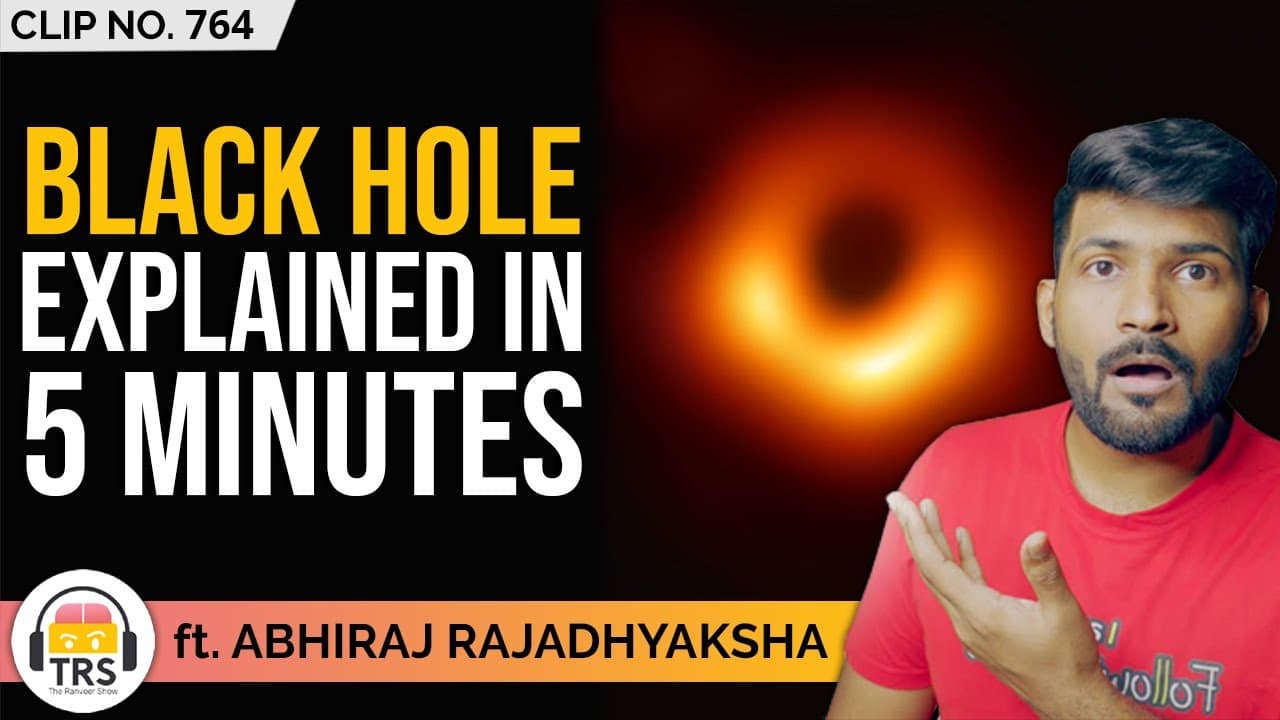
All You Need To Know About The Black Hole ft. @AbhiandNiyu | TRS Clips
TL;DR
This content explores black holes, wormholes, and their scientific implications.
Transcript
these are the highlights of india's smartest podcast the ranvi show welcome to trs clips make sure you hit that bell icon and don't forget to subscribe huh so now uh the actual name of a wormhole is uh einstein rosenberg bridge so it's actually a bridge between two points in space or in dark it's two points in time uh dark is completely like a scie... Read More
Key Insights
- 👾 Einstein-Rosen bridges signify theoretical wormholes yet to be empirically verified, fundamentally altering our perception of space-time.
- ✴️ The formation of black holes from stars underscores the intricate balance between gravitational collapse and nuclear fusion, determining stellar life cycles.
- 🙂 Escape velocity plays a crucial role in comprehending why light cannot escape black holes, leading to a deeper understanding of gravitational physics.
- 🥰 The philosophical implications of cosmic phenomena ripple through both science and art, as demonstrated by the cultural impact of films depicting these concepts.
- 🖤 The study of black holes remains an evolving field, bridging theoretical physics with empirical research, culminating in significant discoveries such as the first black hole image.
- 🕳️ The idea of white holes exists theoretically as a possible counterpart to black holes, sparking speculation on multi-dimensional possibilities.
- 🫵 Carl Sagan's view intertwines science with daily life, urging us to recognize our cosmic connections through even the simplest human activities.
Install to Summarize YouTube Videos and Get Transcripts
Explore YouTube Video Summarizer or Get YouTube Transcript Extractor
Questions & Answers
Q: What is the significance of the term "Einstein-Rosen bridge?"
The term "Einstein-Rosen bridge" refers to wormholes, theoretically connecting two points in space-time. This concept, developed by physicist Albert Einstein and his colleague Nathan Rosen, illustrates a possible shortcut through the fabric of the universe, sparking both scientific curiosity and inspiration for science fiction storytelling.
Q: How do black holes form from stars?
Black holes are formed when stars exhaust their nuclear fuel and can no longer combat gravitational collapse. Initially, stars fuse hydrogen into helium; however, when iron accumulates, fusion halts. If gravity surpasses this outward pressure, the star can implode into a black hole or explode as a supernova based on its mass.
Q: Why can’t light escape from a black hole?
A black hole's escape velocity surpasses the speed of light, meaning that nothing, including photons (light particles), can break free from its gravitational grip. This characteristic is essential in defining black holes, and it leads to the formation of an event horizon, beyond which events cannot be observed.
Q: Are there any observable phenomena that suggest the existence of wormholes?
While wormholes remain purely theoretical at this stage, some physicists suggest their potential existence based on mathematical models and the implications of general relativity. Furthermore, the potential for black holes to have counterparts in white holes fuels interest, even though direct observation has yet to confirm their existence.
Q: What role do movies like Interstellar and Contact play in understanding these concepts?
Movies like Interstellar and Contact serve as visual and narrative tools for exploring complex scientific theories. They bring concepts such as black holes and cosmic exploration to life, making them more accessible and stimulating philosophical inquiries into humanity's place in the universe, thus merging science with storytelling.
Q: How do escape velocities relate to black holes?
Escape velocity is the minimum speed an object must reach to break free from a celestial body's gravitational pull. In the context of black holes, when the required escape velocity exceeds that of light, it creates a region where light cannot escape, solidifying the definition and properties of a black hole.
Q: What did Carl Sagan mean by needing to create a universe to make an apple pie?
Carl Sagan highlighted the interconnectedness of all matter in the universe, implying that the elements forming an apple pie originated from ancient star explosions. This poetic analogy emphasizes that human creations are deeply rooted in cosmic history and science, reinforcing the bond between biological and cosmic phenomena.
Q: How does current scientific understanding view the nature of black holes?
Current scientific understanding considers black holes to be regions of infinite density where the laws of physics as we know them break down. Their study involves complex theories of general relativity and quantum mechanics, and while captured photographic evidence has emerged, the mysteries of black holes continue to perplex scientists and inspire research.
Summary & Key Takeaways
-
The discussion begins with the definition of wormholes, also known as Einstein-Rosen bridges, and their theoretical relation to black holes, highlighting a gap in our understanding of these cosmic phenomena.
-
It details how black holes form from stars collapsing under gravity, transitioning from nuclear fusion to a point where they can no longer sustain themselves, leading to either a supernova or an implosion into a black hole.
-
Concepts such as escape velocity are explained, emphasizing that a black hole's gravitational pull is so strong that even light cannot escape, and touching on theoretical aspects like the existence of white holes.
Read in Other Languages (beta)
Share This Summary 📚
Summarize YouTube Videos and Get Video Transcripts with 1-Click
Try YouTube Summary with ChatGPT & Claude or YouTube Transcript Generator
Explore More Summaries from TRS Clips 📚





Summarize YouTube Videos and Get Video Transcripts with 1-Click
Try YouTube Summary with ChatGPT & Claude or YouTube Transcript Generator