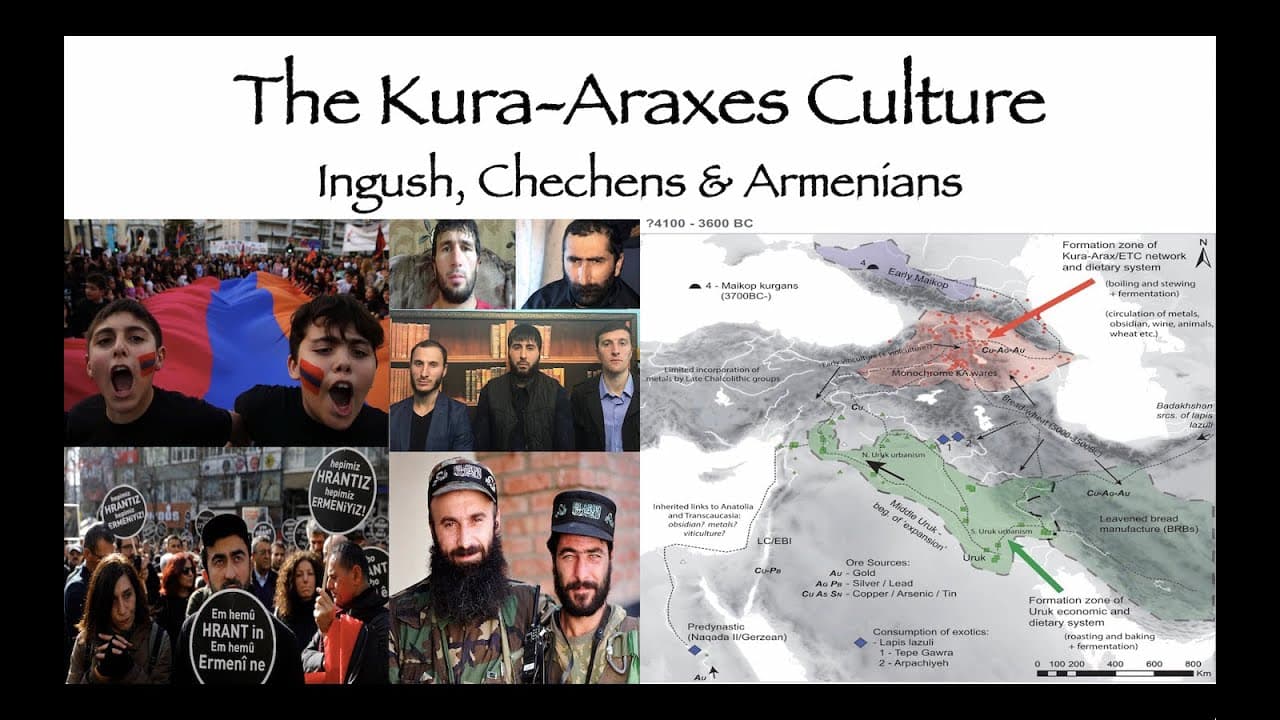
The Kura-Araxes Culture: Ingush, Chechens & Armenians
TL;DR
Exploration of the Kura-Araxes culture's impact on Ingush, Chechens, and Armenians.
Transcript
the kora araxis culture the english the chechnyans and the armenians but before we get too deep into the video first i want to tell you guys about my social media platforms so i have a clubhouse account and we can actually talk to one another on it i also host clubhouse rooms every now and then where i might talk about history and genetics of the m... Read More
Key Insights
- The Kura-Araxes culture significantly influenced the formation of the Chechen and Ingush peoples, with roots in ancient Caucasian civilizations over five millennia ago.
- Linguistic evidence connects the Kura-Araxes culture to the Hurrian and Urartian civilizations, highlighting a shared cultural heritage in the Near East.
- The Kura-Araxes culture, originating in the Transcaucasus region, was a major civilization comparable to Mesopotamia, with extensive trade relations.
- The culture's influence extended to parts of Asia Minor and the Middle East, impacting the development of early Armenian culture and language.
- The Hurrians, descending from the northeast, played a significant role in spreading the Kura-Araxes culture into Syria and beyond.
- Archaeological evidence shows the Kura-Araxes culture's decline in the late third millennium BC, giving way to the Middle Bronze Age cultures.
- The Armenians, Chechens, and Ingush are believed to be descendants of Togarmah, a figure mentioned in historical and biblical texts.
- The Kura-Araxes culture is characterized by distinctive pottery styles, initially featuring coarse designs and later evolving into more refined motifs.
Install to Summarize YouTube Videos and Get Transcripts
Explore YouTube Video Summarizer or Get YouTube Transcript Extractor
Questions & Answers
Q: What is the significance of the Kura-Araxes culture in the formation of the Chechen and Ingush peoples?
The Kura-Araxes culture is significant in the formation of the Chechen and Ingush peoples as it represents one of the earliest cultural influences in the Caucasus region. Linguistic and archaeological evidence ties these groups to the ancient Hurrian and Urartian civilizations, indicating a shared cultural and historical heritage that has shaped their identities over millennia.
Q: How did the Kura-Araxes culture influence early Armenian civilization?
The Kura-Araxes culture influenced early Armenian civilization through cultural exchanges and linguistic influences. The spread of this culture into Asia Minor and the Middle East introduced new pottery styles and societal structures. The Armenians are believed to have been influenced by the early Transcaucasian culture, which is another term for the Kura-Araxes culture, impacting their language and cultural development.
Q: What role did the Hurrians play in the spread of the Kura-Araxes culture?
The Hurrians played a pivotal role in spreading the Kura-Araxes culture by migrating from the northeast into regions such as Syria. Their movement facilitated the cultural exchange and dissemination of the Kura-Araxes civilization's characteristics, including its pottery styles and societal structures, thereby influencing various cultures in the Near East and contributing to the culture's extensive reach.
Q: What characterized the pottery of the Kura-Araxes culture?
The pottery of the Kura-Araxes culture was initially characterized by coarse incised markings and bold decorations, often featuring spirals. Over time, the designs evolved into more refined motifs, including birds and animal figures on black burnished ware. This distinctive pottery style is a key archaeological marker of the culture and provides insight into its artistic and cultural practices.
Q: How did the Kura-Araxes culture compare to other major civilizations of its time?
The Kura-Araxes culture was comparable to other major civilizations of its time, such as Mesopotamia, in terms of its cultural and trade influence. It established extensive trade relations and was a significant player in the cultural exchanges of the region, contributing to the development of early civilizations in the Transcaucasus and beyond. Its impact is evident in the archaeological and linguistic records of the area.
Q: What evidence supports the connection between the Kura-Araxes culture and the Urartian civilization?
The connection between the Kura-Araxes culture and the Urartian civilization is supported by linguistic and archaeological evidence. Similarities in language, pottery styles, and cultural practices suggest a shared heritage. The Urartian language shows influences from the Kura-Araxes culture, and archaeological findings indicate cultural exchanges between these civilizations, highlighting their intertwined histories.
Q: Who are the descendants of Togarmah according to historical texts?
According to historical and biblical texts, the descendants of Togarmah include the Armenians, Chechens, and Ingush. Togarmah is a figure mentioned in various historical narratives, and these groups claim lineage from him. This connection is part of the cultural and historical identity of these peoples, linking them to ancient traditions and narratives of the Caucasus region.
Q: What marked the decline of the Kura-Araxes culture?
The decline of the Kura-Araxes culture occurred in the late third millennium BC, marking a transition to the Middle Bronze Age. This decline was characterized by changes in pottery styles and societal structures, as well as the emergence of new cultural influences in the region. Despite its decline, the culture's legacy continued to influence subsequent civilizations and contributed to the historical narratives of the Caucasus.
Summary & Key Takeaways
-
The Kura-Araxes culture played a crucial role in shaping the identities of the Ingush, Chechens, and Armenians, with its origins tracing back over five millennia. It established significant cultural and trade connections with Mesopotamia and influenced the development of early Armenian civilization.
-
Linguistic and archaeological evidence suggests a strong connection between the Kura-Araxes culture and the Hurrian and Urartian civilizations. This cultural exchange contributed to the spread of the culture across the Transcaucasus region, impacting language and societal structures.
-
The decline of the Kura-Araxes culture in the late third millennium BC marked the transition to the Middle Bronze Age. Despite its decline, the culture left a lasting legacy on the peoples and cultures of the Caucasus, as well as on historical narratives connecting them to biblical figures.
Read in Other Languages (beta)
Share This Summary 📚
Summarize YouTube Videos and Get Video Transcripts with 1-Click
Try YouTube Summary with ChatGPT & Claude or YouTube Transcript Generator