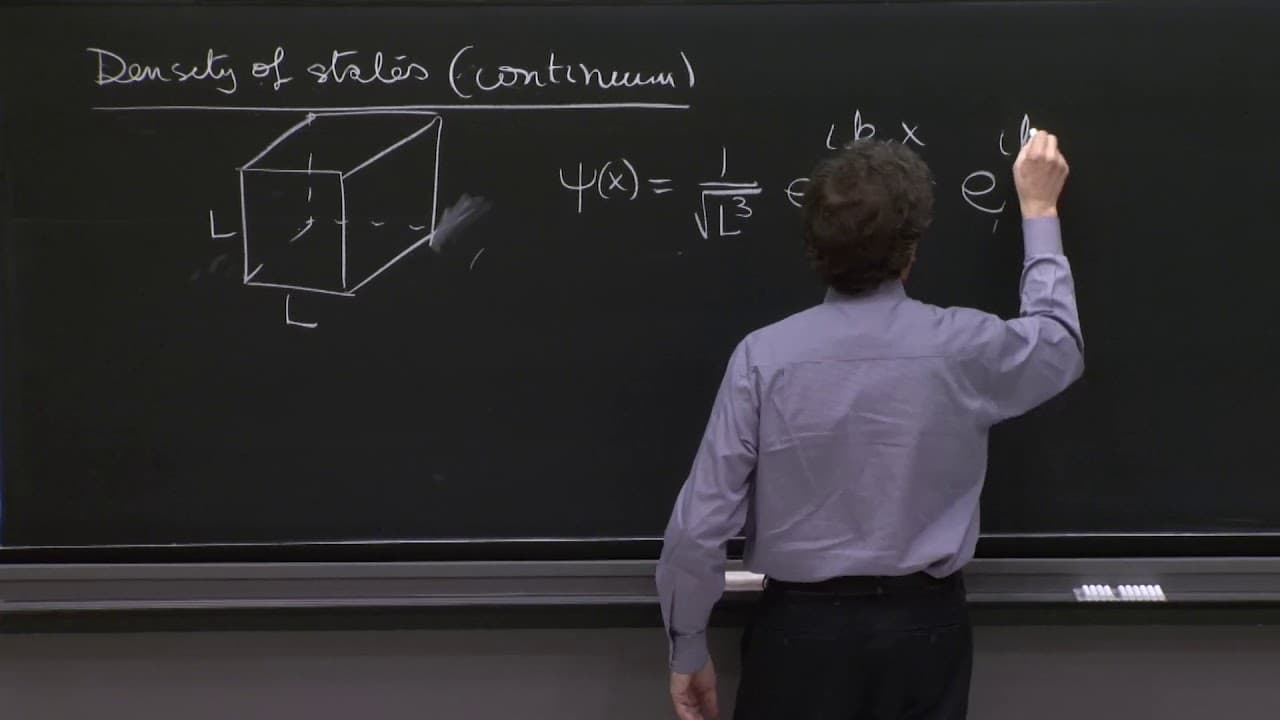
L10.1 Box regularization: density of states for the continuum
TL;DR
Fermi's Golden Rule is a method used to study transitions from discrete states to states in a continuum, with a focus on constant and harmonic perturbations. The calculation requires the concept of density of states.
Transcript
PROFESSOR: Our subject today then is Fermi's golden rule. So that's what we're going to develop. Fermi's golden rule. Fermi's golden rule. And this has to do with the study of transitions. And typically, the interesting and sophisticated thing about this subject is that you have a transition from some initial state to a state that is part of a cont... Read More
Key Insights
- ❓ Fermi's Golden Rule is used to study transitions from discrete states to states in a continuum, which can be more complex than transitions between discrete states.
- 💼 Constant and harmonic perturbations are two main cases considered in Fermi's Golden Rule.
- 🫀 Constant perturbations are useful for understanding auto-ionization phenomena, while harmonic perturbations are relevant to atoms interacting with radiation.
- 🇦🇪 The density of states is necessary for calculating transition rates and represents the number of states per unit energy within a specific angular range.
- 🍱 Initially, the density of states is calculated using a quantization approach within a large box, but in the final calculations, the size of the box becomes irrelevant.
Install to Summarize YouTube Videos and Get Transcripts
Explore YouTube Video Summarizer or Get YouTube Transcript Extractor
Questions & Answers
Q: What is Fermi's Golden Rule used for?
Fermi's Golden Rule is used to study transitions from discrete states to states in a continuum. It is particularly useful for understanding phenomena such as auto-ionization and atoms interacting with radiation.
Q: What is the difference between transitions to continuum states and transitions between discrete states?
Transitions between discrete states with a perturbation are relatively simple, while transitions to continuum states require integration over a set of final states. This integration makes transitions to continuum states more challenging.
Q: What are the two main cases of perturbations considered in Fermi's Golden Rule?
The two main cases of perturbations considered are constant perturbations and harmonic perturbations. Constant perturbations involve a time-independent perturbation, while harmonic perturbations involve a time-dependent perturbation that fluctuates between certain time intervals.
Q: How is the density of states used in Fermi's Golden Rule?
The density of states is used to describe the continuum of states in which the transitions occur. It represents the number of states per unit energy within a certain angular range, and is necessary for calculating transition rates.
Summary & Key Takeaways
-
Fermi's Golden Rule is used to study transitions from discrete states to states in a continuum.
-
Transitions from discrete to continuum states are more complicated than transitions between discrete states with a perturbation.
-
Two main cases of perturbations, constant and harmonic, are considered for calculating transitions.
Read in Other Languages (beta)
Share This Summary 📚
Summarize YouTube Videos and Get Video Transcripts with 1-Click
Try YouTube Summary with ChatGPT & Claude or YouTube Transcript Generator
Explore More Summaries from MIT OpenCourseWare 📚



Summarize YouTube Videos and Get Video Transcripts with 1-Click
Try YouTube Summary with ChatGPT & Claude or YouTube Transcript Generator