Inference in Deep Learning
TL;DR
Nvidia leads deep learning inference benchmarks, showcasing significant advancements in speed and efficiency.
Transcript
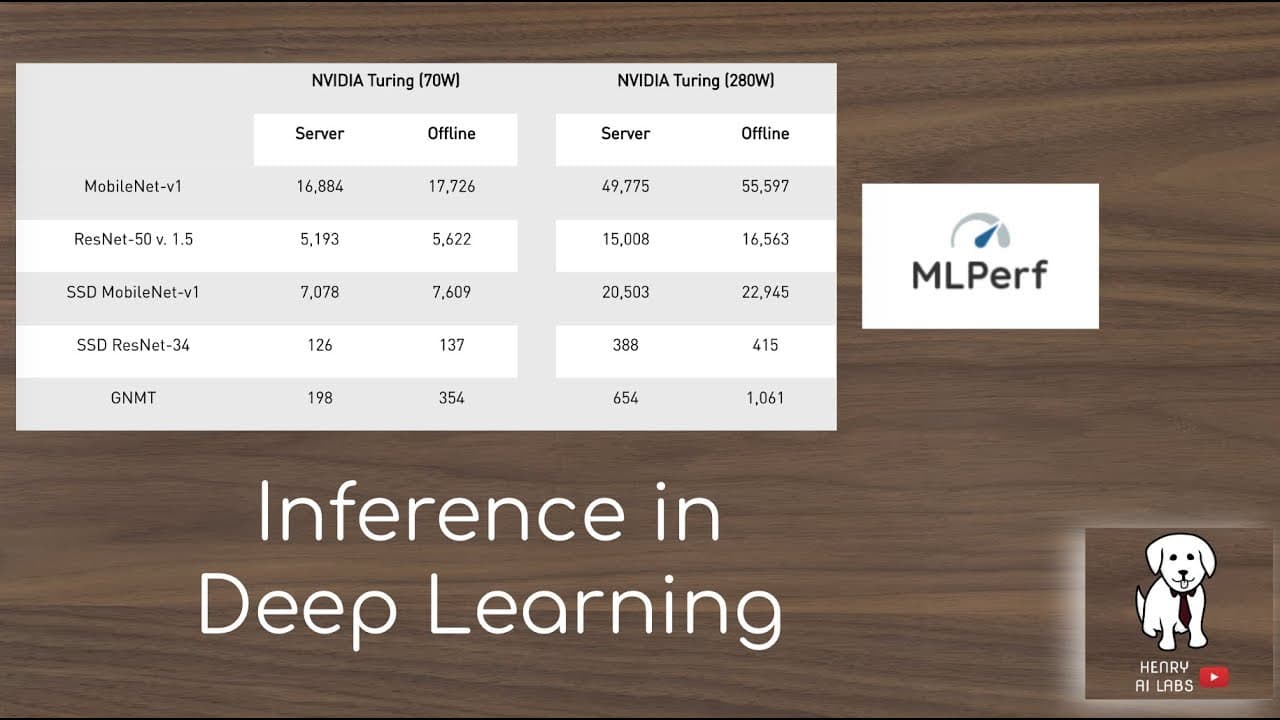
this video will discuss inference and deep learning around the context of the recently released results from the ml per inference benchmark challenge with Nvidia taking the trophy over companies like Intel Google Dell amongst others with achievements like fifty five thousand five hundred ninety seven image net classifications per second using the m... Read More
Key Insights
- 😫 Nvidia's benchmark performance showcases a significant leap in the speed of deep learning inference, setting industry standards.
- 🚂 Understanding inference is vital for effective model deployment, as it involves utilizing the already-trained models to make predictions efficiently.
- 📱 Innovations such as quantization significantly enhance the feasibility of deploying models on resource-constrained devices like smartphones.
- 😚 Pruning techniques can dramatically reduce model size and improve inference speed without losing significant functionality.
- 🗯️ The context of the application is critical in choosing the right inference architecture, whether for server or edge deployment.
- 😘 Low latency is essential for user satisfaction in applications such as chatbots, requiring optimized models that can deliver quick responses.
- 🙂 The distinction between heavy and light computational models facilitates benchmarking across varying architectures and operational contexts in inference tasks.
Install to Summarize YouTube Videos and Get Transcripts
Explore YouTube Video Summarizer or Get YouTube Transcript Extractor
Questions & Answers
Q: What is the significance of Nvidia's performance in the MLPerf Inference Benchmark?
Nvidia's performance in the MLPerf Inference Benchmark is noteworthy because it sets a high standard for efficient deep learning model deployment. Achieving over 55,597 ImageNet classifications per second demonstrates not only the speed of their technology, but also exemplifies how Nvidia's innovations, such as the TensorRT platform, contribute to real-world applications needing high throughput and low latency.
Q: What are the main advantages of quantization in deep learning inference?
Quantization offers critical advantages by reducing the numerical precision of calculations, resulting in faster inference times and lower memory consumption. By converting weights from 32-bit floating-point to lower precision formats, models can operate much efficiently with minimal impact on accuracy. This enables deployment on edge devices, where computational resources and power are limited while maintaining a practical level of performance.
Q: How does pruning contribute to model efficiency during inference?
Pruning helps streamline neural networks by removing weights that contribute minimally to the output during the inference phase. By minimizing unnecessary computations, it enhances the model's efficiency without significant loss in accuracy. This technique is particularly useful for deployment in scenarios where response time and resource usage are critical, ultimately speeding up overall inference times.
Q: What challenges does inference present in real-time applications like voice recognition?
Inference poses challenges in real-time applications due to the need for ultra-low response times. For instance, in voice recognition, delays can hinder user experience significantly. If the inference model takes too long to process input, the application may seem unresponsive, leading to frustrations for users expecting instant feedback, emphasizing the need for optimized inference techniques.
Q: What role does Nvidia's TensorRT platform play in accelerating inference?
Nvidia's TensorRT platform serves to optimize deep learning models for deployment by transforming trained networks into highly efficient inference engines. It incorporates several advanced techniques, including precision calibration, layer fusion, and dynamic tensor memory management, allowing for substantial speed improvements and making it suitable for high-demand applications requiring low latency.
Q: How do offline and server scenarios differ in the MLPerf benchmarking?
In MLPerf benchmarking, offline scenarios involve having the complete dataset available for batch processing, allowing for predictions on pre-loaded data. Conversely, server scenarios consist of dynamically receiving data samples, necessitating more complex processing strategies. Each setting tests different aspects of inference capability, essential for evaluating how well models can adapt to real-time data streams.
Q: What are depth-wise separable convolutions in MobileNet architecture?
Depth-wise separable convolutions are a key feature in the MobileNet architecture that enhance efficiency. They split standard convolutions into two layers: depth-wise convolutions, which filter inputs individually, followed by point-wise convolutions that combine the outputs. This greatly reduces computational requirements, makes the model lighter, and speeds up inference without drastically losing accuracy.
Q: Why is the trade-off between speed and accuracy important in model performance?
The trade-off between speed and accuracy is crucial since real-world applications often prioritize timely responses without excessively sacrificing accuracy. Achieving higher accuracy usually comes at the cost of slower inference times, which can limit usability in scenarios where quick predictions are essential, like autonomous vehicles or real-time translation software.
Summary & Key Takeaways
-
This analysis focuses on Nvidia's success in the MLPerf Inference Benchmark, achieving an impressive classification speed, which significantly outshone competitors like Intel and Google using the MobileNet architecture.
-
The video delves into inference concepts, including its role post-training, algorithmic advancements such as TensorRT, quantization, and pruning techniques, which enhance model performance.
-
Additionally, it contrasts different benchmarking scenarios, emphasizing the trade-offs between speed and accuracy in various tasks including image classification, object detection, and machine translation, while exploring the implications for real-world applications.
Read in Other Languages (beta)
Share This Summary 📚
Summarize YouTube Videos and Get Video Transcripts with 1-Click
Try YouTube Summary with ChatGPT & Claude or YouTube Transcript Generator
Explore More Summaries from Connor Shorten 📚
Summarize YouTube Videos and Get Video Transcripts with 1-Click
Try YouTube Summary with ChatGPT & Claude or YouTube Transcript Generator