Permutations and Combinations | Circle & Circular arrangement | Aptitude | Part- 16 | Bharath Kumar
TL;DR
This session covers problems related to arranging boys and girls in specific formats and the letters of a word.
Transcript
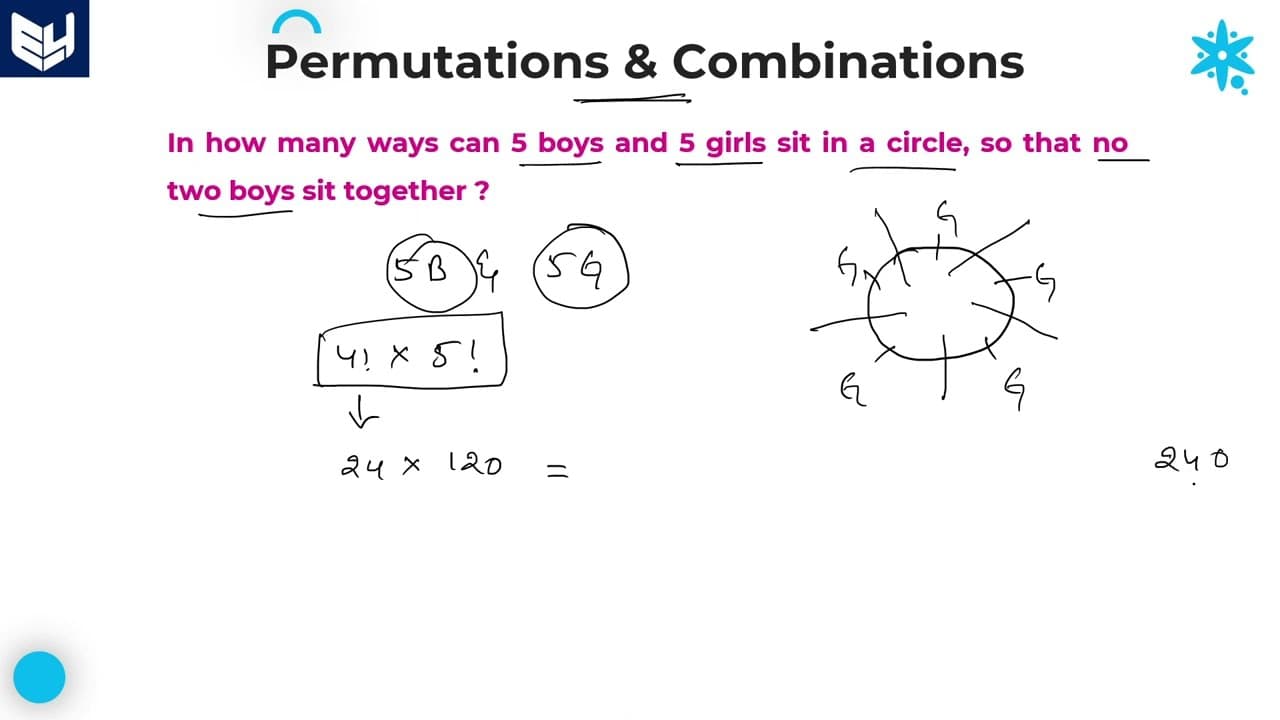
hi everyone welcome to the session in this session i will explain some more problems related to permutations and combinations let's see the first question in this session see here in how many ways five boys and five girls sit in a circle so that no two boys sit together here total we need to arrange five boys and five girls five boys and five girls... Read More
Key Insights
- 👨👩👧👦 Arranging boys and girls in a circle requires strategic placement to meet conditions like preventing adjacent boys, demonstrating the importance of position fixing in permutations.
- ❓ Circular permutations introduce complexities that differentiate them from linear arrangements, requiring specific formulas like (n-1)!.
- 🔑 The session highlights that awareness of repeating characters is crucial in word arrangements, impacting the total count of unique permutations.
- 🦻 Understanding the principles of permutations and combinations can greatly aid in solving various mathematical problems efficiently.
- 🫵 Each problem illustrates a unique aspect of combinations and arrangements, enriching the viewer's grasp of these mathematical concepts.
- ❓ Incorporating visuals or examples when explaining complex arrangements can enhance comprehension, especially for visual learners.
- 🪡 The breakdown of factorial calculations emphasizes the need for attention to detail in mathematical problem-solving.
Install to Summarize YouTube Videos and Get Transcripts
Explore YouTube Video Summarizer or Get YouTube Transcript Extractor
Questions & Answers
Q: Why do we arrange girls first when calculating the seating of boys and girls?
In this scenario, girls are arranged first to create fixed positions in a circular format. By fixing the girls' seats, we create defined spaces between them for the boys. This strategy ensures that no two boys are adjacent, following the condition of the arrangement.
Q: How do we calculate the arrangement of seven individuals around a circular table?
The arrangement of seven persons involves using the formula (n-1)!, where n is the total number of people. By fixing one person and arranging the other six around them, we simplify the arrangement to 6!, leading to a total of 720 unique arrangements.
Q: What is the significance of dividing by 3! when arranging the letters of "believe"?
Dividing by 3! accounts for the repeated letter 'e', which appears three times in "believe". Without this adjustment, permutations would inaccurately count identical arrangements as distinct. Thus, the correct total distinct arrangements must reflect the repetitions.
Q: Can you explain why we use n-1 factorial for circular arrangements?
We use (n-1)! because, in a circular arrangement, one position is fixed to remove redundancy created by rotations. This ensures that arrangements are unique, as rotating an entire arrangement of n objects does not yield new outcomes.
Summary & Key Takeaways
-
The session presents various problems focused on permutations and combinations, specifically the seating arrangement of five boys and girls in a circle while adhering to specific conditions, such as ensuring no two boys sit together.
-
It provides a detailed explanation on calculating arrangements around a circular table, highlighting the importance of fixing positions when working with circular permutations and the rationale behind using (n-1)! for arrangements.
-
The session further explores the arrangement of letters in the word "believe," emphasizing the need to adjust calculations for repeated letters and demonstrating how to find distinct arrangements through permutation principles.
Read in Other Languages (beta)
Share This Summary 📚
Summarize YouTube Videos and Get Video Transcripts with 1-Click
Try YouTube Summary with ChatGPT & Claude or YouTube Transcript Generator