Absolute Value Theorem For Sequences
TL;DR
The content explains how to determine if a sequence is convergent or divergent using the absolute value theorem and provides a graphical representation of the concept.
Transcript
consider the sequence a sub n is equal to negative 1 raised to the nth power divided by n now is this sequence convergent or is it divergent what would you say well we need to take the limit as n approaches infinity and if it's equal to a constant then the sequence converges if the limit doesn't exist or if it equals positive or negative infinity t... Read More
Key Insights
- ⛔ Convergence or divergence of a sequence can be determined by finding the limit as n approaches infinity.
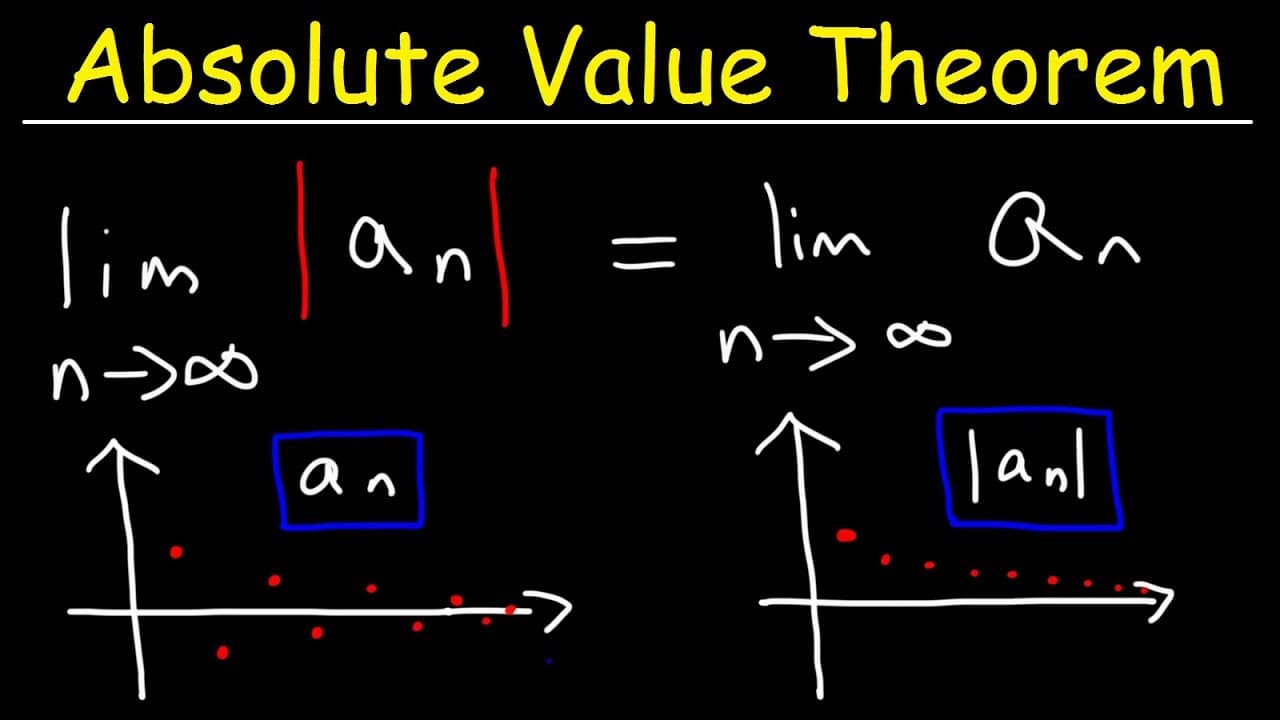
- 0️⃣ The absolute value theorem states that if the limit of the absolute value of a sequence is zero, then the original sequence also converges to zero.
- 📈 Graphing a sequence and its absolute value visually demonstrates convergence and the validity of the absolute value theorem.
- 🤘 The absolute value of (-1)^n is always 1, and taking the absolute value of a sequence only changes the sign to positive.
- 👎 The given sequence, a sub n = (-1)^n/n, converges to zero, proving it is convergent.
- ⛔ The absolute value theorem for sequences provides a method to determine convergence by analyzing the limit of the absolute value of a sequence.
- 🌥️ When graphing the sequence and its absolute value, both converge to zero as n becomes large.
Install to Summarize YouTube Videos and Get Transcripts
Explore YouTube Video Summarizer or Get YouTube Transcript Extractor
Questions & Answers
Q: How can we determine if a sequence converges or diverges based on its limit?
To determine if a sequence converges or diverges, we need to find the limit as n approaches infinity. If the limit is a constant, the sequence converges. If the limit doesn't exist or is positive/negative infinity, the sequence diverges.
Q: How can the absolute value theorem for sequences be applied to determine convergence?
The absolute value theorem states that if the limit of the absolute value of a sequence is zero, then the limit of the sequence itself is also zero. By taking the absolute value of the given sequence and proving that it converges to zero, we can establish convergence.
Q: How does the absolute value of (-1)^n affect the sequence?
The absolute value of (-1)^n is always 1 since (-1)^n oscillates between 1 and -1. Therefore, when we take the absolute value of the sequence, the only change is that all values become positive.
Q: How does the graphical representation of the function help understand convergence?
By graphing the sequence and its absolute value, we can see that both converge to zero as n becomes large. This visual representation validates the absolute value theorem for sequences and illustrates why the absolute value of a sequence can determine its convergence.
Summary & Key Takeaways
-
The sequence provided, a sub n = (-1)^n/n, is analyzed to determine if it converges or diverges.
-
The limit as n approaches infinity is found by taking the absolute value of the sequence and proving that it converges to zero.
-
The graph of the sequence and its absolute value are plotted to show that both converge, demonstrating the validity of the absolute value theorem for sequences.
Read in Other Languages (beta)
Share This Summary 📚
Summarize YouTube Videos and Get Video Transcripts with 1-Click
Try YouTube Summary with ChatGPT & Claude or YouTube Transcript Generator
Explore More Summaries from The Organic Chemistry Tutor 📚



Summarize YouTube Videos and Get Video Transcripts with 1-Click
Try YouTube Summary with ChatGPT & Claude or YouTube Transcript Generator