A Surprisingly Simple Secret to Supersonic Flight
TL;DR
Engineers overcame aerodynamic challenges to achieve supersonic flight, leading to innovations like swept wings in aircraft design.
Transcript
{♫Intro♫} When the Wright Brothers made their first flight in 1903, people had been trying to fly for centuries. So even though their plane didn’t go much faster than 10 kilometers per hour -- basically, running speed -- it was a major achievement. What’s maybe equally amazing, though, is that it didn’t take another few centuries for us to achieve ... Read More
Key Insights
- 🐎 The evolution of flight from the Wright Brothers to supersonic speed showcases rapid technological progress.
- 🚄 Aerodynamic challenges at high speeds led to innovative solutions like swept wings in aircraft design.
- ✈️ Supersonic flight revolutionized aviation and shaped modern aircraft design practices.
- 🚄 Incompressible air assumptions in traditional aerodynamics were debunked by high-speed flight research.
- ✈️ Shockwave mitigation strategies were crucial in achieving safe and efficient supersonic flight.
- 🚄 Swept wings revolutionized aircraft design by optimizing airflow at high speeds.
- ✈️ Modern aircraft design reflects solutions to historical aerodynamic challenges in supersonic flight.
Install to Summarize YouTube Videos and Get Transcripts
Explore YouTube Video Summarizer or Get YouTube Transcript Extractor
Questions & Answers
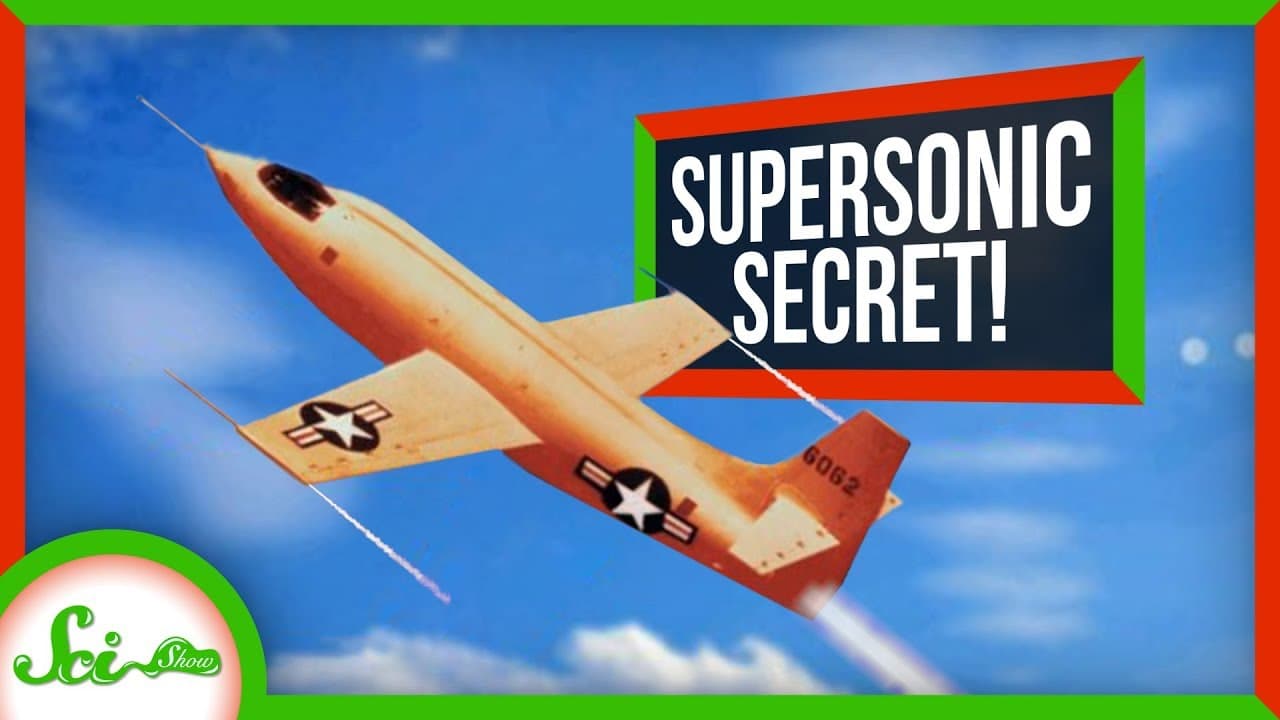
Q: How did Chuck Yeager's flight break the sound barrier?
Chuck Yeager broke the sound barrier by flying faster than the speed of sound, over 1200 kilometers per hour, in 1947, demonstrating the achievement of supersonic flight.
Q: What was the fundamental flaw in aerodynamic models discovered by John Stack?
John Stack discovered that the assumption of incompressible air in aerodynamic models was incorrect at high speeds, where air pressure drops due to compression, leading to aerodynamic challenges.
Q: How did engineers overcome the issue of shockwaves at high speeds?
Engineers developed innovations like swept wings to mitigate shockwaves by allowing air to flow smoothly along the wings, increasing efficiency and reducing drag forces.
Q: Why do modern airplanes still use swept wings in their design?
Modern airplanes utilize swept wings for efficient airflow at high speeds, preventing shockwaves and improving aerodynamic performance, demonstrating a successful solution to aerodynamic challenges.
Summary & Key Takeaways
-
The Wright Brothers' achievement in 1903 laid the foundation for supersonic flight.
-
Engineers faced aerodynamic challenges at high speeds, leading to the development of swept wings.
-
Supersonic flight innovations revolutionized aircraft design, shaping the modern aviation industry.
Read in Other Languages (beta)
Share This Summary 📚
Summarize YouTube Videos and Get Video Transcripts with 1-Click
Try YouTube Summary with ChatGPT & Claude or YouTube Transcript Generator
Explore More Summaries from SciShow 📚


Summarize YouTube Videos and Get Video Transcripts with 1-Click
Try YouTube Summary with ChatGPT & Claude or YouTube Transcript Generator