Converting between Moles, Atoms, and Molecules (Part 2)
TL;DR
Practice converting between moles and molecules using scientific notation and significant figures.
Transcript
This is the second part to converting between moles, atoms, and molecules. We're going to do some more practice problems but if you haven't seen the first video, check that out first and then come and watch this. How many molecules in 0.63 moles of molecules? Now we're talking about molecules here, before we were talking about atoms but it doesn't ... Read More
Key Insights
- ☺️ Molar conversions involve a conversion factor of 6.02 x 10^23 for atoms or molecules per mole.
- 🛝 Significant figures are crucial in rounding final answers when converting between moles and particles.
- 🫀 Understanding the relationship between moles and atoms/molecules is essential for accurate conversions.
- 🦻 Utilizing scientific notation simplifies calculations and aids in maintaining precision.
- 🧑🏭 Conversion factors help in transitioning between moles and particles efficiently.
- 🛝 Rounding with significant figures ensures the accuracy of the final converted quantities.
- 🫀 The process of conversion remains consistent regardless of the type of particles being converted (atoms, molecules, etc.).
Install to Summarize YouTube Videos and Get Transcripts
Explore YouTube Video Summarizer or Get YouTube Transcript Extractor
Questions & Answers
Q: How many molecules are in 0.63 moles of molecules?
To determine this, multiply 0.63 moles by 6.02 x 10^23, yielding 3.8 x 10^23 molecules after rounding with significant figures.
Q: How do you convert moles to molecules using conversion factors?
Start with the given moles, use the conversion factor of 6.02 x 10^23 molecules per mole, and perform the multiplication to find the number of molecules.
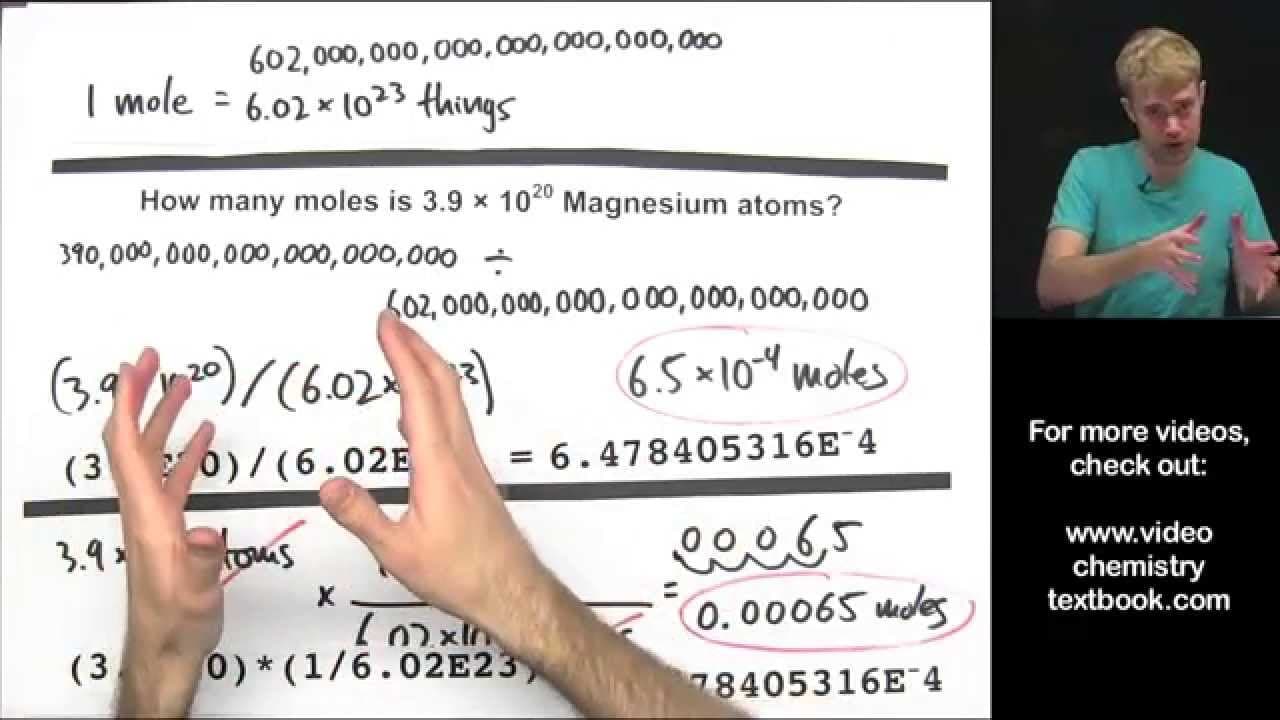
Q: What is the process to convert 3.9 x 10^20 Magnesium atoms to moles?
Divide 3.9 x 10^20 atoms by 6.02 x 10^23 (the number of atoms in one mole) using scientific notation and significant figures to obtain 6.5 x 10^-4 moles.
Q: Why is scientific notation used in these mole conversion problems?
Scientific notation streamlines large numbers, making calculations easier and accurate while applying rounding rules consistently for significant figures.
Summary & Key Takeaways
-
Converting between moles and molecules involves using a conversion factor of 6.02 x 10^23.
-
Scientific notation is utilized to simplify calculations and round answers using significant figures.
-
Conversion factors are applied to convert quantities in moles to atoms or molecules.
Read in Other Languages (beta)
Share This Summary 📚
Summarize YouTube Videos and Get Video Transcripts with 1-Click
Try YouTube Summary with ChatGPT & Claude or YouTube Transcript Generator
Explore More Summaries from Tyler DeWitt 📚

Summarize YouTube Videos and Get Video Transcripts with 1-Click
Try YouTube Summary with ChatGPT & Claude or YouTube Transcript Generator