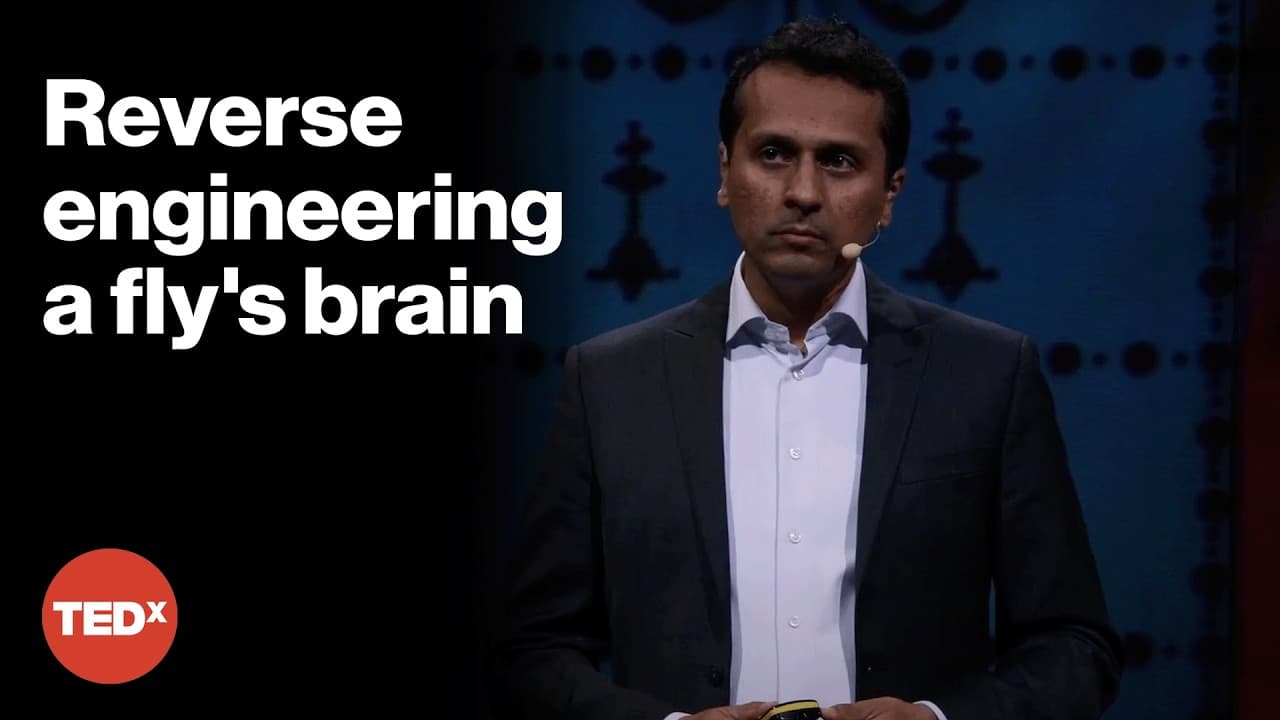
How Can Fruit Flies Improve Robot Design and AI?
TL;DR
Studying fruit fly behavior and neural activity can enhance robot design and artificial intelligence by providing insights into decision-making and motor control. Researchers utilize the fly's brain map and simulations to develop advanced robotic systems capable of autonomous exploration, potentially revolutionizing how we understand movement and navigation in both biological and artificial contexts.
Transcript
[Applause] in the future I believe we're going to send robots into outer space and these robots are going to look more like this fly that you might find in your kitchen than like any one of us pretty surprising right how might these annoying little 2mm long animals inform how we build robots well like many of you perhaps I've always been fascinated... Read More
Key Insights
- 🪽 Flies have colonized various habitats due to their complex decision-making and agile movements, making them compelling subjects for robotic studies.
- 🧠 The fruit fly, Drosophila melanogaster, provides a manageable model for neuroscientists due to its complex but easier-to-manipulate brain structure compared to larger animals.
- 👻 The development of a comprehensive fruit fly brain map allows scientists to visualize the entire neural architecture, facilitating targeted studies of neuronal interactions.
- 🪽 By simulating fly behavior through a digital twin, researchers can test hypotheses and train robotic systems in controlled environments without risking live subjects.
- 💁 The hierarchical model of motor control in flies might inform the design of more adaptive and responsive robotic systems that operate in real-time.
- 🪽 Integrating biological algorithms derived from the fly’s neural functions into robotic systems could potentially enhance automated exploration missions on various celestial bodies.
- 👻 Ongoing advancements in imaging technology are crucial for making precise measurements of neural activity, allowing for deeper insights into the complexities of behavior and movement.
Install to Summarize YouTube Videos and Get Transcripts
Explore YouTube Video Summarizer or Get YouTube Transcript Extractor
Questions & Answers
Q: How do flies serve as an inspiration for robot design?
Flies possess remarkable agility and decision-making abilities, enabling them to navigate complex environments. By studying their behavior and neural functions, researchers hope to mimic these traits in robots, allowing for better autonomous navigation in challenging conditions and less reliance on human oversight.
Q: What methods are used to study the fly's brain?
Research methods include measuring fly behavior to understand locomotion patterns, micro-dissecting their nervous system to visualize neural activity, and using advanced imaging techniques to track neurons in real time during behavior execution, offering insights into complex motor control processes.
Q: What insights were gained about the way the fly brain controls movement?
It was discovered that the fly's brain employs a hierarchical system to control movements. Rather than issuing simple commands, multiple neurons activate simultaneously to coordinate complex actions like walking or grooming, thus revealing a more sophisticated neural interaction than previously understood.
Q: What is a digital twin of a fly and its purpose?
A digital twin of a fly is a computer-generated model that simulates the physical characteristics and neural functions of a fly. This platform allows researchers to test biological algorithms digitally, enabling experiments that bridge the gap between biological understanding and robotic design.
Q: How does studying flies enhance our understanding of human biology?
Flies share fundamental biological principles with humans. Understanding their neural functions may accelerate insights into our own motor control systems, guiding advancements in neuroscience and potentially informing the development of AI and robotic systems that mirror human capabilities.
Q: What technological advancements facilitate the study of fly behavior?
The use of machine learning algorithms allows for the automated tracking of the sometimes intricate movements of fly body parts in real-time, thus overcoming the limitations of manual tracking and providing a comprehensive view of their actions during various tasks.
Summary & Key Takeaways
-
Researchers are exploring how fruit flies navigate their environment, using their motor skills and decision-making abilities as models for developing advanced robotic systems.
-
By analyzing the behavior and neural activity of fruit flies, scientists can reverse engineer their brains, leading to insights into complex motor controls.
-
Creating a digital twin of the fruit fly allows for simulations that bridge biological understanding with robotics, potentially enhancing exploration capabilities on Earth and beyond.
Read in Other Languages (beta)
Share This Summary 📚
Summarize YouTube Videos and Get Video Transcripts with 1-Click
Try YouTube Summary with ChatGPT & Claude or YouTube Transcript Generator
Explore More Summaries from TEDx Talks 📚



Summarize YouTube Videos and Get Video Transcripts with 1-Click
Try YouTube Summary with ChatGPT & Claude or YouTube Transcript Generator