Problem on Calculation of Internal and External Diameter of Shaft - Torsion - Strength of Materials
TL;DR
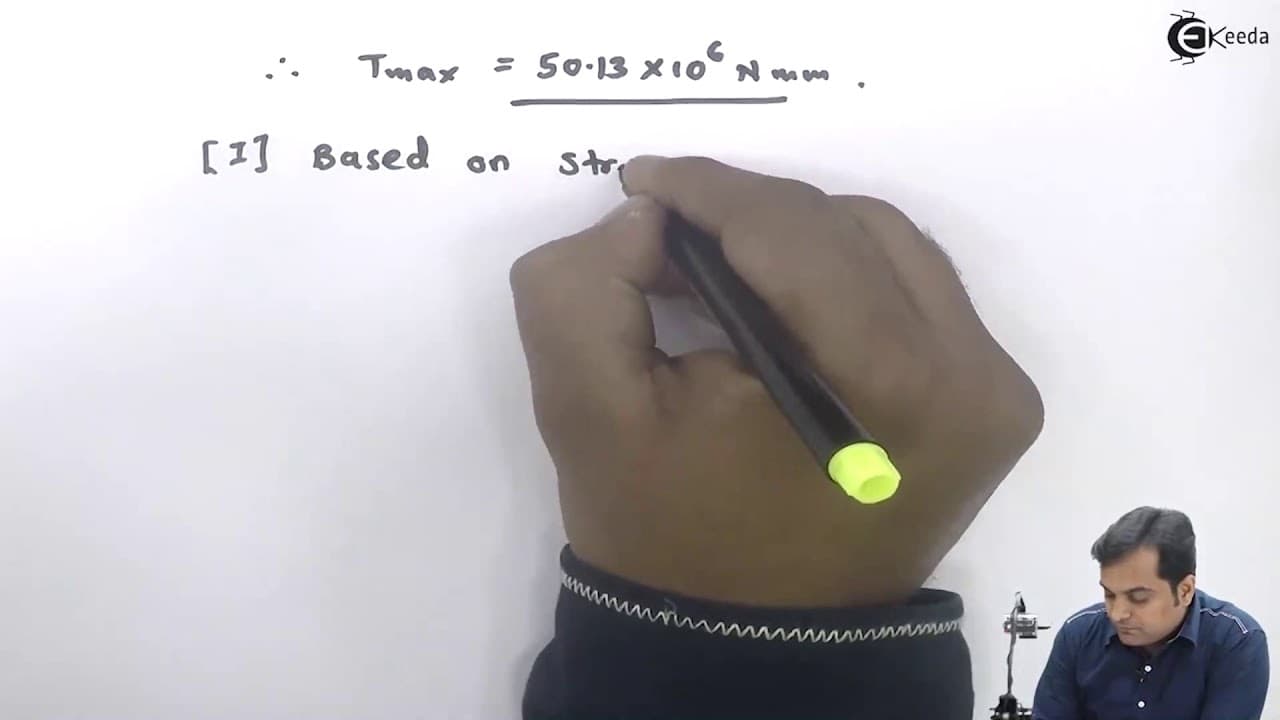
Calculate internal and external diameters for a hollow shaft transmitting 300kW at 80 rpm, with a max shear stress of 60 N/mm².
Transcript
let us take the next question internal diameter of a hollow shaft is 0.6 of its external diameter full stop it has to transmit 300 kilowatts at 80 rpm if shear stress is not to exceed 60 newton per mm square comma find internal and external diameters of the shaft assuming t max as 1.4 times of t mean this is the question which we have let us write ... Read More
Key Insights
- ✊ Power and RPM are crucial for determining torque in shaft design.
- 📶 Maximum torque considerations are vital for ensuring shaft strength under varying loads.
- 📶 Strength criteria and geometric relations are employed to calculate shaft diameters accurately.
- 🏋️ Hollow shafts require careful design to balance strength and weight considerations effectively.
- 🤩 Torque, shear stress, and geometric equations are key elements in shaft sizing calculations.
- 🍵 Understanding material properties is essential for ensuring the shaft can handle intended loads.
- 🎨 The interplay between torque, stress, and geometry is critical in optimizing shaft designs.
Install to Summarize YouTube Videos and Get Transcripts
Explore YouTube Video Summarizer or Get YouTube Transcript Extractor
Questions & Answers
Q: What data is required to determine the internal and external diameters of a hollow shaft?
Data needed includes the internal diameter, power transmission requirement, RPM, and the max shear stress limit the shaft can handle.
Q: How is torque calculated for the shaft given power and RPM values?
Torque is computed using the formula T = (P * 60) / (2 * π * N), where P is power and N is RPM, resulting in the main torque value.
Q: Why is the maximum torque taken as 1.4 times the main torque in this analysis?
The maximum torque is set at 1.4 times the main torque to account for peak load conditions and ensure the shaft can handle varying stresses.
Q: How are the internal and external diameters of the hollow shaft finally calculated in this problem?
By equating torque to shear stress for the shaft geometry equations with the given internal diameter ratio, the final diameters of 102mm and 170mm are obtained.
Summary & Key Takeaways
-
Given data includes internal diameter, power transmission requirement, rpm, and shear stress limit for a hollow shaft.
-
Torque calculations are done based on power and rpm, and maximum torque is determined as 1.4 times the average torque.
-
Using strength criteria and expressions for hollow shaft geometry, the internal and external diameters are calculated as 102mm and 170mm, respectively.
Read in Other Languages (beta)
Share This Summary 📚
Summarize YouTube Videos and Get Video Transcripts with 1-Click
Try YouTube Summary with ChatGPT & Claude or YouTube Transcript Generator
Explore More Summaries from Ekeeda 📚





Summarize YouTube Videos and Get Video Transcripts with 1-Click
Try YouTube Summary with ChatGPT & Claude or YouTube Transcript Generator