Comparative Advantage Homework
TL;DR
Countries benefit from trade through specialization and comparative advantage.
Transcript
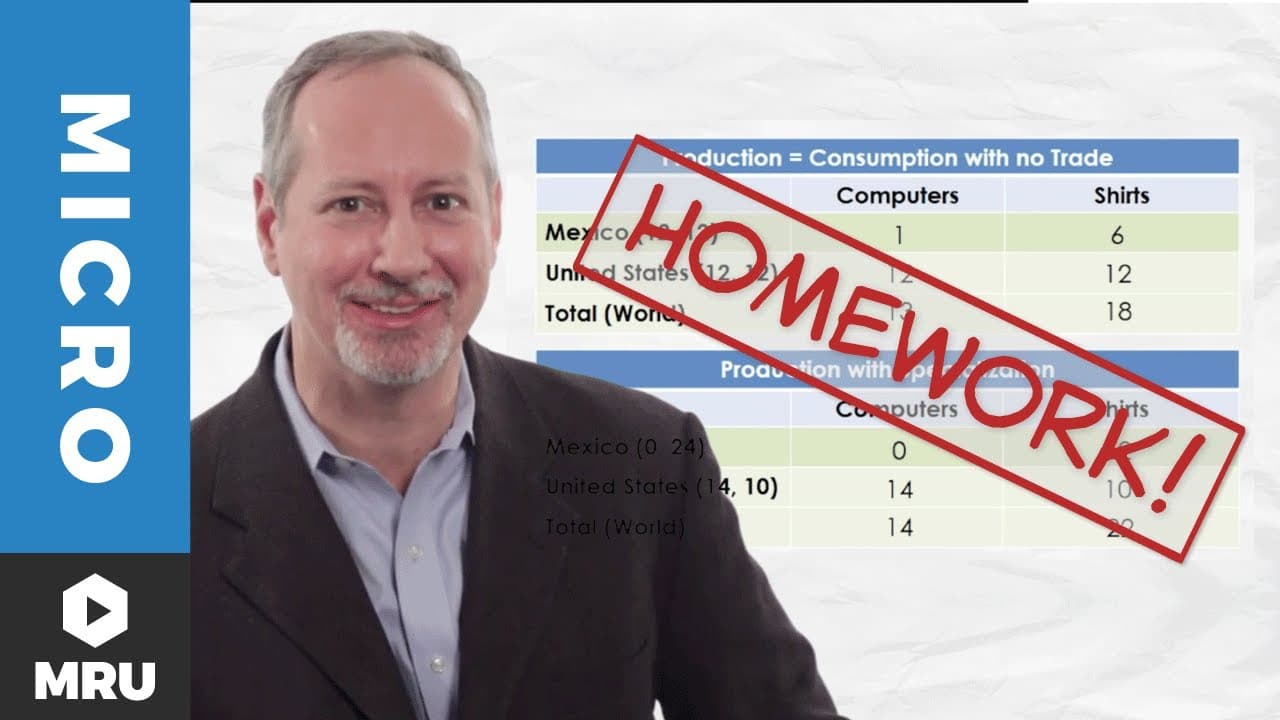
♪ [music] ♪ - [Alex Tabarrok] In this talk I'm going to give you the answer to the homework question, so before you begin, make sure you've done your homework. No cheating. So remember our basic data is in the top figure right here, and we want to now answer suppose that there's 24 units of labor -- 12 devoted to computers, 12 to shirts -- how... Read More
Key Insights
- Mexico and the United States have different labor requirements for producing computers and shirts, influencing their production capabilities and trade potential.
- Specialization increases total world production of goods, as demonstrated by the increase in both computers and shirts when countries specialize.
- Trade allows countries to consume more than they could without it, benefiting both parties involved in the trade.
- The concept of Comparative Advantage explains why countries engage in trade, even if one country is less wealthy or has an Absolute Advantage.
- Absolute Advantage describes the overall wealth and production capacity of a country, but doesn't explain trade dynamics.
- Specialization and trade lead to increased efficiency and better allocation of resources, resulting in higher consumption levels.
- The United States benefits from specialization by trading one computer for three shirts, improving its consumption of both goods.
- Comparative Advantage highlights the importance of focusing on goods where countries have a lower opportunity cost, optimizing trade benefits.
Install to Summarize YouTube Videos and Get Transcripts
Explore YouTube Video Summarizer or Get YouTube Transcript Extractor
Questions & Answers
Q: How does specialization affect total world production?
Specialization increases total world production by allowing countries to focus on producing goods where they have a comparative advantage. In the video, when Mexico specializes in shirts and the United States in computers, the total production of computers and shirts increases, demonstrating the efficiency gains from specialization.
Q: What is the role of Comparative Advantage in trade?
Comparative Advantage explains why countries engage in trade by focusing on goods they can produce at a lower opportunity cost. This concept allows countries to benefit from trade, even if they don't have an Absolute Advantage, by optimizing resource allocation and increasing overall consumption.
Q: Why is Absolute Advantage not sufficient to explain trade?
Absolute Advantage describes a country's overall production capacity and wealth but doesn't explain trade dynamics. Comparative Advantage, on the other hand, focuses on the relative efficiency of producing specific goods, enabling countries to trade beneficially even if one is wealthier or more productive overall.
Q: How does trade improve consumption for both countries?
Trade improves consumption by allowing countries to access goods they don't produce efficiently. In the video, the United States trades one computer for three shirts with Mexico, increasing its consumption of both goods. Mexico also benefits by consuming more shirts than it would without trade.
Q: What is the impact of specialization on resource allocation?
Specialization leads to more efficient resource allocation by directing labor and resources towards goods where countries have a comparative advantage. This results in increased production and consumption, as seen in the video where specialized production boosts the total output of computers and shirts.
Q: How does the video illustrate the benefits of trade?
The video illustrates trade benefits by showing how specialization increases total production and allows for advantageous trade agreements. By trading based on comparative advantage, both Mexico and the United States consume more than they could without trade, highlighting the mutual benefits of strategic economic partnerships.
Q: What is the significance of the trade example in the video?
The trade example in the video demonstrates how countries can optimize production and consumption through specialization and trade. By focusing on goods with a comparative advantage, both Mexico and the United States increase their output and improve their consumption, showcasing the practical benefits of economic theory.
Q: How does the video relate to the concept of economic efficiency?
The video relates to economic efficiency by showing how specialization and trade maximize resource use and production. By focusing on comparative advantage, countries achieve higher output and consumption, illustrating the efficiency gains from optimizing labor allocation and engaging in beneficial trade agreements.
Summary & Key Takeaways
-
The video explains how Mexico and the United States can optimize their production and consumption through specialization and trade, using the example of computers and shirts. By focusing on goods with a comparative advantage, both countries increase their total production and consumption levels.
-
Specialization according to Comparative Advantage increases the total output of goods. When Mexico and the United States specialize, they produce more computers and shirts collectively, demonstrating the benefits of trade. The video emphasizes how both countries can be better off through strategic trade agreements.
-
Absolute Advantage explains wealth disparities between countries, but Comparative Advantage is key to understanding trade. The video illustrates that even countries with less wealth, like Mexico, can benefit from trade by specializing in goods they produce more efficiently, leading to mutual benefits.
Read in Other Languages (beta)
Share This Summary 📚
Summarize YouTube Videos and Get Video Transcripts with 1-Click
Try YouTube Summary with ChatGPT & Claude or YouTube Transcript Generator
Explore More Summaries from Marginal Revolution University 📚

Summarize YouTube Videos and Get Video Transcripts with 1-Click
Try YouTube Summary with ChatGPT & Claude or YouTube Transcript Generator