Mesh Current Problems - Electronics & Circuit Analysis
TL;DR
Use mesh current analysis to calculate currents and electric potentials in a circuit with multiple resistors and batteries.
Transcript
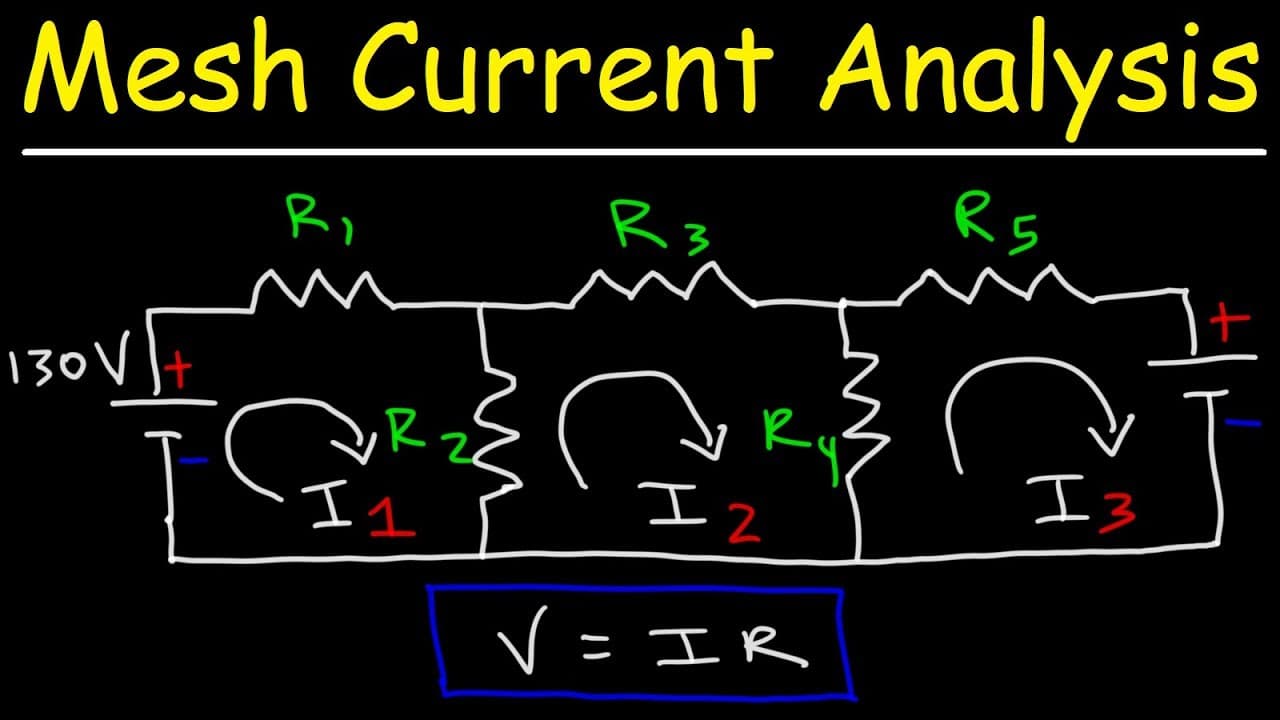
in this video we're going to solve this circuit using mesh current analysis so what we have here on the left is a 90 volt battery r1 is 9 ohms r2 is 6 ohms r3 is 8 ohms and we have a 5 amp current source so using mesh current analysis calculate the current flowing through each resistor as well as the electric potentials at these points let's say th... Read More
Key Insights
- 🔁 Mesh current analysis is a powerful technique for analyzing circuits with multiple loops and complex resistor configurations.
- 👮 Kirchhoff's voltage law and Ohm's law are essential for solving mesh current equations and calculating currents and voltages.
- 🪘 The direction of mesh currents is arbitrary, and as long as the chosen directions are consistent, the analysis will be accurate.
- 😮 The electric potentials at different points in the circuit can be determined by calculating the voltage drops/rises across resistors or batteries using the corresponding currents and resistance values.
Install to Summarize YouTube Videos and Get Transcripts
Explore YouTube Video Summarizer or Get YouTube Transcript Extractor
Questions & Answers
Q: What is mesh current analysis and why is it useful in circuit analysis?
Mesh current analysis is a technique used to analyze circuits with multiple loops. It involves assigning currents to each loop and applying Kirchhoff's voltage law to derive equations that can be solved to determine unknown currents and voltages. It is useful because it simplifies complex circuits and allows for step-by-step analysis.
Q: How do you determine the direction of mesh currents?
The direction of mesh currents is arbitrary and does not affect the analysis as long as the chosen directions are consistent with Kirchhoff's voltage law. It is common to choose clockwise directions for simplicity. If the actual direction of the current is opposite to the chosen direction, the calculated value will be negative.
Q: How is Kirchhoff's voltage law used in mesh current analysis?
Kirchhoff's voltage law states that the sum of the voltages around a closed loop in a circuit is always zero. In mesh current analysis, the voltage drops across resistors and voltage rises across batteries are expressed as functions of the mesh currents, and these equations are set equal to zero to form a system of equations that can be solved.
Q: How do you calculate the electric potentials at different points in the circuit?
The electric potential at a point in the circuit can be determined by calculating the voltage drops or rises across the resistors or batteries between that point and the reference point (often chosen as the ground). Using Ohm's law (V = IR), the voltage can be obtained by multiplying the corresponding current and resistance values.
Summary & Key Takeaways
-
The video explains how to use mesh current analysis to solve circuits with multiple resistors and batteries.
-
The method involves assigning currents to each loop in the circuit and applying Kirchhoff's voltage law.
-
By solving the resulting equations, the currents flowing through each resistor and the electric potentials at different points in the circuit can be determined.
Read in Other Languages (beta)
Share This Summary 📚
Summarize YouTube Videos and Get Video Transcripts with 1-Click
Try YouTube Summary with ChatGPT & Claude or YouTube Transcript Generator
Explore More Summaries from The Organic Chemistry Tutor 📚



Summarize YouTube Videos and Get Video Transcripts with 1-Click
Try YouTube Summary with ChatGPT & Claude or YouTube Transcript Generator