Part One - Explaining the Event Table
TL;DR
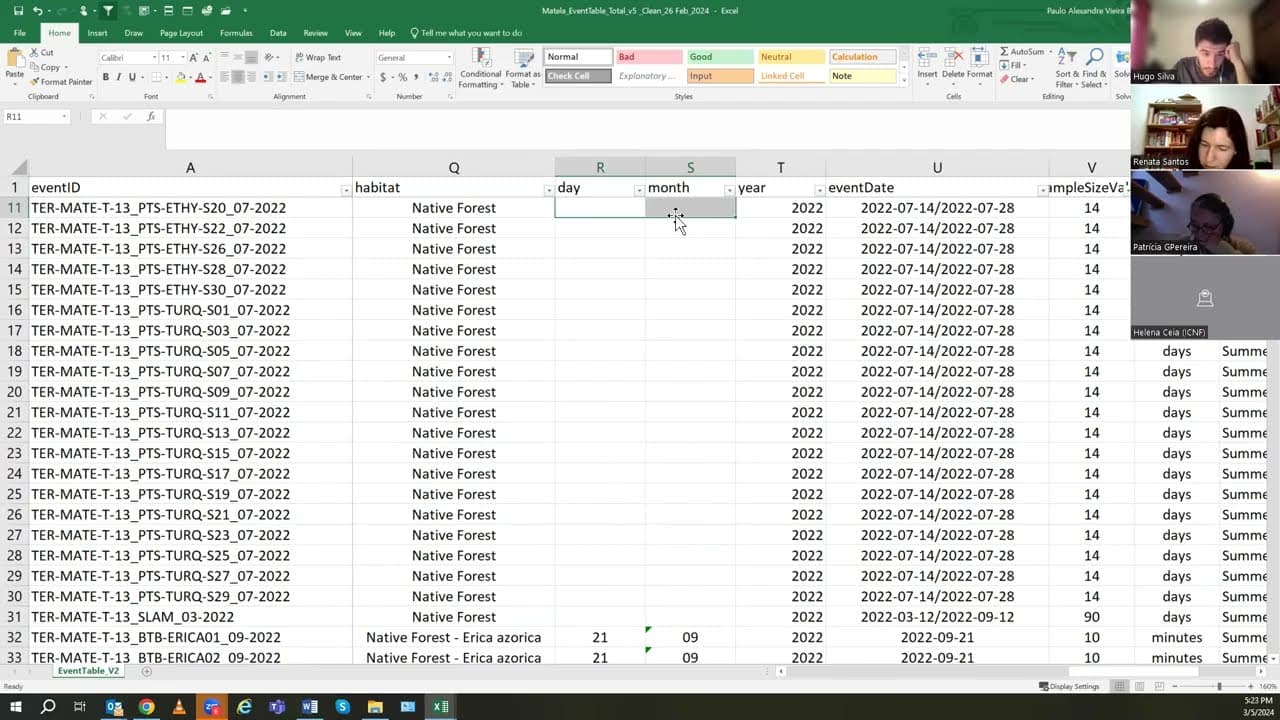
Webinar on creating a Darwin Core database for biodiversity data sharing.
Transcript
okay many thanks for everyone to join this uh webinar uh the aim of this course is to show how to uh produce a Darwin core database for biodiversity sharing in GBF um and if possible if we have time also to show how to start the data paper um uh structure using this kind of data I will share the screen okay I think everyone is now seeing my screen ... Read More
Key Insights
- The webinar explains the process of creating a Darwin Core database for biodiversity sharing, focusing on the event table and its components.
- An event ID is a crucial identifier that connects geographical and taxonomic data, ensuring consistency and traceability across datasets.
- The event ID should be structured in a way that is meaningful to researchers and easily understood by other users.
- Geographical data and sampling protocols are essential components of the event table, which should be meticulously documented for accuracy.
- The occurrence table records taxonomic data, with each species having a unique occurrence ID to track identifications over time.
- License, institution ID, and collection ID are mandatory fields in the occurrence table, ensuring proper attribution and data sharing standards.
- The Darwin Core standard is flexible, allowing researchers to document various types of data, including human observations and preserved specimens.
- Researchers are encouraged to standardize codifications for event and location IDs within projects to facilitate data integration and long-term research.
Install to Summarize YouTube Videos and Get Transcripts
Explore YouTube Video Summarizer or Get YouTube Transcript Extractor
Questions & Answers
Q: What is the primary focus of the webinar?
The primary focus of the webinar is to demonstrate how to create a Darwin Core database for biodiversity data sharing, specifically highlighting the structure and importance of the event table. The session covers how to produce and manage data in a way that aligns with biodiversity sharing standards, such as those required by GBIF.
Q: How is an event ID structured in the Darwin Core database?
An event ID in the Darwin Core database is structured to include several components that describe the data's context. It typically consists of parts that represent the geographical location, the sampling protocol, and the time of sampling. This structure ensures that the event ID is both meaningful to researchers and easily interpretable by others who may use the database in the future.
Q: What are the key components of the event table?
The key components of the event table include the event ID, location ID, state/province, country, country code, and sampling protocol. Each component provides crucial information about the geographical and procedural context of the data collection, ensuring that the data can be accurately interpreted and integrated into broader biodiversity datasets.
Q: Why is standardization of codifications important in research projects?
Standardization of codifications within research projects is important because it ensures consistency and facilitates data integration across different datasets. By agreeing on a common set of codifications for event IDs, location IDs, and other identifiers, researchers can more easily combine and compare data, enhancing the long-term value and usability of the research.
Q: What flexibility does the Darwin Core standard offer?
The Darwin Core standard offers flexibility by allowing researchers to document a wide range of data types, including physical objects, human observations, and machine observations. This flexibility ensures that the standard can accommodate various research methods and data collection techniques, making it a versatile tool for biodiversity data sharing.
Q: How does the occurrence table complement the event table?
The occurrence table complements the event table by recording taxonomic data associated with each event. Each species observed or collected at an event is assigned a unique occurrence ID, which helps track identifications over time and ensures that the taxonomic data is accurately linked to its corresponding geographical and procedural context.
Q: What role do licenses and institutional IDs play in the database?
Licenses and institutional IDs play a crucial role in the database by ensuring proper attribution and adherence to data sharing standards. The license specifies the terms under which the data can be used, while institutional IDs provide a standardized way to identify the organization responsible for the data, facilitating collaboration and data integration.
Q: How should researchers handle missing data in the Darwin Core database?
Researchers should handle missing data in the Darwin Core database by using the available fields to the best of their ability and documenting any uncertainties. For example, if precise geographical coordinates are unavailable, researchers can use broader location descriptors and specify the level of uncertainty. This approach ensures that the data remains as accurate and useful as possible, even when complete information is not available.
Summary & Key Takeaways
-
This webinar introduces the process of creating a Darwin Core database for biodiversity data sharing, with a focus on the event table. It explains the significance of event IDs in linking geographical and taxonomic data, and the importance of structuring these IDs for clarity and usability.
-
Geographical data, sampling protocols, and taxonomic information are key components of the event and occurrence tables. The session emphasizes the need for standardized codifications within research projects to ensure consistency and facilitate data integration.
-
The Darwin Core standard's flexibility allows for the documentation of various data types, including human observations and preserved specimens. Proper licensing, institutional identification, and data sharing protocols are also highlighted as essential elements of the database.
Read in Other Languages (beta)
Share This Summary 📚
Summarize YouTube Videos and Get Video Transcripts with 1-Click
Try YouTube Summary with ChatGPT & Claude or YouTube Transcript Generator