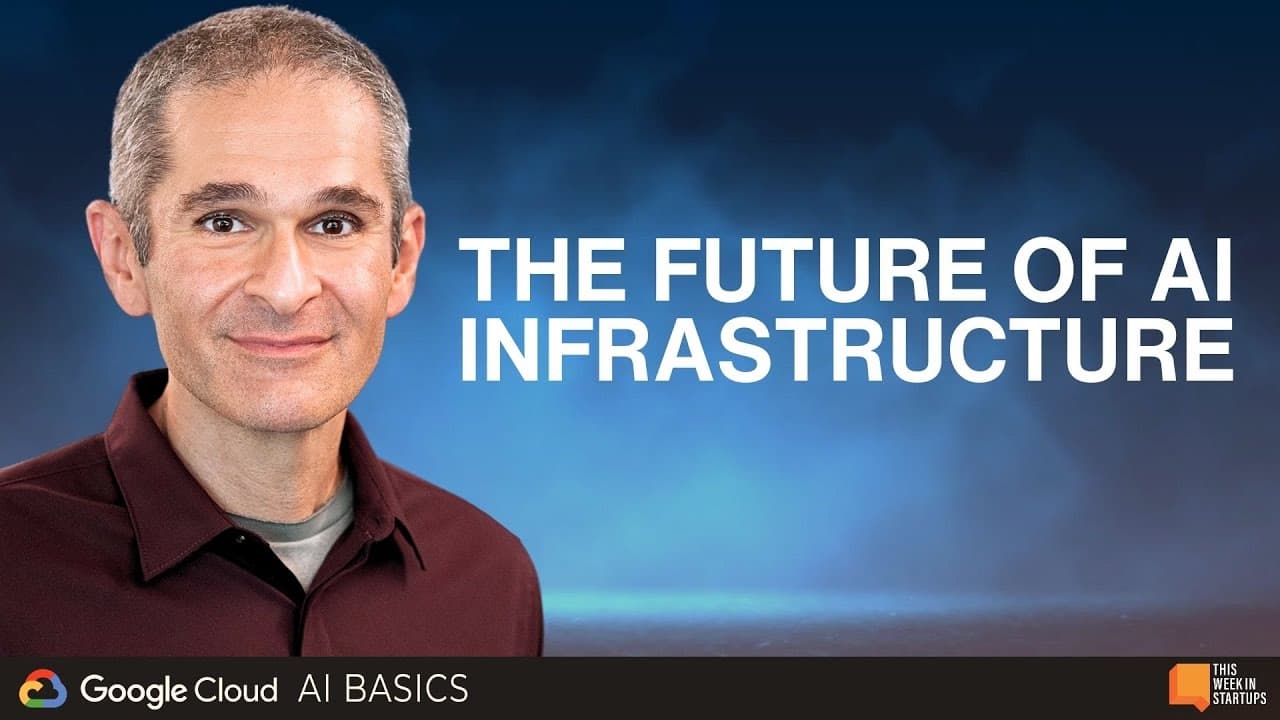
What's Next for AI Infrastructure with Amin Vahdat | AI Basics with Google Cloud
TL;DR
Google Cloud discusses AI advancements and infrastructure for startups in a conversation with Amin Vad.
Transcript
Welcome back to another episode of AI Basics brought to you in partnership with our friends at Google Cloud. Google Cloud just published a fantastic report. It's called the future of AI perspectives for startups. It features insights from 23 leading AI experts. And today on the program, we're delighted to have Amin Vad. He's VP and GM of machine le... Read More
Key Insights
- 💗 TPUs are revolutionizing AI by drastically increasing processing efficiency over traditional CPUs.
- 👤 The current trend is shifting from training AI models to deploying them effectively for real-world user applications.
- 🎚️ Startups are experiencing record levels of productivity gains due to enhanced access to AI infrastructure.
- 👻 The cost of AI operations is plummeting, allowing startups to engage in more ambitious projects without financial constraints.
- 🎭 AI agents are evolving to perform complex tasks autonomously, signaling a leap in automation capability.
- ❓ The scarcity of transformative engineering talent remains a challenge alongside the hardware advancements.
- 🪘 Startups are no longer fixed by infrastructure limits but are encouraged to innovate with newfound capabilities.
Install to Summarize YouTube Videos and Get Transcripts
Explore YouTube Video Summarizer or Get YouTube Transcript Extractor
Questions & Answers
Q: What are TPUs and how do they improve AI processing?
Tensor Processing Units (TPUs) are custom accelerators designed by Google to enhance the efficiency of AI computations, particularly matrix multiplications. They allow significantly higher processing power compared to traditional CPUs, enabling complex AI tasks to run faster, thereby facilitating advancements in deep learning applications and making previously impractical tasks possible.
Q: How has the focus of AI development shifted recently?
The focus has transitioned from merely training models to enhancing inference capabilities. This means making AI outputs such as responses and predictions available more swiftly and efficiently. Vad suggests that the next two years will mark the 'age of inference,' where applications become primarily about utilizing trained models effectively to serve user needs.
Q: What are some challenges startups face despite improved infrastructure?
Even with expanded computational resources, startups often grapple with finding transformative engineering talent. While technological capabilities have increased exponentially, the supply of innovative and skilled developers remains limited. Thus, the challenge is not just about accessing infrastructure, but about leveraging that infrastructure creatively and efficiently.
Q: What impact does enhanced computing power have on software development?
The advancement in computing hardware, such as TPUs, has led to substantial productivity boosts in software development. Developers are now able to generate and debug code with AI's assistance more reliably than before. This shift is allowing even inexperienced programmers to engage in coding effectively, potentially transforming how software is created.
Q: How has the cost associated with AI infrastructure changed?
The cost of running AI models has drastically reduced, with some estimates suggesting a factor of up to three reduction in costs over the past year. This decline allows startups to harness advanced capabilities without the previous financial hurdles, radically altering the startup landscape and facilitating innovative projects.
Q: What role do AI agents play in today's applications?
AI agents are being used to automate complex tasks and interact with other systems on behalf of users. These agents can not only generate responses but can also perform actions based on the data they analyze. This evolution pushes the boundaries of what AI can achieve, enhancing productivity across various sectors.
Q: How does Google Cloud support startups with AI advancements?
Google Cloud is at the forefront of providing scalable AI infrastructure that startups can utilize. This includes access to powerful tools like TPUs and cutting-edge AI models, which are designed to help startups overcome previous limitations and explore innovative uses of technology that were once thought impossible.
Q: What future trends do you anticipate in AI and infrastructure?
Emerging trends indicate a continuous decline in the cost and an increase in the capabilities of AI infrastructures. As more discoveries are made in model efficiency and hardware enhancements, startups will find it increasingly feasible to bring imaginative and ambitious tech products to market, transforming how industries operate.
Summary & Key Takeaways
-
The podcast discusses the significant advancements in AI infrastructure, specifically the transformation from traditional computing to TPUs, which enhance processing capabilities exponentially.
-
Amin Vad emphasizes the growing focus on inference, shifting from training models to making them valuable for users, changing the landscape of AI applications.
-
Startups now have unprecedented access to scalable computing resources, leading to increased productivity and innovation, as they shift from infrastructure constraints to exploring creative solutions.
Read in Other Languages (beta)
Share This Summary 📚
Summarize YouTube Videos and Get Video Transcripts with 1-Click
Try YouTube Summary with ChatGPT & Claude or YouTube Transcript Generator
Explore More Summaries from This Week in Startups 📚






Summarize YouTube Videos and Get Video Transcripts with 1-Click
Try YouTube Summary with ChatGPT & Claude or YouTube Transcript Generator